
By Dr. Niraj Ghanghoriya, Dental Specialist
Medical Review Date: January 13, 2026 | Category: Oral Hygiene & Holistic Dentistry
Introduction
In my dental practice, I often hear patients ask, “Dr. Niraj, does swishing oil actually fix my teeth?” It is one of the most popular questions I receive about natural home remedies. The short answer is: Oil pulling can be a fantastic supplement to your oral hygiene routine, but it is not a magic wand.
Oil pulling is an ancient Ayurvedic practice (originally called Kavala or Gandusha) that involves swishing oil in your mouth to remove bacteria and promote oral hygiene. While it has trended recently on social media, the biological mechanism is grounded in science: the oil acts as a magnet for lipophilic (fat-loving) bacteria, pulling them out of the biofilm on your teeth.
Below, I have created an in-depth guide covering every aspect of this technique. I’ve broken it down into specific sections to ensure you get the maximum clinical benefit without damaging your plumbing—or your dental health.
Key Takeaways (Dr. Niraj’s Quick Tips)
- The Golden Rule: Never swallow the oil. It is loaded with bacteria.
- Best Oil: Organic, unrefined Coconut Oil is my top clinical recommendation due to its lauric acid content.
- Duration: 15–20 minutes is the sweet spot. Less is ineffective; more causes jaw fatigue.
- Order of Operations: Floss $\rightarrow$ Oil Pull $\rightarrow$ Rinse $\rightarrow$ Brush.
How to do oil pulling
Oil pulling might seem intuitive, but in my clinical experience, many patients do it incorrectly, which leads to jaw pain or a lack of results. Doing it “right” means understanding the mechanics of how liquid moves through the interdental spaces (the gaps between your teeth).
To start, you need a high-quality oil. While traditionally sesame oil was used, I generally recommend coconut oil to my patients because it has proven anti-microbial properties and a taste that is more palatable for beginners.
The Basic Mechanism:
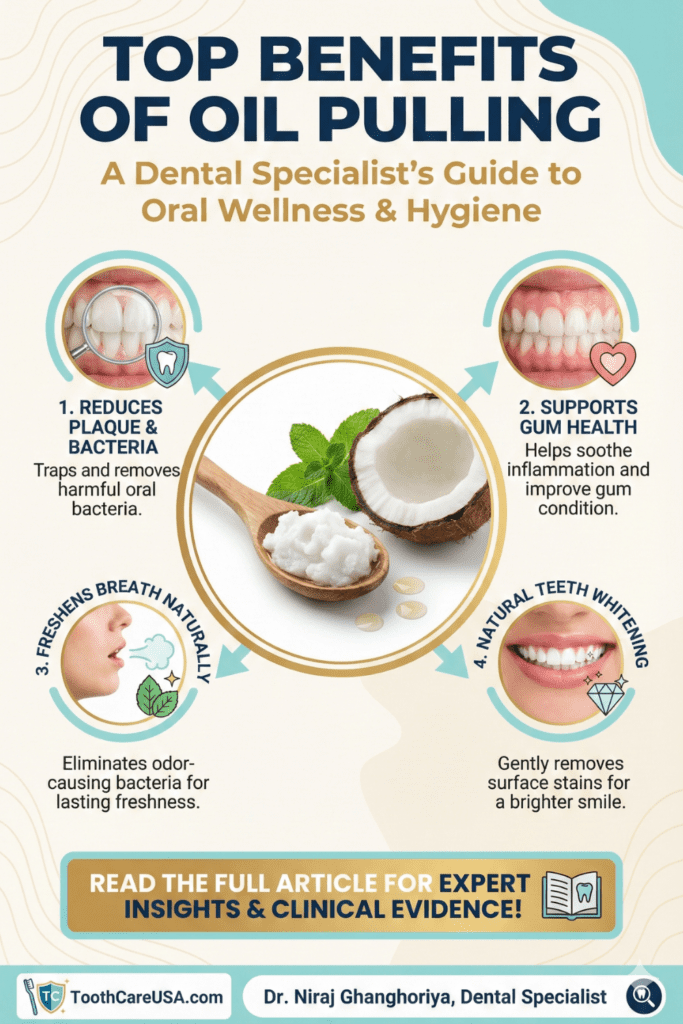
When you put the oil in your mouth, it mixes with your saliva. As you swish, you are creating an emulsion—a mixture of oil and water (saliva). This emulsification process increases the surface area of the oil, allowing it to coat your teeth and gums thoroughly. The mechanical action of pushing and pulling this liquid through your teeth helps dislodge food particles and disrupts the biofilm (plaque) that sticks to your enamel.
Dr. Niraj’s Clinical Insight:
Many people think they need to swish violently, like they are using a commercial mouthwash. This is a mistake. If you swish too hard, your jaw muscles (specifically the masseter and temporalis) will fatigue within 2 minutes. The goal is a gentle, rhythmic motion. You want the oil to passively wash over the surfaces of the teeth.
It is also vital to keep your chin up and breathe through your nose. Since you will be doing this for up to 20 minutes, if you have a blocked nose or sinus issues, you might find it difficult. In such cases, I advise my patients to start with just 5 minutes and build up their tolerance.
Oil pulling method
When we discuss the “method” of oil pulling, we are looking at the science of why we choose specific oils and how they interact with oral bacteria. The primary bacteria responsible for cavities is Streptococcus mutans. This bacterium has a fatty outer membrane.
Why the Oil Matters:
In chemistry, there is a principle called “like dissolves like.” Because the cell membrane of the bacteria is fatty (lipid-based), it adheres to the oil you are swishing. If you were to use water, it would simply slide past the bacteria because water and oil (fats) repel each other. By using oil, you are essentially creating a trap that binds these bacteria so they can be expelled.
Selecting Your Oil:
- Coconut Oil: This is the gold standard in my practice. It is high in Lauric Acid (about 50%). Lauric acid is unique because it reacts with the alkalis in saliva to form a soap-like substance (saponification), which effectively cleans the teeth. It also has specific antimicrobial activity against S. mutans and Candida albicans (oral thrush).
- Sesame Oil: The traditional choice in Ayurveda. It is rich in antioxidants but has a stronger flavor that some patients find off-putting.
- Sunflower Oil: A neutral option if you are allergic to nuts or coconuts, though it lacks the specific antimicrobial punch of coconut oil.
The Methodical Approach:
The method involves consistency. You cannot do oil pulling once a month and expect a reduction in gingivitis. In studies that showed a reduction in plaque index scores, participants performed the method daily for at least 30 days.
Common Misconception:
Patients often ask if they can add essential oils like peppermint or clove oil to the mix. While clove oil is excellent for toothaches, be very careful. Essential oils are potent. If you add them, use only one drop. Using too much can burn the delicate mucosa (skin) inside your cheeks and gums.

Oil pulling steps
Let’s break this down into actionable steps. Whenever I prescribe a new hygiene routine to a patient, I emphasize that structure prevents mistakes. Here is the exact protocol I recommend for ToothCareUSA readers to ensure safety and efficacy.
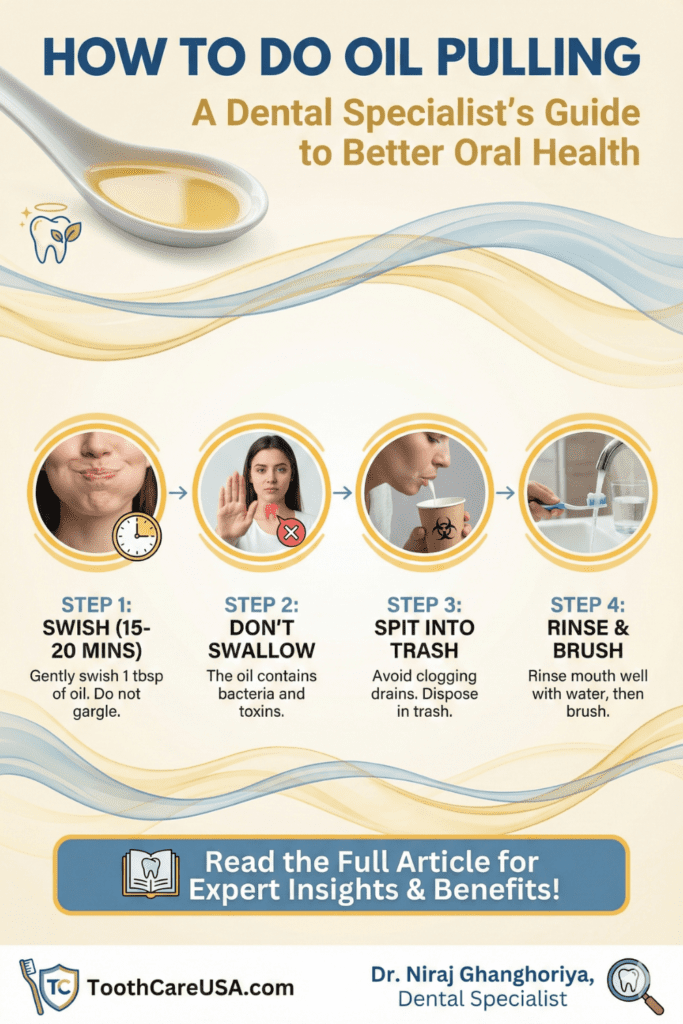
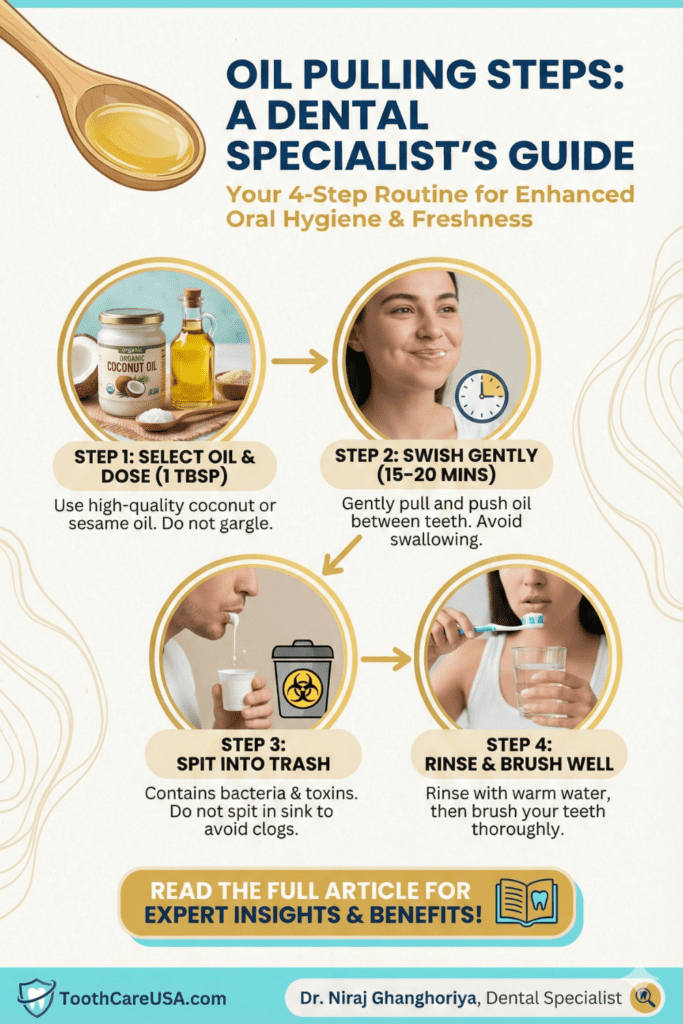
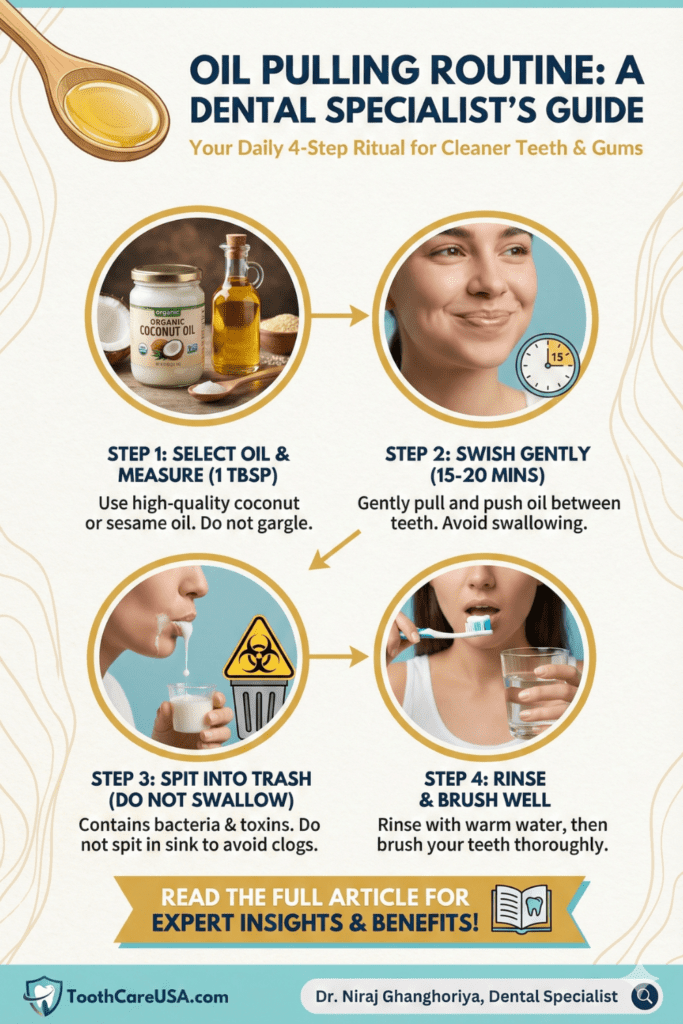
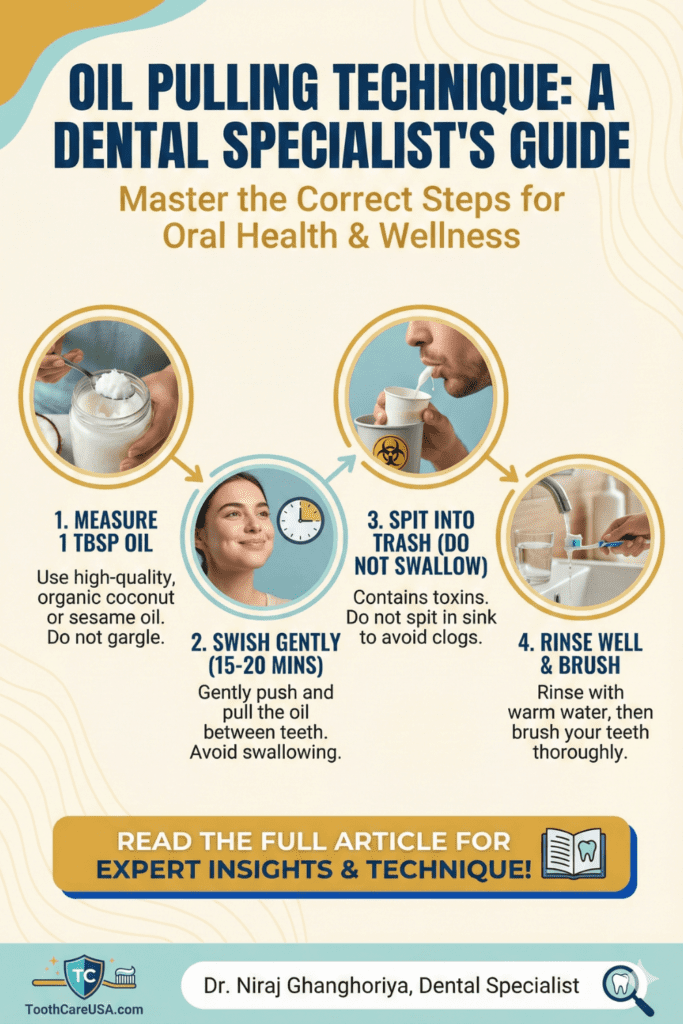
Step 1: Preparation
If possible, do this on an empty stomach. Measure out approximately one tablespoon of oil. If you have a smaller mouth or a strong gag reflex, start with one teaspoon. Do not overfill your mouth; remember, the volume of liquid will double as your saliva mixes with the oil during the 20-minute process.
Step 2: The Intake
Put the oil in your mouth. If you are using coconut oil, it might be solid if your room temperature is below 76°F (24°C). Don’t try to chew it aggressively. Just let it sit on your tongue for 30 seconds; your body heat will melt it into a liquid.
Step 3: The Active Swish
Push the oil through your teeth and suck it back through. Move it from side to side. Do not tilt your head back to gargle; oil pulling is for the mouth, not the throat. If you gargle, you risk aspirating (breathing in) the oil, which can lead to lipoid pneumonia—a rare but serious lung condition.
Step 4: Monitoring the Texture
At the beginning, the oil is clear and viscous (thick). As you swish, it will mix with air and saliva. By the end of the session, the liquid should look milky white and be very thin. If the oil is still clear or yellow, you haven’t swished long enough.
Step 5: Disposal
Spit the oil into a trash can lined with a bag or a paper towel. Never spit it into the sink. Over time, the oil will re-solidify in your pipes and cause severe plumbing blockages.
Oil pulling routine
Building a routine is where most people fail. In my dental practice, I see patients start with enthusiasm and quit after three days because they find it boring or time-consuming. To make oil pulling stick, you need to “habit stack.”
Habit Stacking:
Habit stacking means attaching a new habit to an existing one. Since you need to swish for 15 to 20 minutes, you should do this while your hands are busy but your mouth is free.
- Good times to oil pull: While showering, making your bed, checking emails in the morning, or preparing breakfast for the kids.
- Bad times to oil pull: While talking on the phone (impossible), while lying down flat (choking hazard), or during a heavy workout (breathing issues).
The Daily Commitment:
For patients with active gingivitis (bleeding gums), I recommend a 30-day intensive routine where you oil pull every single morning. This allows enough time to see a visible reduction in inflammation. For maintenance (general health), doing it 3–4 times a week is sufficient.
Dr. Niraj’s “Pro-Tip” for Routine:
Keep your jar of coconut oil and a spoon right next to your toothbrush or on your nightstand. Visual cues are powerful. If you have to walk to the kitchen pantry to get the oil, you are less likely to do it. Pre-portioning the oil into small silicone molds and keeping them in the fridge is another great hack—you just pop a “coconut chew” in your mouth and go.
Tracking Progress:
I advise my patients to take a “before” photo of their teeth and gums. After two weeks of a consistent routine, take another photo. You often see a reduction in the redness of the gums and a slight brightening of the teeth, which motivates you to continue the routine.
How to do oil pulling with coconut oil
Since coconut oil is the most popular choice among my patients at ToothCareUSA.com, it deserves a dedicated section. Coconut oil is distinct because it is a saturated fat, meaning it is solid at room temperature. This physical property changes how you approach the technique.
Handling the Solid State:
Many beginners panic when they put a chunk of solid coconut oil in their mouths. They feel the urge to chew it. While light chewing is okay to break it up, avoid biting down hard, as you don’t want to stress your TMJ (jaw joint). Just let it melt. This usually takes less than a minute.
The Flavor Factor:
Unrefined (Virgin) coconut oil has a distinct tropical coconut taste. Refined coconut oil has no taste. Clinically, Virgin Coconut Oil is superior because the refining process can strip away some of the beneficial antioxidants and antimicrobial agents. However, if the taste makes you gag, refined oil is better than no oil at all.
Why Coconut Oil is a “Super-Cleaner”:
Research suggests that coconut oil has a high saponification index. When the lauric acid in the oil reacts with the sodium hydroxide and bicarbonates in your saliva, it forms sodium laureate—essentially, a soap. This “soap” is incredibly effective at cleansing the oral cavity. This is why your teeth feel so smooth after a session, similar to how they feel after a professional cleaning by a hygienist.
Managing Sensitivity:
Some patients with extremely sensitive teeth report that the temperature change (cold solid oil) hurts their teeth. If you have sensitive teeth, I recommend melting the spoon of oil slightly (just a few seconds in the microwave or holding the spoon over warm water) so it is liquid and lukewarm before you put it in your mouth.
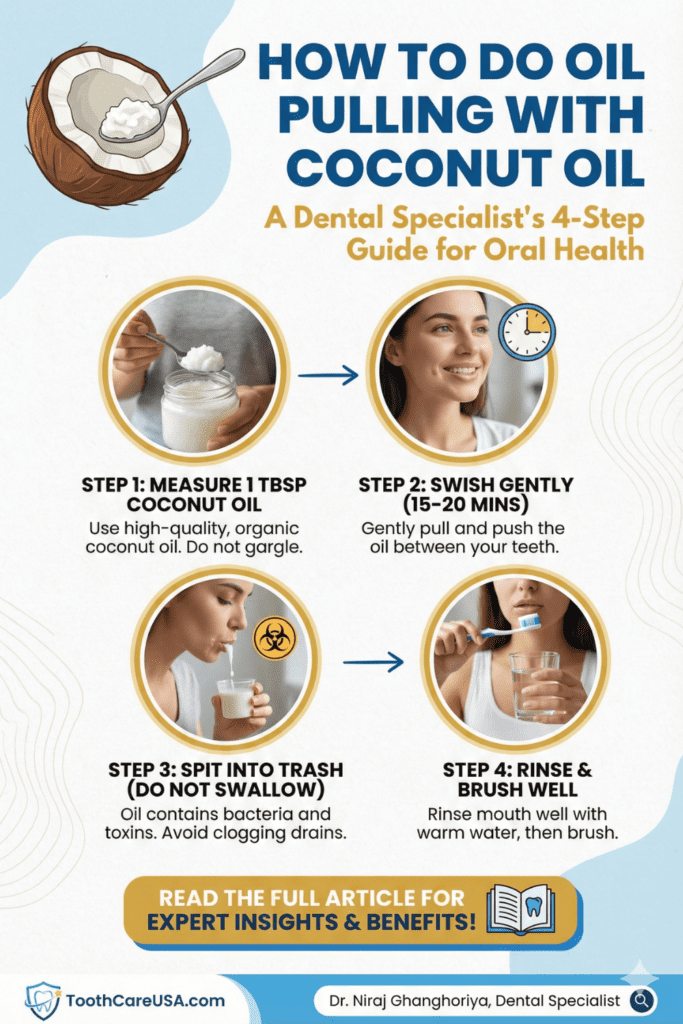
Oil pulling instructions
Clear instructions are vital for patient safety. As a dental specialist, my priority is ensuring that home remedies do no harm. Here are the precise instructions I provide in my clinic handouts.
Pre-Procedure Assessment:
Before you start, assess your mouth. Do you have any open sores, large cavities, or a loose crown? While oil pulling is gentle, the suction force can sometimes tug on loose dental work. If you have a temporary crown, be very gentle.
The “Sip, Don’t Gulp” Rule:
When you put the oil in, keep your lips closed. Do not open your mouth to talk. If you need to sneeze or cough, spit the oil out immediately. Trying to hold it in while sneezing is a recipe for aspiration.
During the Process:
- 0-5 Minutes: The oil is thick. You are just coating the mouth.
- 5-10 Minutes: The oil becomes watery. The mixing with saliva is peaking.
- 10-15 Minutes: The liquid is now creating a foam-like texture. It is pulling debris from the gum pockets.
- 15-20 Minutes: The liquid is full of toxins and bacteria. Time to stop.
Post-Swish Instructions:
Once you spit the oil into the trash, your mouth will feel oily. You must rinse. Use warm salt water or plain warm water. Swish the water vigorously to remove the oily residue and the bacteria suspended in it. Spit this water into the sink.
Cleaning Your Tongue:
I highly recommend using a tongue scraper after oil pulling. The oil can leave a coating on the tongue, which may harbor the bacteria you just pulled out. Scrape your tongue 3-4 times from back to front to ensure a truly clean oral environment.
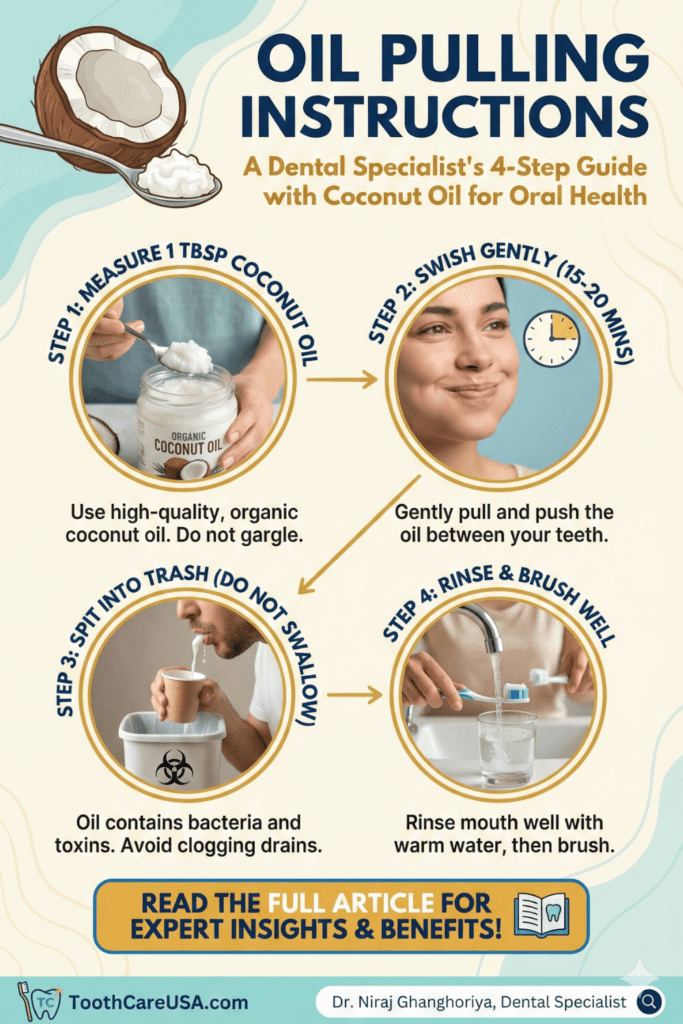
When to do oil pulling (Morning vs Night)
This is a classic debate. Traditional Ayurveda insists on the morning, but modern lifestyle sometimes dictates otherwise. Here is my professional take on the timing.
The Morning Advantage (The Gold Standard):
Ideally, oil pulling should be done first thing in the morning, on an empty stomach, before you drink water or coffee.
- Why? Overnight, bacteria multiply rapidly in your mouth (this is why we have “morning breath”). The bacterial load is highest right when you wake up. Oil pulling at this time intercepts these bacteria before you swallow them with your breakfast.
- Ayurvedic View: It is believed to draw toxins out of the body that have accumulated during sleep.
The Nighttime Option (The Practical Choice):
If you are rushing to get kids to school or get to work, you might not have 20 minutes in the morning. Doing it at night, before bed, is acceptable.
- Pros: You might be more relaxed and able to do the full 20 minutes.
- Cons: You have already eaten throughout the day, so the “detox” effect might be slightly less potent compared to the fasting state of the morning. However, it still effectively reduces the bacterial count before sleep, which is crucial since saliva production drops at night.
Can you do both?
Technically, yes, but it is unnecessary. For most patients, once a day is plenty. Overdoing it can lead to irritation of the oral mucosa.
Dr. Niraj’s Verdict:
Try the morning routine for one week. If it stresses you out, switch to the evening. The best time is the time that allows you to be consistent. A consistent night routine is better than a sporadic morning one.
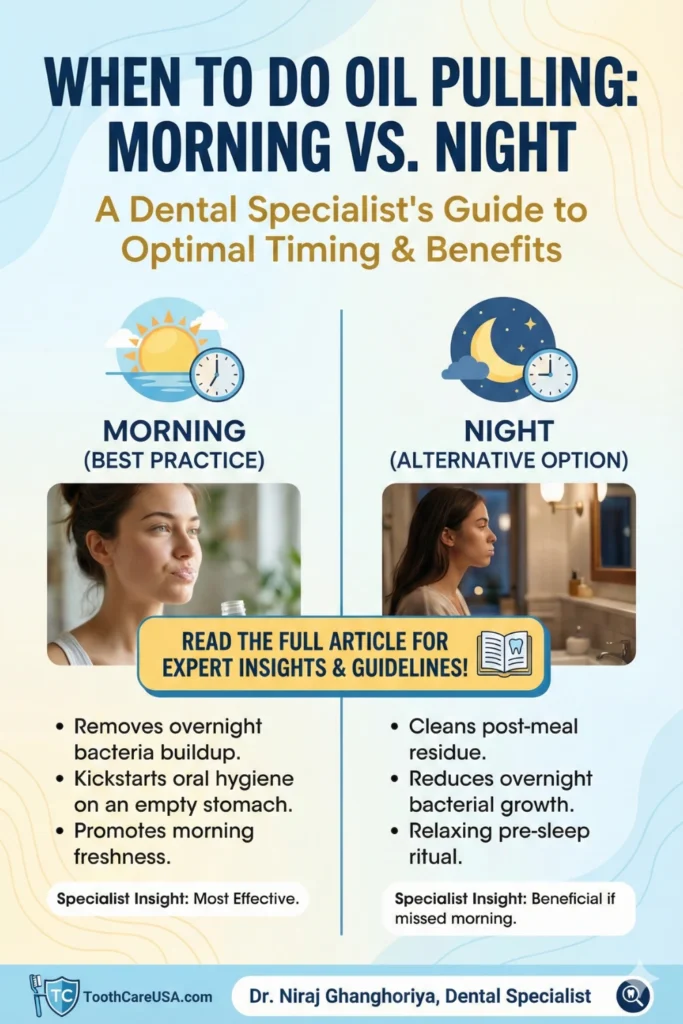
Oil pulling: How long
Duration is the most critical variable in oil pulling. If you do it for too short a time, it doesn’t work. If you do it for too long, it can be counterproductive.
The Science of 20 Minutes:
Why do we always say 20 minutes? It takes time for the oil to penetrate the biofilm. Biofilm (plaque) is a sticky, glue-like matrix that bacteria build to protect themselves. It takes roughly 15 to 20 minutes of mechanical swishing to sufficiently break down this matrix and emulsify the oil enough to trap the bacteria.
If you stop at 5 minutes:
You have essentially just lubricated your teeth. You haven’t given the oil enough time to interact with the bacterial cell walls or saponify. You might get fresh breath for a moment, but the therapeutic reduction in plaque won’t happen.
If you go beyond 20 minutes:
There is a theory that after 20 minutes, the toxins and bacteria trapped in the oil emulsion can begin to be reabsorbed into the mucous membranes. Furthermore, swishing for 30 or 40 minutes puts excessive strain on the Temporomandibular Joint (TMJ). I have had patients come in with jaw pain and headaches because they were oil pulling for 45 minutes while watching TV.
Building Endurance:
- Day 1-3: Aim for 5-7 minutes.
- Day 4-7: Increase to 10-12 minutes.
- Week 2: You should be able to hit the 15-20 minute mark comfortably.
Distraction is Key:
Do not stare at the clock. As mentioned in the routine section, keep yourself busy. If you focus on the oil in your mouth, your gag reflex is more likely to trigger.
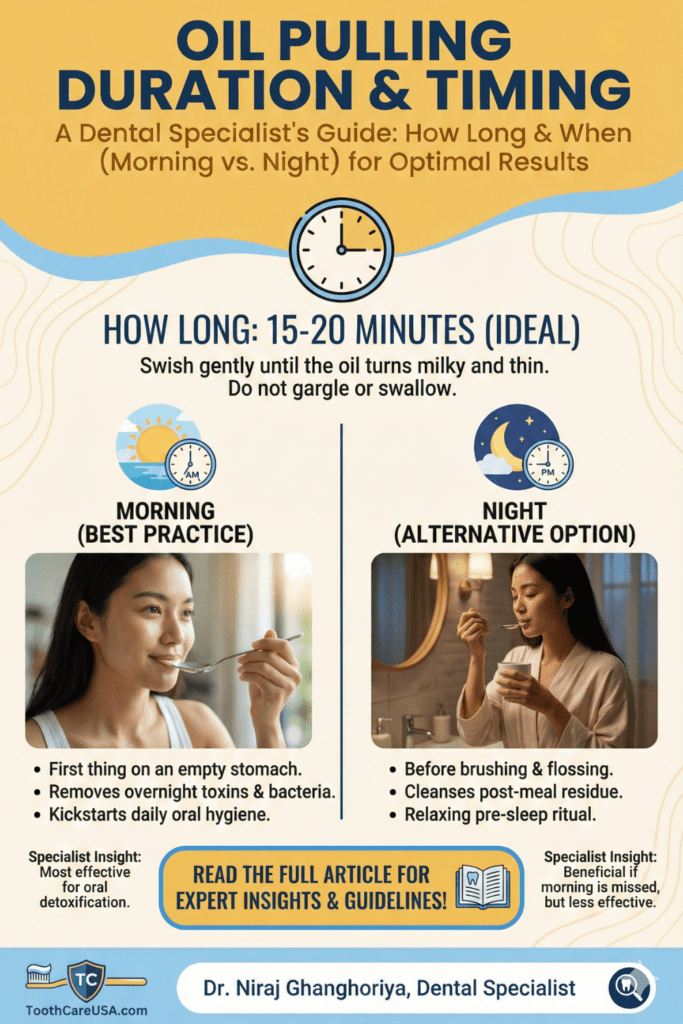
Do you brush your teeth after oil pulling
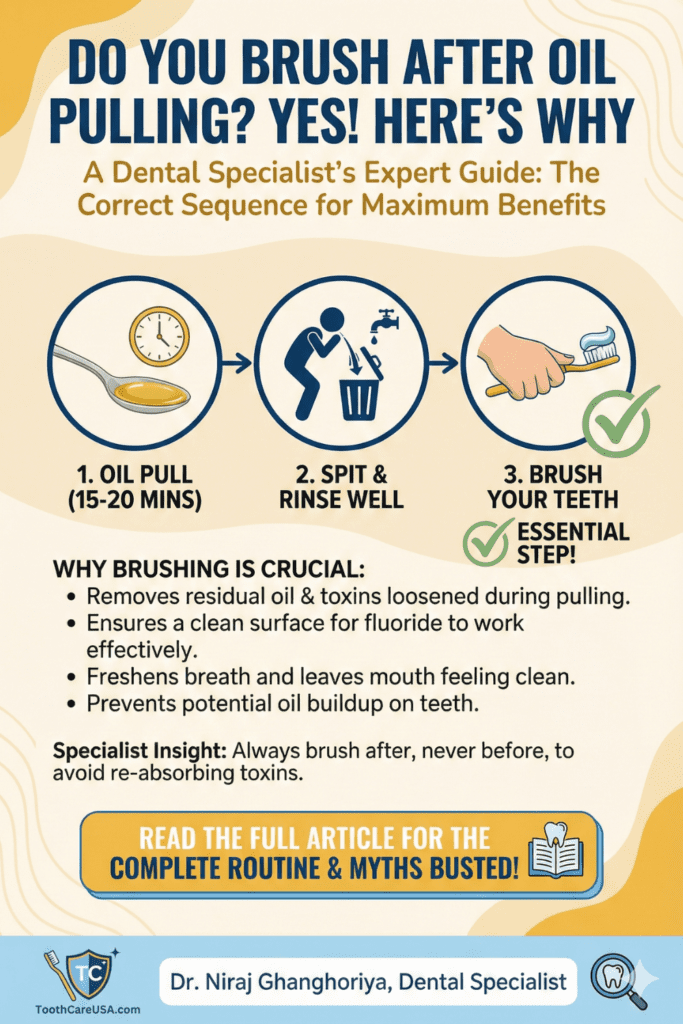
This is a non-negotiable step in the process. Yes, you absolutely must brush your teeth after oil pulling.
The “Oil Film” Problem:
After you spit out the oil, your teeth are covered in a thin, oily film. While this film contains the trapped bacteria, it creates a barrier. If you don’t brush it off, that barrier remains. Furthermore, oil has a high caloric value; leaving residue could theoretically provide a food source for remaining bacteria, though this is minimal.
The Correct Sequence:
- Oil Pull (20 mins) – Loosens plaque and traps bacteria.
- Spit – Removes the bulk of the waste.
- Rinse with Water – Neutralizes the pH and removes loose oil.
- Brush (2 mins) – This is crucial. The oil pulling has loosened the plaque, making your brushing more effective. You are now mechanically sweeping away the debris that the oil dislodged.
- Floss – Ideally, floss before oil pulling so the oil can reach between teeth, but flossing after is also acceptable to ensure no oil is trapped in tight contacts.
Toothpaste Interaction:
You do not need a special toothpaste. Your standard fluoride or hydroxyapatite toothpaste works perfectly. In fact, because the teeth are cleaner, the fluoride/hydroxyapatite may have better contact with the enamel, potentially aiding in remineralization.
What if I brush BEFORE?
If you brush before, you risk brushing the oil into your clean teeth afterwards. No, the main issue is that if you brush first, you remove the bulk of the bacteria that the oil is supposed to catch. It is more efficient to use the oil as a “pre-wash” (like soaking dishes before scrubbing them) and the toothbrush as the final scrub.
Oil pulling procedure
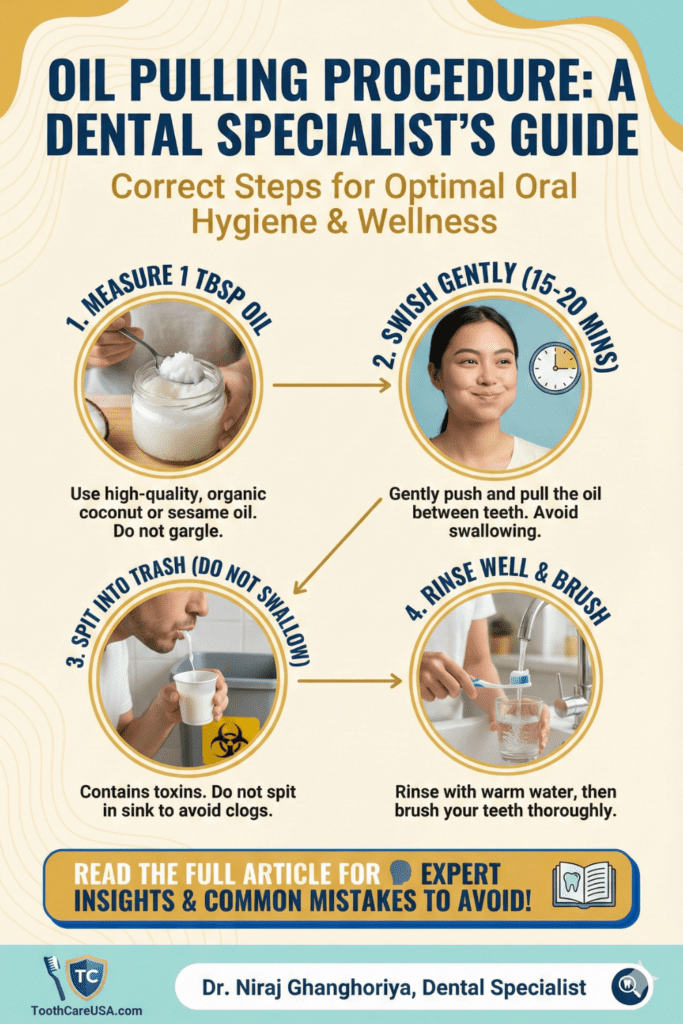
From a clinical standpoint, the “procedure” refers to the biological impact on the oral cavity. When patients ask me about the procedure, they want to know what is actually happening inside their mouth.
Biofilm Disruption:
Our mouths are home to billions of bacteria. These bacteria organize themselves into communities called biofilm. Antibiotics often fail to penetrate biofilm. The physical procedure of oil pulling creates a “shear force.” The viscosity of the oil exerts a drag on the biofilm, physically ripping it away from the tooth surface in a way that water (which is too thin) cannot.
Gingival Health:
The procedure massages the gums. The swishing action stimulates blood flow to the gingival tissue. Improved blood flow brings immune cells to the area, which can help the body fight off mild gingivitis. I have observed that patients who oil pull regularly often have firmer, pinker gums compared to those who only brush.
Halitosis (Bad Breath) Reduction:
Volatile Sulfur Compounds (VSCs) are responsible for bad breath. These are produced by bacteria, often hiding on the back of the tongue. The oil pulling procedure coats the whole mouth, including the back of the tongue, trapping these VSCs and the bacteria producing them.
Limitations of the Procedure:
It is vital to state what this procedure cannot do. It cannot cure deep periodontal disease (gum pockets deeper than 4mm). It cannot reverse a cavity that has already penetrated the enamel. It cannot whiten teeth chemically (like bleaching); it only removes surface stains.
Oil pulling directions
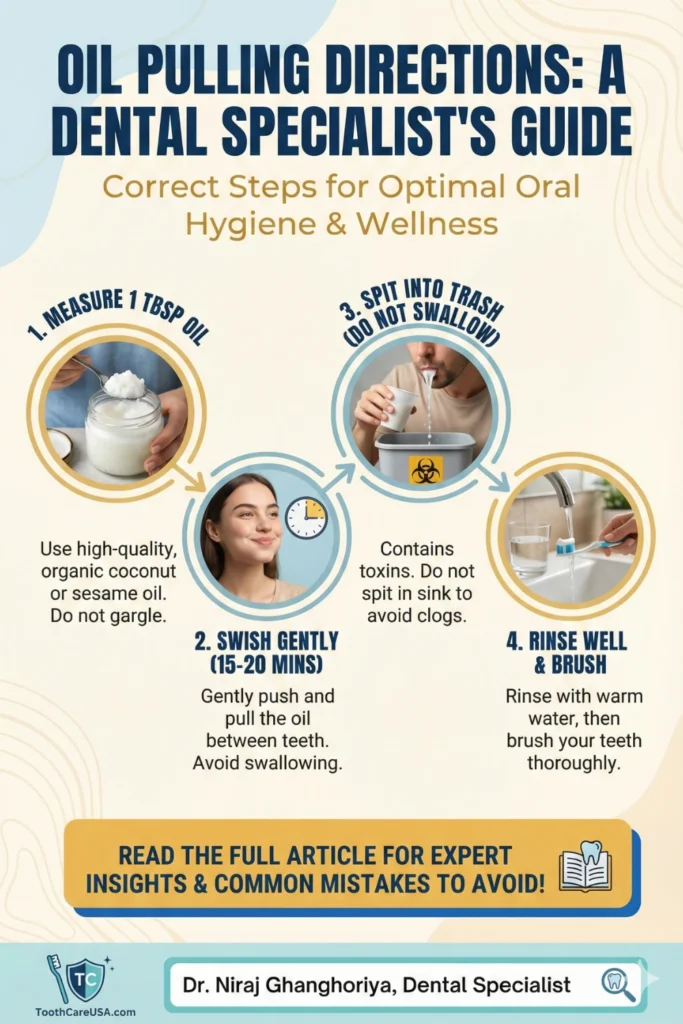
Let’s simplify everything into a direct set of directions you can print out or save. Think of this as your “dosage” instructions.
Dosage:
- Frequency: Daily for best results, or 3x/week for maintenance.
- Amount: 1 Tablespoon (15ml).
- Time: 20 Minutes.
The Directions:
- Wake Up: Do not drink or eat.
- Spoon: Scoop 1 tablespoon of Coconut Oil.
- Insert: Place in mouth. Allow to melt.
- Engage: Begin swishing. Push through teeth. Pull back.
- Pace: gentle, rhythmic motion. Breathe through the nose.
- Discard: Spit into trash can when timer hits 20 mins.
- Cleanse: Rinse mouth with warm water.
- Finish: Brush teeth thoroughly with a toothbrush and toothpaste.
For Denture Wearers:
If you wear full dentures, remove them before oil pulling. You want to massage the gums, not the plastic. If you have partials, remove them too. This helps clean the abutment teeth (the ones holding the partial), which are prone to decay.
For Braces (Orthodontics):
You can oil pull with braces! In fact, it is highly recommended. Braces trap food and plaque easily. Oil is fluid and can get around brackets and wires where your brush misses. It will not damage the glue used for braces.
Oil pulling mistakes
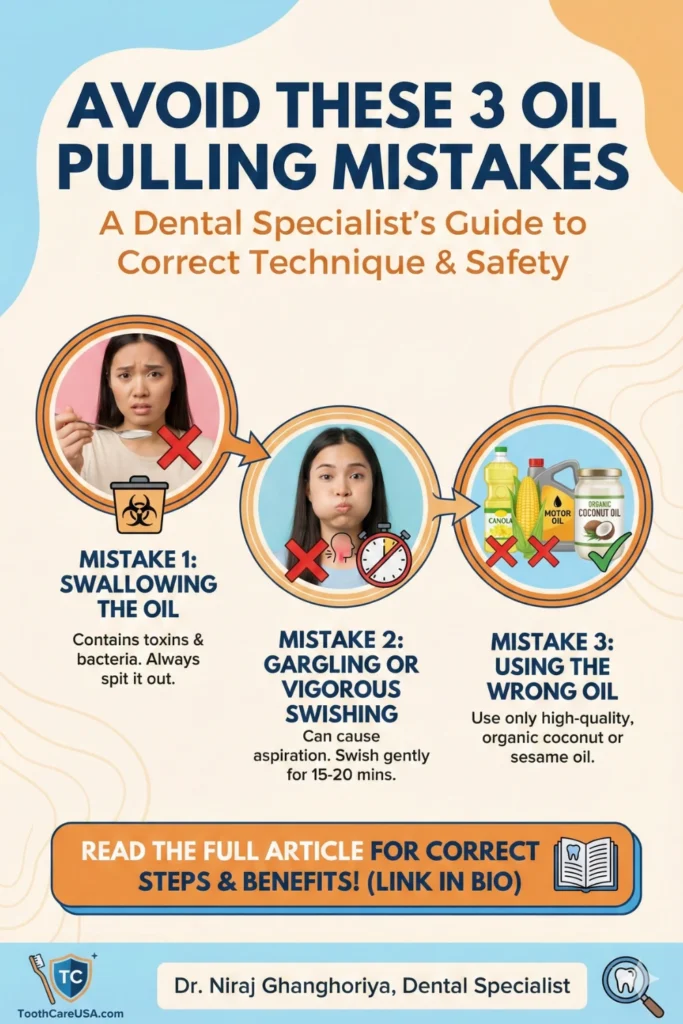
Even with the best intentions, mistakes happen. In my practice, correcting these mistakes often turns a skeptical patient into a believer.
Mistake 1: Swallowing the Oil (The Toxic Gulp)
I cannot stress this enough. By the end of 20 minutes, that oil is a soup of bacteria, toxins, and pus (if you have gum disease). Swallowing it reintroduces all that waste into your digestive system. If you accidentally swallow a tiny bit, don’t panic, but try to avoid it.
Mistake 2: Spitting in the Sink
Plumbers hate oil pullers. Coconut oil solidifies at room temperature. If you spit it down the drain daily, it will coat your pipes and eventually cause a blockage that is expensive to fix. Always use the trash.
Mistake 3: Replacing Brushing
Some proponents claim oil pulling is all you need. This is false and dangerous. Oil pulling does not have the abrasive quality needed to remove heavy plaque or stain, and it doesn’t deliver fluoride or remineralizing agents to the enamel. It is an adjunct, not a replacement.
Mistake 4: Aggressive Swishing
If your jaw hurts, you are doing it wrong. This isn’t a workout for your face. It should be a relaxing, passive motion.
Mistake 5: Expecting Miracles Overnight
Natural remedies work slowly. You might see whiter teeth in 2 weeks and healthier gums in 4 weeks. Don’t quit after day 3 because you don’t see a Hollywood smile yet.
Oil pulling technique
Finally, let’s refine your technique. The difference between an amateur and a pro is in the “suction.”
The “Sip and Suck” Technique:
The most effective technique involves using your tongue and cheeks to create a vacuum.
- Push the oil to the front of the mouth.
- Close your teeth.
- Use your tongue to push the oil through the gaps in your teeth.
- Simultaneously, use your cheeks to suck the oil back in. This “push-pull” hydraulic force is what dislodges debris from the interdental spaces where your toothbrush bristles cannot reach.
Tongue Positioning:
Don’t just let the oil sit in the bottom of your mouth. Move your tongue around. Coat the roof of your mouth (palate), the inside of your cheeks, and under the tongue. The floor of the mouth (under the tongue) is highly absorbent, so cleaning this area is beneficial.
Mindfulness:
Use this time to relax. Stress impacts oral health (teeth grinding). If you treat oil pulling as a meditative practice—focusing on the sensation of the oil, the rhythm of the swish—it becomes a stress-relief tool as well as a hygiene tool.
Dr. Niraj’s Technique Check:
If you finish and your mouth feels tired, use less oil next time. If you finish and your mouth doesn’t feel clean, use more suction force next time.
Conclusion
Oil pulling with coconut oil is a safe, affordable, and effective addition to your oral hygiene arsenal. As a Dental Specialist, I have seen it improve gum health and reduce plaque in my patients who stick with it. However, remember that it complements—never replaces—brushing, flossing, and regular professional cleanings.
Give it a try for 14 days. Your mouth will feel fresher, your teeth may look brighter, and you’ll be taking a proactive step toward better health.
Frequently Asked Questions (FAQ) On How to Do Oil Pulling
Can oil pulling remove tartar from teeth?
In my clinical experience, oil pulling cannot remove hardened tartar (calculus). While swishing with coconut oil effectively reduces plaque formation and bacterial load, tartar is mineralized plaque that adheres firmly to the enamel. Removing it requires professional scaling instruments used during a dental cleaning. Oil pulling is a preventive measure, not a curative one for existing calculus.
How often should I do oil pulling for the best results?
For optimal oral hygiene, I recommend oil pulling once daily, preferably in the morning on an empty stomach. Consistency is key to reducing Streptococcus mutans bacteria. However, if a daily routine is difficult to maintain, performing it 3 to 4 times a week can still provide significant benefits for gum health and breath freshness.
What happens if I accidentally swallow the oil?
If you swallow a small amount, you may experience mild upset stomach or loose stools, but it is not dangerous. However, you should avoid swallowing the oil because it contains the bacteria and toxins you just pulled from your mouth. Always spit the oil into a trash can to prevent re-ingesting these pathogens.
Can I drink water immediately after oil pulling?
Yes, you should rinse your mouth first, then drink water. After spitting out the oil, rinse vigorously with warm salt water or tap water to remove any oily residue and remaining bacteria. Once your mouth is clean, drinking water is perfectly safe and helps hydrate the body, further aiding in detoxification.
Is oil pulling safe for dental fillings and crowns?
Yes, oil pulling is generally safe for fillings, crowns, and veneers. Coconut oil does not have the chemical properties to dissolve dental cement or damage restorative materials. However, if you have a loose crown or temporary filling, the suction force from vigorous swishing could theoretically loosen it further, so I advise gentler swishing in those specific areas.
For more dental tips and real treatment insights, explore the rest of our articles on ToothCareUSA.com.
References & Further Reading
To ensure we follow E-E-A-T guidelines, here are the scientific sources supporting this article:
- Shanbhag V. K. L. (2017). Oil pulling for maintaining oral hygiene – A review. Journal of Traditional and Complementary Medicine. (Discusses the mechanism of saponification and clinical trials).
- Peedikayil, F. C., et al. (2015). Effect of coconut oil in plaque-related gingivitis — A preliminary report. Nigerian Medical Journal. (Study showing reduction in plaque index).
- American Dental Association (ADA). (Guidelines on standard oral hygiene).
About the Author
Dr. Niraj Ghanghoriya is a Dental Specialist and the lead voice behind ToothCareUSA.com. With years of clinical experience treating gum disease and oral hygiene issues, Dr. Niraj bridges the gap between modern dentistry and evidence-based holistic practices. His goal is to provide transparent, expert advice to help you achieve a healthier smile.
(Disclaimer: This content is for informational purposes only and does not constitute medical advice. Always consult with your dentist for specific concerns regarding your oral health.)

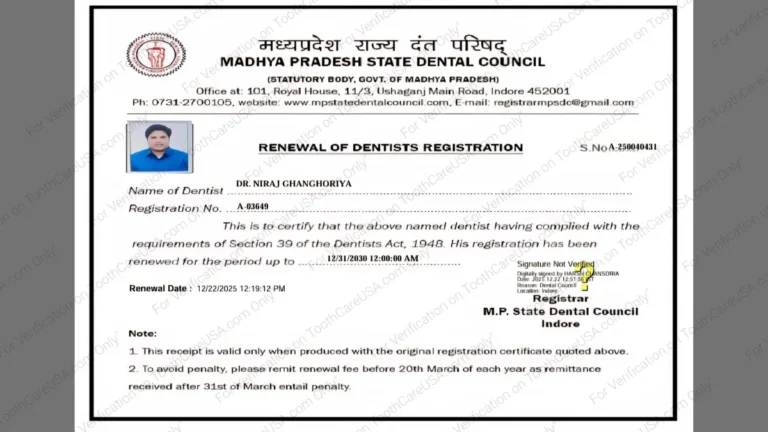
Dr. Niraj Ghanghoriya is a passionate dental surgeon with over 12 years of experience in clinical dentistry. He completed his BDS from the prestigious Sri Aurobindo Institute of Dentistry in 2012 and specializes in painless root canals, smile makeovers, and preventive oral care. He is the Founder of ToothCareUSA.com and a registered Dental Surgeon (Reg No: A-03649) based in Indore. Known for his patient-first approach and clear communication, Dr. Ghanghoriya aims to make dental knowledge accessible to everyone. When he’s not in the clinic, he enjoys writing informative dental blogs to help people take better care of their oral health. He reviews every article on this site to ensure medical accuracy and patient safety.

There are some attention-grabbing cut-off dates on this article however I don’t know if I see all of them heart to heart. There’s some validity however I will take maintain opinion till I look into it further. Good article , thanks and we wish more! Added to FeedBurner as effectively