Dr. Niraj’s Quick Answer (2026 Estimate)
In the US, Cost of Zirconia Implants(single) lies between $4,000 and $6,500. Full arch restorations can range from $40,000 to $60,000.
Warning: Lower quotes ($1,500-$2,000) often use Monobloc (one-piece) designs which carry higher surgical risks. You are not just paying for a “white screw”; you are paying for biocompatibility, advanced osseointegration, and surgical precision to prevent future bone loss.
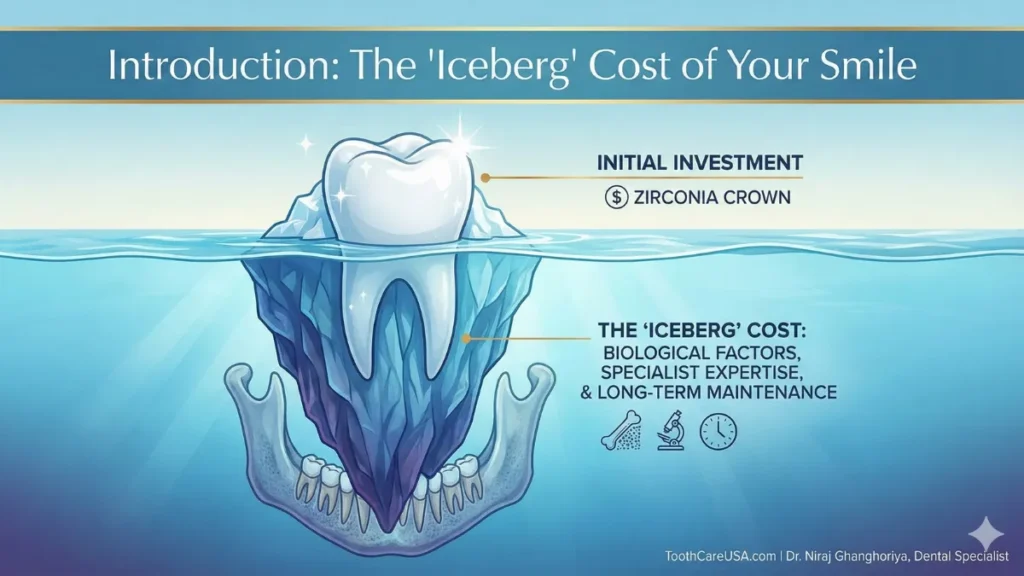
Introduction: The “Iceberg” Cost of Your Smile
When patients sit in my chair, the first question is almost always, “Dr. Niraj, why is the quote for Zirconia so much higher than Titanium?”
It is a fair question. On paper, the difference between a $3,000 titanium implant and a $5,000 ceramic one looks purely financial. But in oral surgery, the price tag is just the tip of the iceberg.
Here is the truth that many generic dental blogs won’t tell you: Zirconia is a technique-sensitive material. It is not just a “metal-free alternative”; it is a completely different biological approach to replacing a tooth.
If you choose a “budget” Zirconia implant, you aren’t just saving money—you might be compromising the implant’s flexural strength (the material’s ability to resist fracture). Unlike titanium, which bends, cheap ceramic cracks. And if an implant cracks inside your jaw, the cost to remove it—drilling away your healthy bone—far outweighs the initial savings.
In this guide, I will break down exactly where your money goes, why biocompatibility is worth the investment, and how to spot a “deal” that is actually a medical risk.
The Hardware: Monobloc vs. Two-Piece Systems (The Hidden Price Driver)
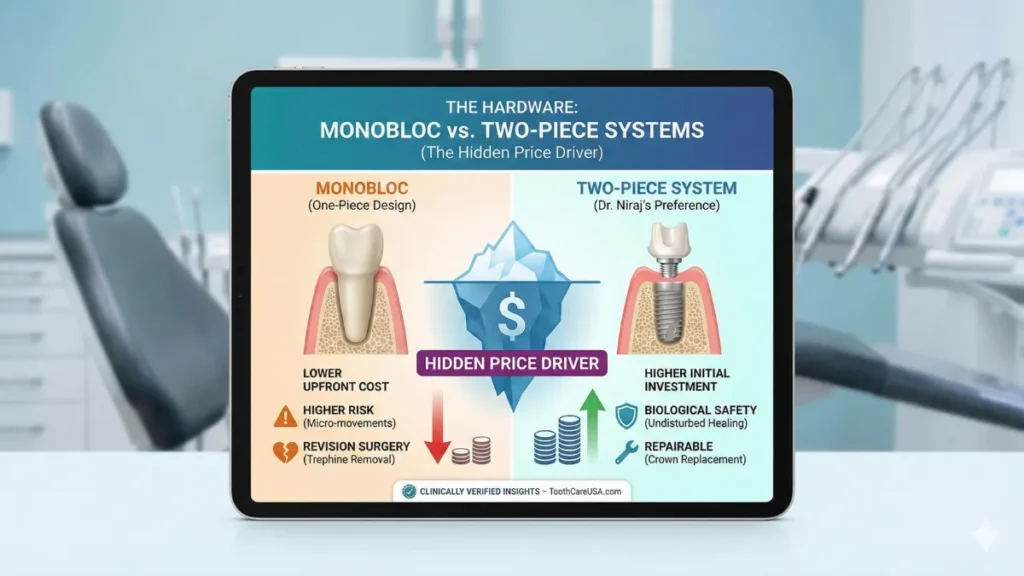
This is the most critical section of this article. If you see an advertisement for “Zirconia Implants: $1,999,” they are almost certainly using a Monobloc system. You need to understand the difference.
The Monobloc (One-Piece) Design
In this older design, the implant (the root) and the abutment (the post that holds the tooth) are fused into a single solid piece of ceramic.
- The Cost: It is cheaper to manufacture and faster to insert.
- The Risk: Because it sticks out of your gum immediately after surgery, it is vulnerable to micro-movements. If your tongue pushes it or you chew on it slightly while the bone is healing, the implant may fail to fuse.
- The “Nightmare” Scenario: If the top part chips years later, we cannot just replace the top. We have to surgically remove the entire implant from your jawbone. This is a massive revision surgery cost.
The Two-Piece Design (Dr. Niraj’s Preference)
This mimics a natural tooth. We place the implant entirely under the gum to heal, and later attach a separate Zirconia Abutment.
- The Cost: Higher. It requires more precision components and a second minor procedure.
- The Benefit: It allows for undisturbed osseointegration (the biological process where your bone grows tightly around the implant). If the crown breaks in 10 years, we unscrew it and make a new one. The root stays safe in your bone.
The Bottom Line: I rarely recommend Monobloc implants for back teeth. The risk of ceramic fracture toughness failing under biting pressure is too high. The extra cost for a Two-Piece system is an insurance policy for your jawbone.
The Clinical Breakdown: What Are You Actually Paying For?
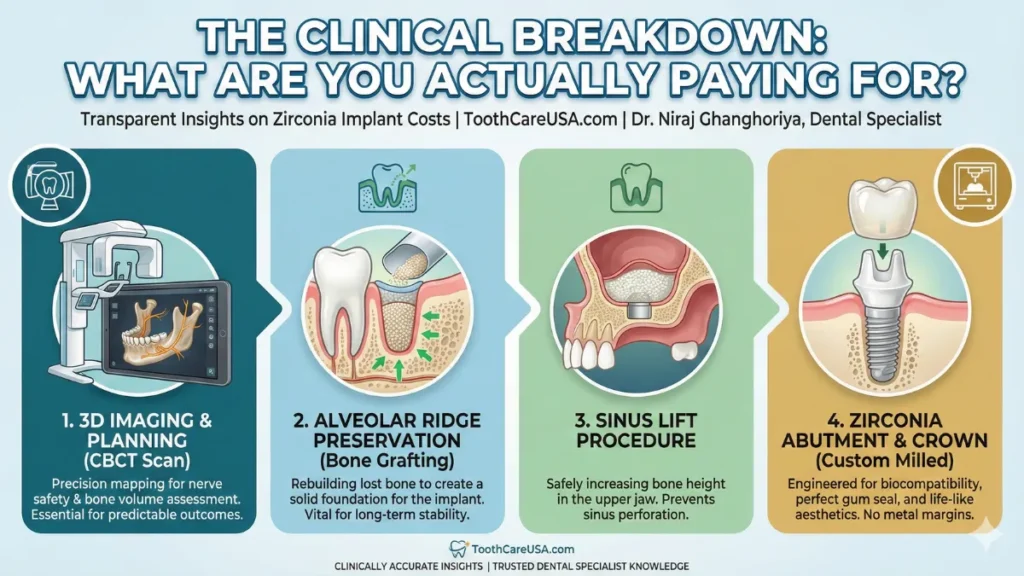
When you look at your invoice, you aren’t just buying a ceramic screw. You are paying for the biological foundation that keeps that screw in your head for life. Here is the line-by-line reality.
A. 3D Imaging & Planning ($300 – $600)
We cannot place Zirconia “blind.” We use CBCT (Cone Beam Computed Tomography) scans to map your nerves and bone density. Zirconia requires a specific volume of bone to be successful. If we skip this to save money, we risk hitting a nerve or placing the implant where the bone is too soft.
B. Alveolar Ridge Preservation ($500 – $3,000)
The alveolar ridge is the part of your jawbone that holds teeth. When you lose a tooth, this bone melts away (resorbs).
- Why pay for it? Zirconia implants need a thick customized bed of bone. If your ridge has shrunk, we must perform grafting. This ensures the implant is surrounded by living tissue, which is vital for long-term stability.
C. The Sinus Lift ($1,500 – $3,000)
For upper back teeth, your sinus cavity might be too close to the jaw. A sinus lift gently moves the sinus floor up and adds bone.
- The Intent: Without this, the implant would puncture your sinus, leading to chronic infection and failure.
D. The Zirconia Abutment & Crown ($1,500+)
This is the visible part. We use Yttria-Stabilized Zirconia, a specific grade of ceramic that is incredibly tough.
- Customization: I often use a custom abutment to shape the gingival architecture (your gum line). This ensures the gums look natural and, more importantly, creates a seal against bacteria.
The Biological Value: Why Zirconia Costs More Than Titanium
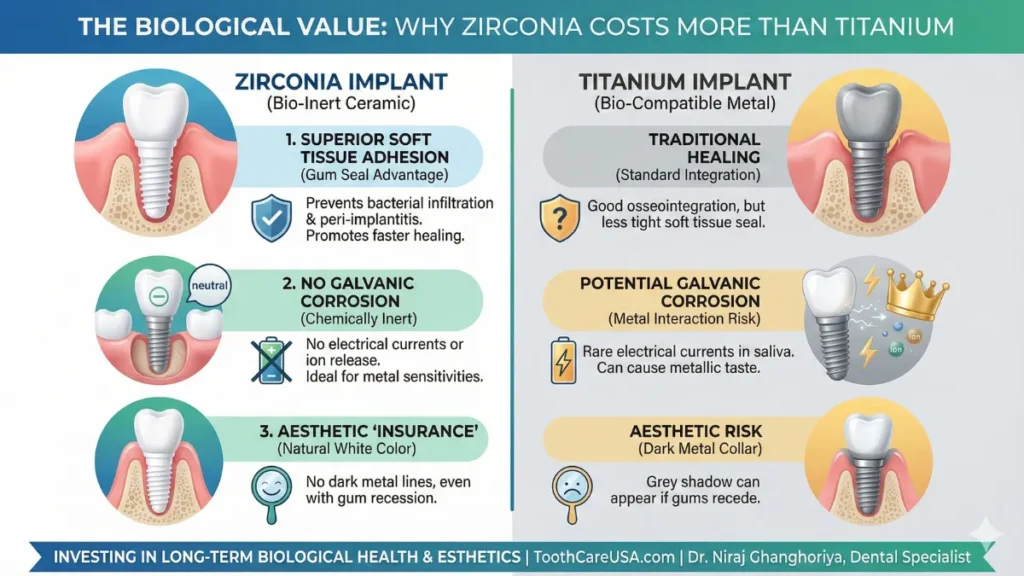
You are likely asking: “Is it really worth 30% more than Titanium?”
As a doctor, my answer depends on your biology. Here is why the price is justified for many patients.
1. Soft Tissue Adhesion (The “Gum Seal” Advantage)
This is Zirconia’s superpower. Your gum tissue (soft tissue) actually loves zirconia. It heals faster and attaches physically to the ceramic surface.
- Why this matters: This tight seal prevents bacteria from slipping down between the gum and the implant. It significantly lowers the risk of peri-implantitis, a destructive inflammatory condition that destroys bone around implants.
- The Savings: By paying more now, you reduce the risk of needing expensive gum treatments later.
2. No Galvanic Corrosion
Titanium is a metal. When placed in a wet, salty environment (your mouth), it can sometimes release ions or interact with other metals (like gold crowns), creating a tiny electrical current. This is called galvanic corrosion.
- The Benefit: Zirconia is chemically inert. It does not corrode. It does not conduct electricity or heat. For patients with Titanium Intolerance or autoimmune sensitivities, this peace of mind is priceless.
3. Aesthetic “Insurance.”
With titanium, if you have thin gums, you might eventually see a grey shadow at the gum line. Zirconia is white. Even if your gums recede slightly with age, you will never have that dark metal line.
Detailed Comparison: Zirconia vs. Titanium vs. “Cheap” Options
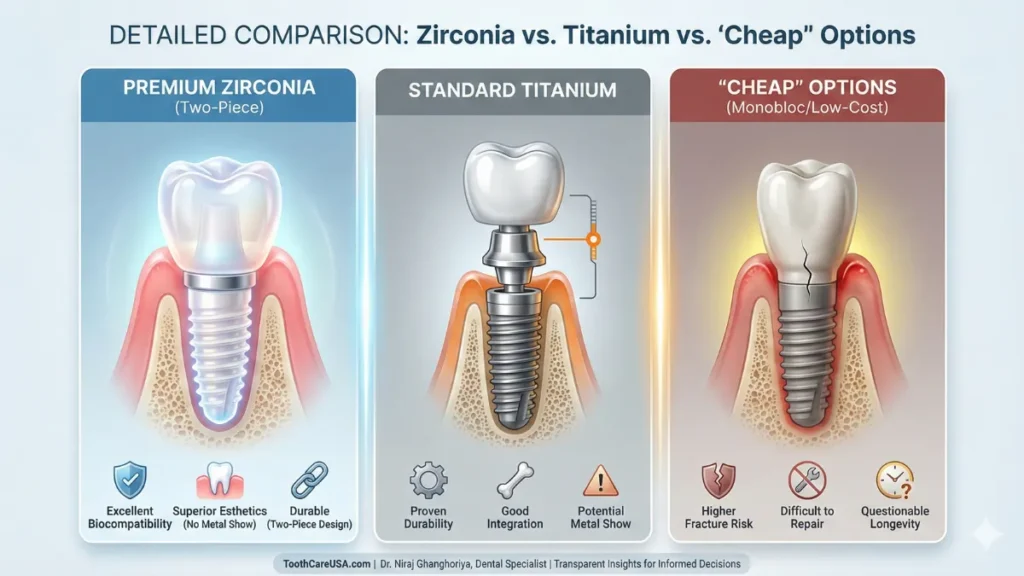
To help you make an informed decision, I have compiled this comparison based on clinical performance and long-term value.
| Feature | Premium Zirconia (Two-Piece) | Titanium Implant | “Discount” Zirconia (Monobloc) |
| Average Cost (Single) | $4,500 – $6,500 | $3,000 – $4,500 | $1,500 – $2,500 |
| Biocompatibility | Excellent (Tissue Integration) | Good (Bio-inert) | Moderate (Risk of irritation) |
| Material Risk | Low (with proper engineering) | Galvanic Corrosion (Rare but possible) | Ceramic Fracture (High risk) |
| Gum Health | Superior Soft Tissue Adhesion | Standard healing | Difficult to clean if shape is poor |
| Surgical Risk | Moderate (Requires precision) | Low (Forgiving material) | High (Cannot be buried to heal) |
| Repairability | High (Replace crown only) | High (Replace crown only) | Zero (Must remove implant) |
| Aesthetics | Excellent (White) | Good (Grey undertone risk) | Good (White) |
The Hidden “Safety” Costs
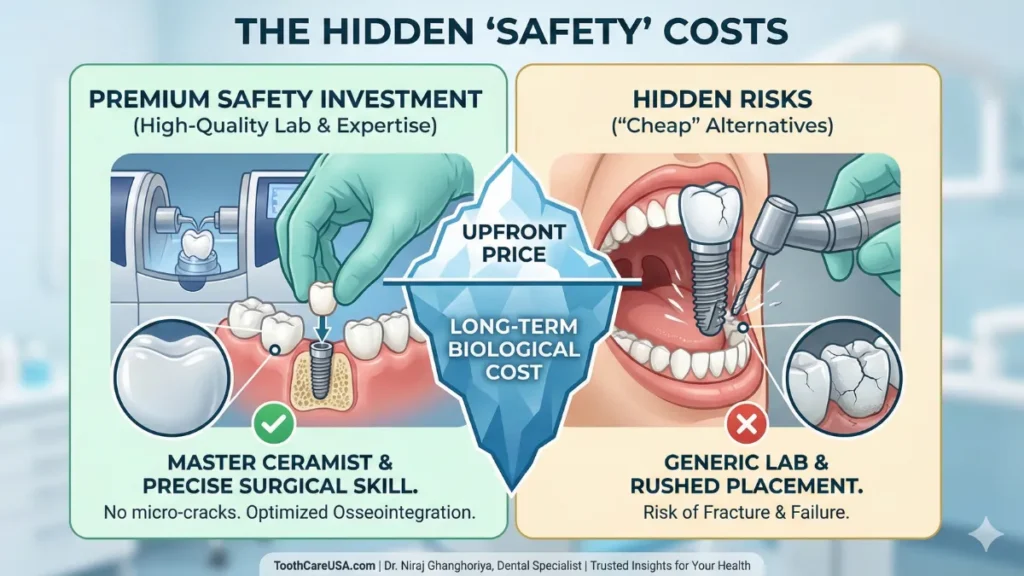
Why do some clinics charge $6,000 while others charge $2,000? It often comes down to the “Invisible” costs that ensure your safety.
- The Lab Fee: Zirconia is unforgiving. It cannot be adjusted in your mouth like metal. If a dentist drills on it to make it fit, they create micro-cracks that will cause the implant to shatter years later. We pay higher hidden lab fees to master ceramists who use CAD/CAM technology to mill the tooth perfectly before it touches your mouth.
- Surgical Expertise: Placing Zirconia requires a “perfect” angled entry. Titanium allows for slight angle correction; Zirconia does not. You are paying for the surgeon’s skill to navigate the osteoconductivity (bone growth potential) of your jaw without damaging the implant material.
Insurance & Financing: The “Lifetime Value.
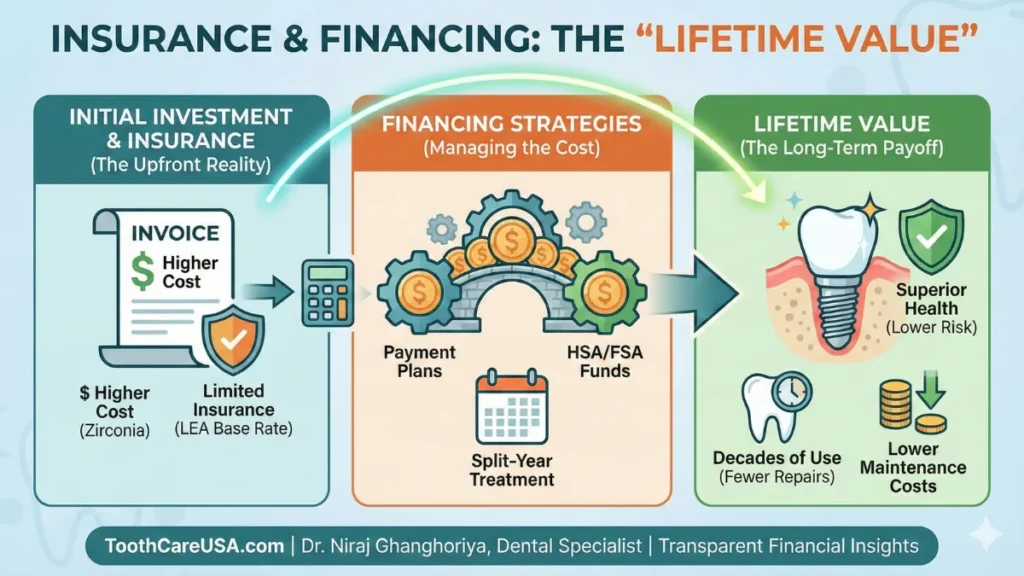
Let’s talk about the elephant in the room: Insurance Reimbursement.
Most dental insurance plans classify implants as “cosmetic” or will only pay the rate of a standard titanium implant (LEA – Least Expensive Alternative).
How to manage the cost:
- Split the Procedure: We often do the extraction and Alveolar Ridge Preservation (grafting) in one year (using that year’s maximum benefits) and place the implant the next year.
- HSA/FSA: Because implants restore function and bone health, they are fully eligible for Health Savings Accounts.
- Focus on Lifetime Value: A titanium implant that develops peri-implantitis might need laser cleaning every 6 months. A Zirconia implant, with its superior hygiene and tissue response, often requires less maintenance over 20 years. The Lifetime Value of a healthy, low-maintenance implant is far higher than the upfront savings of a cheap alternative.
Is the Higher Cost of Zirconia Implants Worth It for You?
Zirconia (ceramic) implants typically require a higher investment than titanium. Take this 60-second check to see if the benefits justify the price for your specific case.
Understanding Your Results:
If you checked ANY boxes:
The Cost of Zirconia Implants is likely a smart investment for you. The hypoallergenic properties and natural white color offer long-term value that cheaper options cannot match.If you checked NO boxes:
Traditional titanium implants may be the more cost-effective “gold standard” for your needs.
Note: This quiz is for educational purposes only and does not replace a clinical examination.
Infographic on Cost of Zirconia Implants
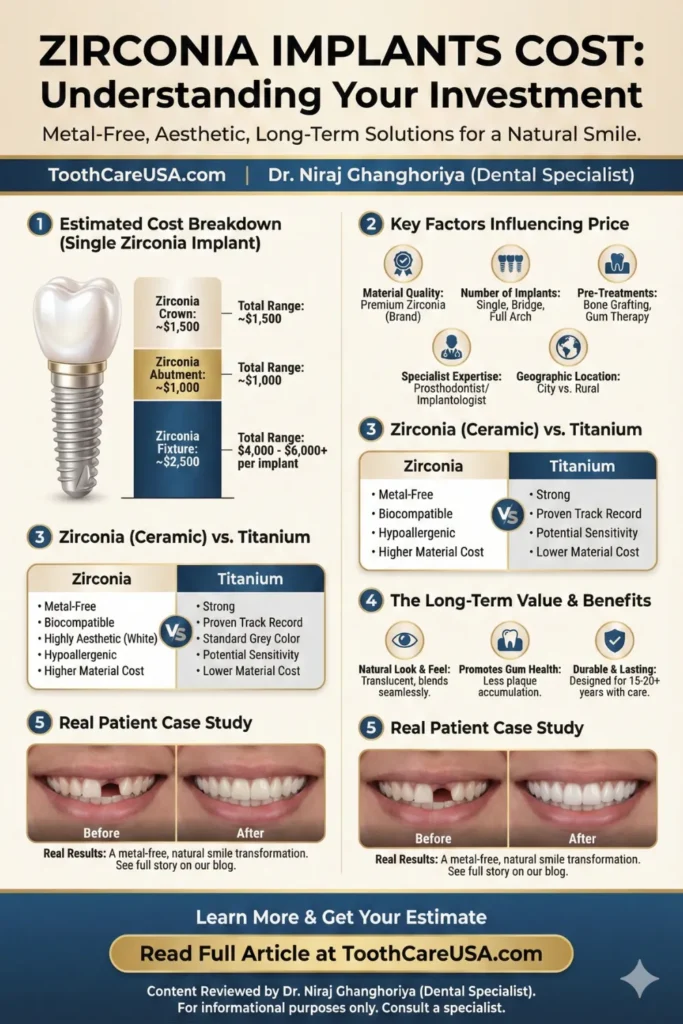
Zirconia vs. Titanium: The Price of Metal-Free Dentistry
Zirconia implants, often requested by patients seeking a holistic or metal-free alternative, represent the cutting edge of dental technology. As shown in our infographic, the cost for a single zirconia implant typically ranges from $4,000 to $6,000+. This premium price point—generally 15-20% higher than traditional titanium—reflects the advanced manufacturing costs of ceramic materials and the specialized expertise required to place them.
The primary advantage of zirconia is its biocompatibility and aesthetics. Because the implant itself is white (tooth-colored), it eliminates the risk of a dark metal line showing through the gums, which is a concern for patients with thin gingival tissue. Furthermore, zirconia is hypoallergenic, making it the ideal solution for the small percentage of patients with metal sensitivities.
However, the “one-piece” design common in many ceramic implant systems requires precise surgical placement by an experienced specialist. There is little room for error, which is why choosing a skilled provider at ToothCareUSA.com is critical. While the financial investment is significant, for patients prioritizing superior aesthetics and holistic health, zirconia implants offer a safe, durable, and highly natural-looking solution that justifies the cost.
Visualizing the Procedure: Understanding the Investment
To understand the premium nature of Zirconia implants, watch the step-by-step engineering process below. This visual breakdown highlights why this metal-free choice is the gold standard for long-term esthetics.
“Notice at 0:50 how the white ceramic implant blends perfectly with the gum tissue? Unlike titanium, which can sometimes leave a dark gray line at the base, Zirconia offers superior esthetics for front teeth. At ToothCareUSA, we specifically select this material for patients with thin gum biotypes, ensuring that your investment results in a smile that looks completely natural, even years down the road.”
Dr. Niraj Ghanghoriya’s Verdict On Cost of Zirconia Implants
So, is the higher cost of Zirconia right for you?
YES, if:
- You have a known metal allergy or Titanium Intolerance.
- You have thin gums and are worried about dark metal showing through.
- You want a “holistic” approach that prioritizes soft tissue adhesion and gum health.
- You are willing to pay for a Two-Piece System that ensures safety.
NO, if:
- You have extremely heavy biting forces (bruxism/grinding). In these rare cases, the flexibility of titanium might still be mechanically superior.
- You are looking for the cheapest option. “Bargain” Zirconia is a recipe for disaster.
My Advice: Do not shop for a product; shop for a provider. Ask your dentist: “Do you use a one-piece or two-piece system?” and “Who manufactures your Zirconia?” If they can’t answer, walk away.
Conclusion
The cost of Zirconia implants reflects the advanced technology, biological benefits, and surgical precision required to place them safely. While the upfront investment is higher, the payoff is a restoration that looks like a tooth, acts like a tooth, and respects the biology of your body.
At ToothCareUSA.com, we prioritize your long-term health over short-term trends. If you are considering Zirconia, ensure you are getting a comprehensive breakdown that includes everything from the CT scan to the final Zirconia abutment.
Next Step: Are you unsure if your bone density is ready for Zirconia? Consult with a specialist who understands alveolar ridge preservation to get a personalized roadmap for your smile.
References & Further Reading
- International Journal of Oral & Maxillofacial Implants: “Clinical Outcomes of Zirconia Implants.”
- Periodontology 2000: “Osseointegration and Soft Tissue Healing in Zirconia vs. Titanium.”
- The Journal of Prosthetic Dentistry: “Fracture strength of one-piece vs two-piece zirconia implants.”
Disclaimer: The information provided in this article is for educational purposes only and does not constitute medical advice. Prices mentioned are estimates based on 2026 US averages and vary by location and case complexity. Always consult with a qualified dental specialist for diagnosis and treatment.
Frequently Asked Questions (FAQ) on the Cost of Zirconia Implants
1. Why are Zirconia implants more expensive than Titanium?
Answer: Zirconia implants cost 20–30% more because they are harder to manufacture. Unlike titanium, which is a mass-produced metal, Zirconia must be milled from a solid crystal block (Yttria-stabilized zirconia) to ensure it doesn’t crack. You are paying for a material that mimics natural tooth enamel and supports soft tissue adhesion.
Dr. Niraj’s Take: “Think of titanium as ‘hardware’ and Zirconia as ‘biomaterial.’ The extra cost covers the advanced technology needed to make a ceramic screw strong enough to chew on.”
2. Is the high cost of Zirconia implants actually worth it long-term?
Answer: Yes, studies suggest the Lifetime Value is higher because Zirconia resists peri-implantitis (gum infection) better than titanium. While you pay ~$1,000 more upfront, you save money over 20 years by avoiding treatment for gum recession, dark metal lines, or corrosion-related failures common with older metal implants.
Dr. Niraj’s Take: “I tell my patients: You can pay a bit more now for Zirconia, or you can pay a lot more later to treat gum disease around a metal implant.”
3. Does dental insurance cover the full cost of Zirconia implants?
Answer: Rarely. Most insurance plans use a “Least Expensive Alternative” (LEA) clause, meaning they will pay what they would for a standard titanium implant, leaving you to pay the difference (the upgrade fee). However, the bone grafting and exam portions are often covered at standard major restorative rates (50–80%).
Dr. Niraj’s Take: “Ask your coordinator to file the ‘Alveolar Ridge Preservation’ code separately. That is a medical necessity, not a cosmetic upgrade, and is more likely to be covered.”
4. Do Zirconia implants break easily compared to metal?
Answer: Modern high-grade Zirconia has a success rate of over 96%, comparable to titanium. However, “cheap” Monobloc (one-piece) implants have a higher risk of fracture because they cannot withstand immediate biting forces. Premium Two-Piece Zirconia systems are engineered to be as tough as metal for normal chewing.
Dr. Niraj’s Take: “The risk isn’t the material; it’s the design. If you choose a Two-Piece system from a reputable brand, fracture is extremely rare in my clinical experience.”
5. Are there hidden costs with Zirconia implants I should know about?
Answer: Yes. Because Zirconia cannot be “patched” or added to, the initial surgery requires higher precision. You may see extra fees for CBCT 3D Scans ($300+) or Custom Zirconia Abutments ($500+). These aren’t “junk fees”—they are mandatory for the material’s safety to ensure it doesn’t touch the nerve or sinus.
Dr. Niraj’s Take: “Never trust a quote that includes the implant but excludes the 3D Scan. Placing Zirconia without a scan is medically negligent.”

Dr. Niraj Ghanghoriya is a passionate dental surgeon with over 12 years of experience in clinical dentistry. He completed his BDS from the prestigious Sri Aurobindo Institute of Dentistry in 2012 and specializes in painless root canals, smile makeovers, and preventive oral care. Known for his patient-first approach and clear communication, Dr. Ghanghoriya aims to make dental knowledge accessible to everyone. When he’s not in the clinic, he enjoys writing informative dental blogs to help people take better care of their oral health.