Author: Dr. Niraj Ghanghoriya (Dental Specialist)
Educational purposes only. See full disclaimer below.
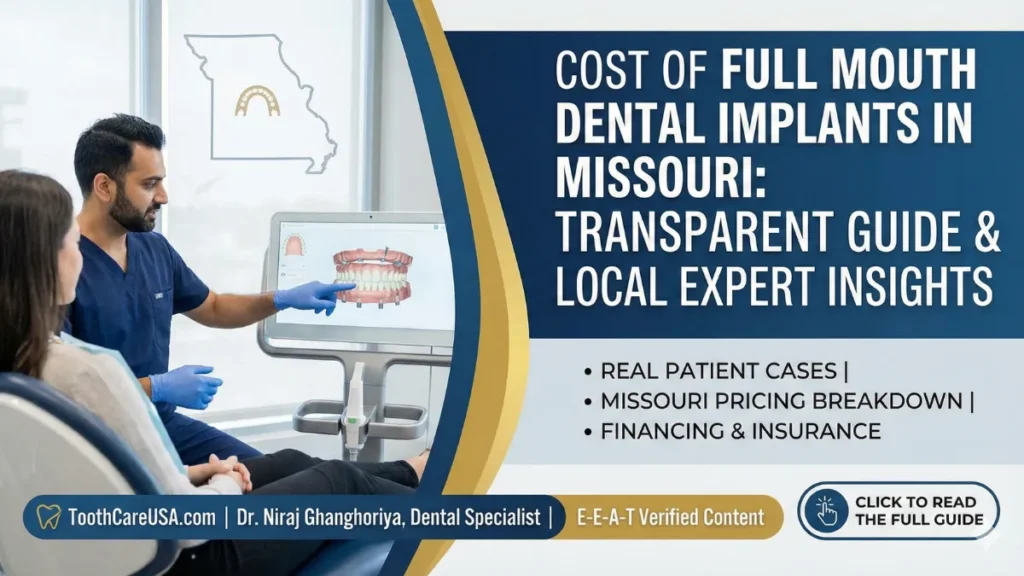
Quick Answer: How Much Do Implants Cost in Missouri?
The average cost of full mouth dental implants in Missouri ranges from $20,000 to $30,000 per arch. This typically covers the surgery, anesthesia, and the final permanent teeth. However, complex cases requiring dual-arch zirconia prosthesis or extensive bone grafting in metro areas like St. Louis or Kansas City can exceed $50,000. Beware of advertised prices lower than $15,000 per arch, as these often exclude critical fees for the final permanent teeth or sedation.
Introduction: The Danger of “Discount” Dentistry
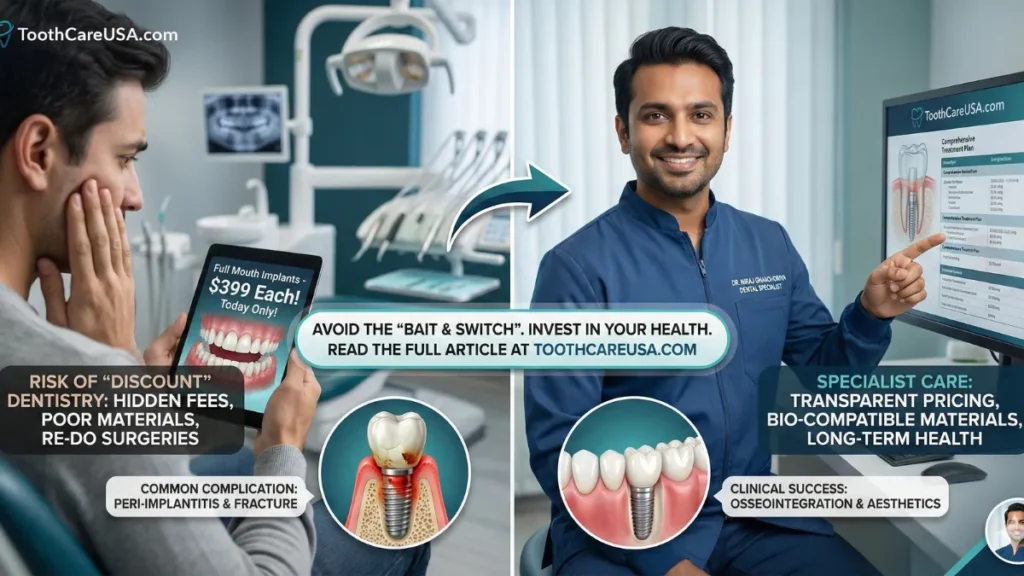
If you are looking for the “cheapest” full mouth implants in Missouri, you might be setting yourself up for the most expensive mistake of your life. As a dental specialist, I’ve seen too many patients pay double to fix “discount” work—here is the transparent breakdown of what you actually need to pay for safety and longevity.
Facing the reality of losing all your teeth is terrifying. I see the anxiety in my patients’ eyes every day. It’s not just about the inability to chew a steak or enjoy an apple; it’s the fear of “sticker shock” when they see the treatment plan. You are likely overwhelmed by conflicting prices, hearing $10,000 from one ad and $60,000 from a clinic down the street.
Why is there such a massive gap?
At ToothCareUSA.com, I emphasize that the price tag often hides the most critical factor for long-term success: the biological stability of the implant and the skill of the surgeon. In this guide, we are going to look strictly at the cost of full mouth dental implants in Missouri, dissecting the hidden fees, the insurance realities, and why “rural” pricing differs from “metro” pricing in our state.
Quick Answer: What is the Average Cost in Missouri?
When we talk about the price, we need to be precise. In 2026, the market in Missouri has stabilized around specific price points, but these vary heavily based on the materials used.
The Numbers: What to Expect
For a standard All-on-4 procedure (four implants supporting a full set of fixed teeth), Missouri residents should expect to pay between $20,000 and $30,000 per arch. This means if you need both the top and bottom teeth replaced, the total investment is often between $40,000 and $60,000.
The “All-In” Rule
One common frustration I hear is, “Dr. Niraj, the ad said $12,999!” This is where you must be careful. That lower price usually covers only the surgical phase—placing the titanium screws. It often leaves out:
- The surgeon’s fee for complex extractions.
- The cost of Intravenous (IV) Sedation (essential for a pain-free experience).
- The temporary teeth you wear while healing.
- The final, permanent Zirconia Prosthesis.
Location Variance
Missouri is unique because we have major metropolitan hubs and vast rural areas. A specialist in downtown St. Louis or Kansas City often has higher overhead costs and invests in advanced technology like Cone Beam Computed Tomography (CBCT). Consequently, their fees might be 15-20% higher than a clinic in Springfield, Joplin, or Columbia. However, as we will discuss, traveling for cheaper care has its own hidden costs.
Understanding “Full Mouth” Implants: It’s Not Just One Procedure
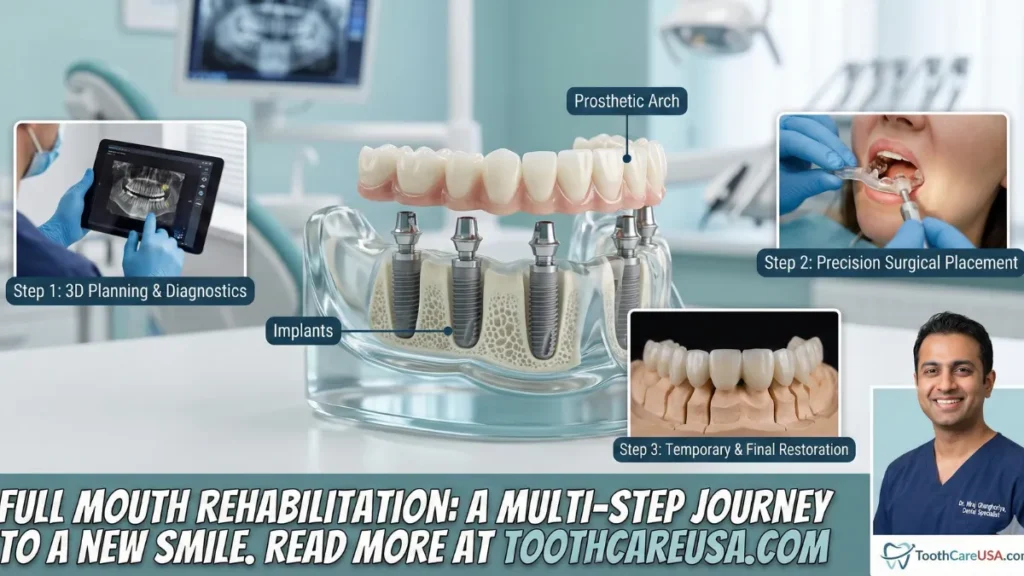
To understand the bill, you have to understand the biology. You aren’t just buying “fake teeth”; you are paying for a complex medical reconstruction known as Full Arch Rehabilitation.
All-on-4 vs. All-on-6 Protocols
The term “All-on-4” is popular, but it isn’t the only way. It involves placing four implants at specific angles to avoid the sinuses and nerves.
- All-on-4: Great for patients with less bone. It tilts the back implants to grab onto better bone density.
- All-on-6: Uses six implants. In my clinical experience, I often prefer this for the upper jaw because the bone there is softer. More implants mean better distribution of bite force, which reduces mechanical stress. If one implant fails in an All-on-6, we still have five left to support the bridge. In an All-on-4, one failure can ruin the whole restoration.
Fixed vs. Removable (Snap-On)
This is the biggest price driver.
- Fixed Hybrid Denture: These are screwed into the implants. You cannot remove them; only I can remove them at your yearly cleaning. They feel like real teeth.
- Implant-Supported Overdenture (Snap-On): These snap onto the implants but must be taken out at night to clean. They are significantly cheaper (often $10,000–$15,000 per arch) but are bulkier and less natural.
Material Science: Acrylic vs. Zirconia
“Teeth in a day cost” packages usually include acrylic teeth reinforced with titanium. Acrylic is softer and can stain or wear down over 5-7 years. Zirconia, on the other hand, is the gold standard. It is “diamond-hard,” resistant to chipping, and does not stain. Upgrading to Zirconia usually adds $5,000–$8,000 to the total cost, but it lasts decades longer.
Breakdown: Where Does Your Money Actually Go?
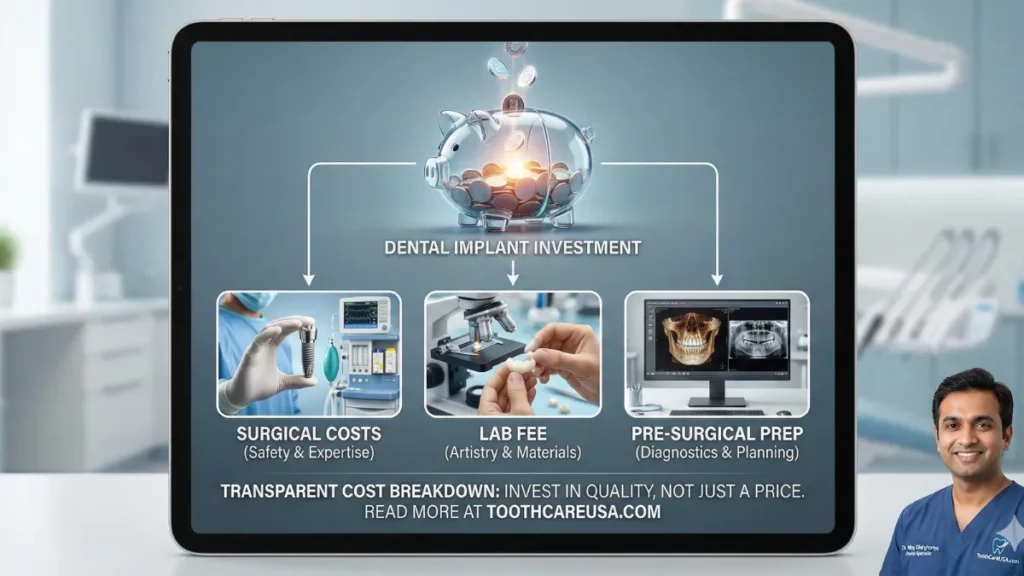
Patients often ask, “Why is it so expensive?” It’s a fair question. Let’s look at the ledger.
Surgical Costs
The surgery involves a sterile operating environment. We use hospital-grade sterilization protocols to prevent infection. Intravenous (IV) Sedation requires a trained provider and monitoring equipment to ensure your heart rate and breathing are safe while you “sleep” through the procedure. The titanium implants themselves must be genuine, FDA-approved hardware. Cheap “knock-off” implants from overseas carry a higher risk of fracture and rejection.
The Lab Fee (The Hidden Cost)
Approximately 20-30% of your total fee goes directly to the dental laboratory. This is where the artistry happens. A master technician custom-designs your smile to match your facial structure. Discount centers often use automated, generic designs that look like “piano keys”—too white, too straight, and fake. A high-quality lab ensures the “bite” (occlusion) is perfect so you don’t develop jaw pain later.
Pre-Surgical Prep
Before we even touch a scalpel, we incur costs:
- CBCT 3D Scans: To map your nerves and bone volume.
- Extractions: Removing the remaining failing teeth.
- Alveoloplasty: This is smoothing the jawbone. If the bone is jagged after extraction, the implants won’t sit level, and the gums won’t heal in a nice pink curve. This step is crucial for the final aesthetic but is often skipped in budget quotes.
“Hey Google, Does Missouri Medicaid Pay for Dental Implants?”
This is one of the most common questions I get from patients seeking a “denture alternative.”
MO HealthNet Reality
I have to be very direct here to save you time: Missouri Medicaid (MO HealthNet) rarely, if ever, covers dental implants for adults. The state classifies implants as “elective” or “cosmetic” procedures. For adults (21+), Medicaid coverage is typically limited to extractions, basic fillings, and removable dentures.
The “Medical Necessity” Exception
There are extremely rare exceptions. If a patient has undergone significant trauma (like a car accident smashing the jaw) or reconstructive surgery following the removal of an oral tumor, medical insurance (not dental) might step in. However, proving “medical necessity” for standard tooth loss due to decay or gum disease is nearly impossible in the current system.
Medicare Gaps
Standard Medicare does not cover dental surgery. Many patients have “Medicare Advantage” plans that offer some dental benefits, but read the fine print. These plans usually have an annual maximum of $1,000 to $2,000. When a full mouth procedure costs $40,000, that benefit covers less than 5% of the bill.
Missouri-Specific Cost Factors: Why Location Matters
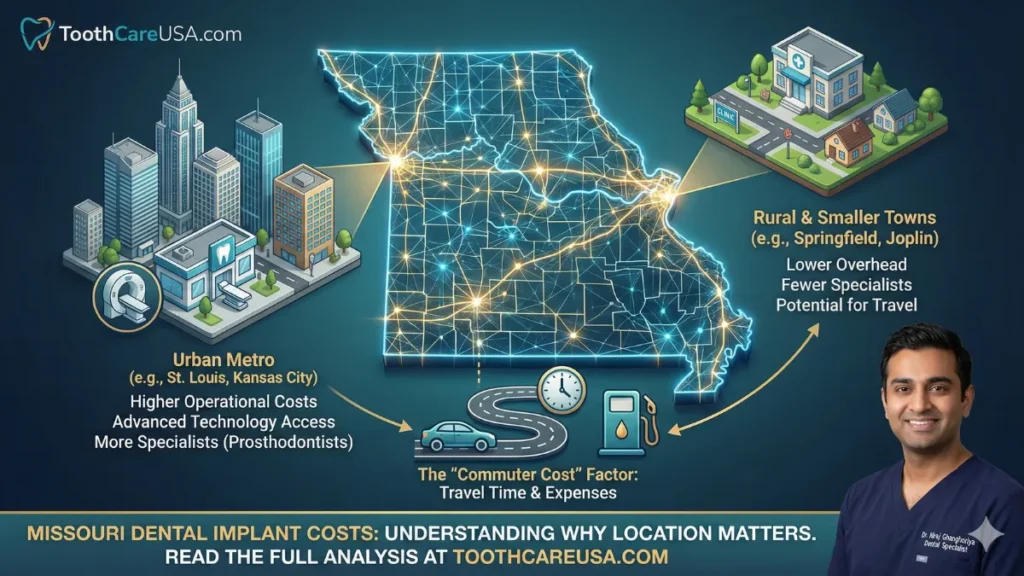
Real estate and operational costs dictate medical fees. In Missouri, your zip code influences your quote.
Urban vs. Rural Pricing
- St. Louis & Kansas City: High rent and salary costs for staff mean higher fees. However, these cities have the highest concentration of Board-Certified Prosthodontists and Oral Surgeons.
- Springfield, Joplin, Cape Girardeau: Prices here are often moderate. You might save $2,000–$4,000 per arch compared to the big cities.
- Rural Private Practice: Some general dentists in rural MO place implants. While the cost might be lower, ensure they have the volume of experience. Placing 50 implants a year is very different from placing 500.
The “Commuter” Cost
I often see patients drive 3-4 hours to save money on surgery. But remember, this isn’t a one-visit procedure.
- Consultation & Scan.
- Surgery Day.
- 1-Week Post-Op (Suture removal/Check).
- 3-Month Check (Osseointegration verify).
- Wax Try-in (Checking the look of new teeth).
- Final Delivery.
If you drive 4 hours each way for 6 visits, that is 48 hours of driving and hundreds of dollars in gas/lodging. That “savings” evaporates quickly.
Specialist Availability
Complex cases—such as those with severe Alveolar Bone Resorption (bone loss)—often require Sinus Augmentation (raising the sinus floor to make room for bone). These procedures are delicate and are best handled by specialists who are mostly found in larger population centers.
Financing Your Smile: Options for Missouri Residents
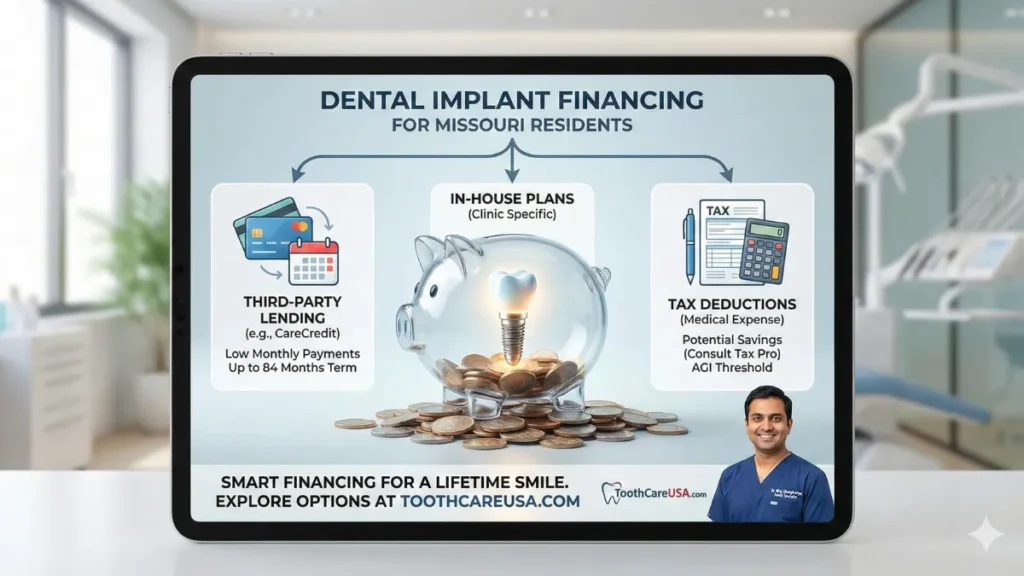
Since insurance is rarely a savior here, how do people afford this?
Third-Party Lending
Most of my patients use healthcare financing companies like CareCredit, Proceed Finance, or LendingClub.
- Terms: These lenders offer loans specifically for medical/dental work, with terms extending up to 84 months (7 years).
- Monthly Payment Plan: This can bring a $25,000 procedure down to a manageable $300–$500 monthly payment, similar to a car payment.
- Interest: Be aware that interest rates vary based on your credit score.
In-House Dental Plans
Some private practices in Missouri offer membership plans. You pay a yearly fee and get a percentage off major procedures. If you don’t have insurance, ask the clinic manager if they offer a “cash discount” for paying the surgical fee upfront, as this saves them credit card processing fees.
Tax Deductions
Here is a financial tip: Dental implants are considered a tax-deductible medical expense if your total medical expenses exceed 7.5% of your adjusted gross income. For a $40,000 procedure, this is highly likely. Always consult a Missouri tax professional, but this can result in significant savings at tax time.
The Procedure: What Happens on Surgery Day?
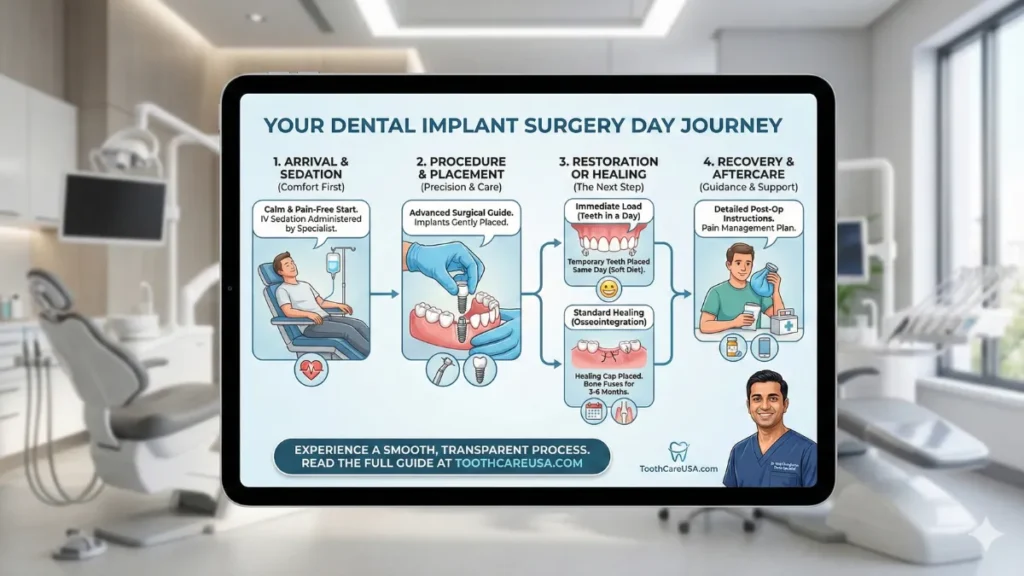
Fear of pain is just as big a barrier as cost. Let’s walk through the “How.”
The Timeline
- Sedation: We administer IV sedation. You drift off and won’t care about what’s happening.
- Extractions & Leveling: We remove bad teeth and smooth the bone.
- Placement: The titanium posts are inserted into the jawbone.
- Loading: In “Teeth in a Day” protocols, we immediately attach a temporary set of teeth.
Immediate Load (“Teeth in a Day”)
Can you really eat right away? Technically, yes, but we put you on a “soft diet” (nothing harder than a scrambled egg) for 4 months. Why? Because of Osseointegration. The bone needs to fuse to the titanium. If you chew a steak too early, the micro-movement can loosen the implant, causing it to fail. We need to achieve a “primary stability” torque value of at least 35Ncm to attach teeth the same day. If the bone is too soft, you might wear a healing denture for a few months instead.
Pain Management
I am always honest: You will be sore. It is surgery. However, most patients report that the pain is less than a severe toothache. We manage this with a combination of NSAIDs (Ibuprofen), Tylenol, and sometimes a short course of stronger pain relievers for the first 2-3 days. Swelling and bruising are normal and peak around day 3.
Risks & Recovery: What No One Tells You About Cheap Implants
This section is the “What If”—the reality check.
The “Bait and Switch”
If you see a billboard for “$399 Implants,” run. This price is usually for the screw only. By the time they add the abutment (connector), the crown (tooth), the scan, and the surgery fee, the price is standard or higher.
Biologic Complications
A major risk is Peri-implantitis. This is like gum disease, but for implants. It causes inflammation and bone loss around the screw. It is often caused by:
- Poor oral hygiene (you still have to brush!).
- Cheap implants with poor surface technology.
- Excess cement left below the gumline (which is why screw-retained teeth are safer).
The Cost of Revision
Repairing a botched implant job is a nightmare. We often have to trephine (drill out) the old implant, graft new bone, wait 6 months, and start over. The cost of revision is often double the original price. It is always cheaper to do it right the first time.
Critical Comparison Table: Full Mouth Implants vs. Traditional Dentures
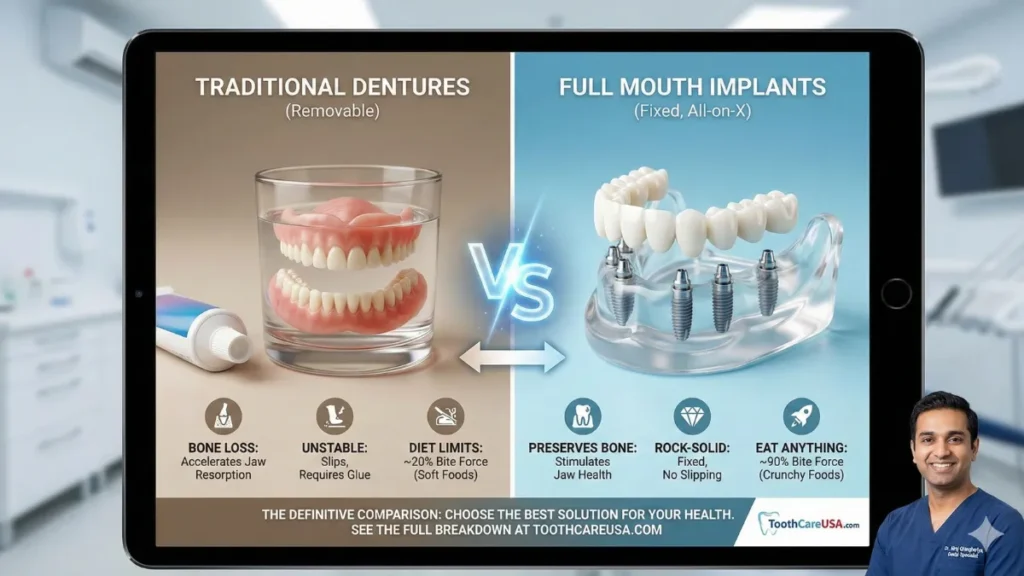
| Feature | Traditional Dentures | Full Mouth Implants (All-on-4/6) |
| Average Cost (Missouri) | $1,500 – $3,000 per arch | $20,000 – $30,000 per arch |
| Bone Health | Accelerates bone loss (facial collapse) | Preserves bone (stimulates jaw) |
| Bite Force | ~20% of natural bite | ~90% of natural bite |
| Stability | Slips, requires adhesive glue | Fixed, does not move |
| Palate Coverage | Covers the roof of mouth (loss of taste) | Open palate (full taste sensation) |
| Maintenance | Reline every 2-3 years, replace every 5-7 | Daily brushing/flossing, yearly checkup |
| Longevity | 5 – 10 years | 20+ years (often lifetime) |
Infographic on Cost of Full Mouth Dental Implants in Missouri
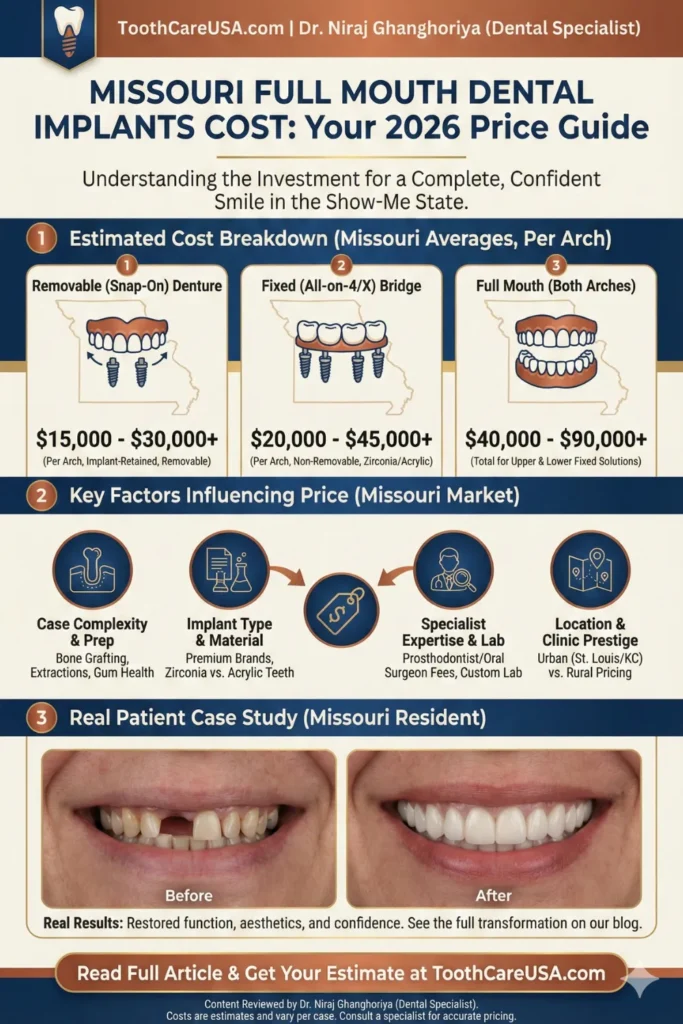
Full Mouth Reconstruction Costs in Missouri
For patients in Missouri facing the loss of all their teeth, full mouth dental implants (often called All-on-4 or All-on-6) offer a permanent solution superior to traditional dentures. Our infographic breaks down the investment, which generally ranges from $20,000 to $35,000 per arch in the Missouri market.
This cost reflects a complete transformation: the extraction of remaining failing teeth, the placement of 4 to 6 titanium implants, and the attachment of a fixed, non-removable bridge. In cities like St. Louis and Kansas City, competition among specialists helps keep prices fair, though costs are driven by the material of the final bridge—acrylic (lower cost) versus zirconia (higher cost but more durable).
It is a significant financial decision, but one that restores 90% of chewing ability compared to the 20% offered by traditional dentures. This improves nutrition and overall health. At ToothCareUSA.com, we recommend Missouri patients view this as a medical necessity rather than cosmetic. Many practices offer “phased treatment” plans or third-party financing to help manage the costs of this comprehensive restoration.

Dr. Niraj Ghanghoriya’s Verdict
As a specialist, here is my direct clinical advice on the cost of full mouth dental implants in Missouri:
Who is this for?
This investment is for the patient who is tired of the “cycle of dentistry”—patching one tooth after another only to lose them anyway. It is for the person who feels their quality of life, nutrition, and confidence are suffering. If you have significant bone loss or terminal dentition (teeth that cannot be saved), this is the standard of care to restore function.
Who should avoid this?
If you are currently a heavy smoker or have uncontrolled diabetes, I may refuse to perform surgery until these are managed. Smoking constricts blood vessels and drastically increases the failure rate. I would rather you keep your money than spend $40,000 on implants that fall out in two years because the gums couldn’t heal.
My Final Advice:
Do not shop for surgery as you shop for a TV. You are buying the surgeon’s hands and the lab’s artistry. In Missouri, finding a provider who is transparent about the “all-in” cost—without hidden fees—is your first step toward a safe, permanent smile.
Conclusion & Next Steps
The cost of full mouth dental implants in Missouri is high, but so is the impact on your health. By understanding the breakdown of surgical fees, lab costs, and the importance of high-quality materials like Zirconia, you can make an informed decision that protects both your wallet and your health.
- Implants stop bone loss.
- Cheaper isn’t better; it’s riskier.
- Financing makes the cost manageable.
Next Step: Are you ready to see exactly what your specific case requires? Consult a specialist for personal guidance. A 3D scan is the only way to get a truly accurate quote.
References & Further Reading
- American Academy of Periodontology (AAP): Peri-implantitis and the importance of maintenance.
- Journal of Oral and Maxillofacial Surgery: Long-term success rates of All-on-4 treatment concepts.
- PubMed / NIH: Comparative analysis of Zirconia vs. Acrylic prostheses in full arch rehabilitation.
- American Dental Association (ADA): Patient resources on dental implants and insurance codes.
Frequently Asked Questions (FAQ) on Cost of Full Mouth Dental Implants in Missouri
What is the average cost of full mouth dental implants in Missouri for 2026?
In Missouri, the cost of full mouth dental implants typically ranges from $25,000 to $50,000 for a full upper and lower set. Prices in St. Louis and Kansas City may reach the higher end due to specialist overhead, while clinics in Springfield or Columbia often offer competitive rates starting around $20,000 per arch.
Dr. Niraj’s Take: “When comparing quotes in MO, ensure they include the ‘final’ restoration—some teaser rates only cover the surgical placement, not the teeth you’ll actually eat with.”
Does Missouri Medicaid (MO HealthNet) cover full mouth dental implants?
MO HealthNet generally does not cover the cost of full mouth dental implants for adults, as they are classified as elective. Coverage is strictly limited to restorative services like extractions or dentures unless the patient is under 21 or has a documented medical trauma that makes implants the only viable reconstructive path.
Dr. Niraj’s Take: “While Medicaid won’t pay for the implants, we can often use your benefits to cover the tooth removals and gum treatment, which can save you $1,500+ on the total project.”
Where can I find affordable full-mouth dental implants in Missouri?
The University of Missouri-Kansas City (UMKC) School of Dentistry offers dental implant services at rates 30% to 50% lower than private practices. Since procedures are performed by residents under expert faculty supervision, the cost is significantly reduced, though the process often requires more appointments than a traditional clinic.
Dr. Niraj’s Take: “If you have a flexible schedule, UMKC is the best way to get university-level precision in Missouri at a price that fits a tighter budget.”
Are there financing plans for full mouth dental implants in Missouri?
Most Missouri dental offices offer third-party financing through CareCredit, LendingClub, or Cherry to manage the cost of full mouth dental implants. Many patients qualify for 0% interest plans for the first 12–24 months, allowing them to pay for their restoration in monthly installments rather than a single lump sum.
Dr. Niraj’s Take: “Think of it like a car payment—it’s much easier to manage $400 a month for 48 months than to come up with $30,000 on day one.”
Is the cost of full mouth implants in Missouri worth it vs. dentures?
Yes, because while traditional dentures are cheaper upfront, they accelerate jawbone loss, leading to facial sagging and frequent replacements every 5 years. Full mouth implants are a permanent solution (25+ years) that preserves your bone structure, making them the most cost-effective long-term investment for your health and appearance.
Dr. Niraj’s Take: “Dentures are a temporary fix; implants are a life-changing restoration that pays for itself by preventing future dental emergencies and bone grafts.”
Medical Disclaimer: The content provided on ToothCareUSA.com, including text, graphics, and images, is for informational purposes only. It is not intended to be a substitute for professional medical advice, diagnosis, or treatment. Always seek the advice of your dentist or other qualified health provider with any questions you may have regarding a medical condition.

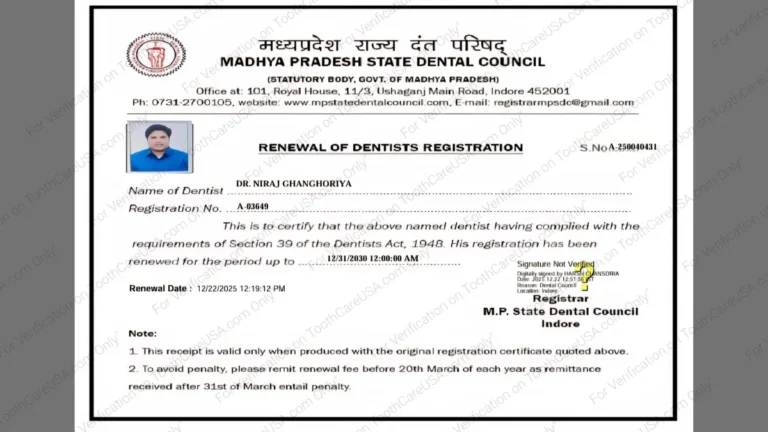
Dr. Niraj Ghanghoriya is a passionate dental surgeon with over 12 years of experience in clinical dentistry. He completed his BDS from the prestigious Sri Aurobindo Institute of Dentistry in 2012 and specializes in painless root canals, smile makeovers, and preventive oral care. He is the Founder of ToothCareUSA.com and a registered Dental Surgeon (Reg No: A-03649) based in Indore. Known for his patient-first approach and clear communication, Dr. Ghanghoriya aims to make dental knowledge accessible to everyone. When he’s not in the clinic, he enjoys writing informative dental blogs to help people take better care of their oral health. He reviews every article on this site to ensure medical accuracy and patient safety.