Author: Dr. Niraj Ghanghoriya (Dental Specialist)
Note: This detailed guide is for educational purposes only. See full medical disclaimer below.
The Quick Answer for How Much Does a Dental Implant Cost Without Insurance
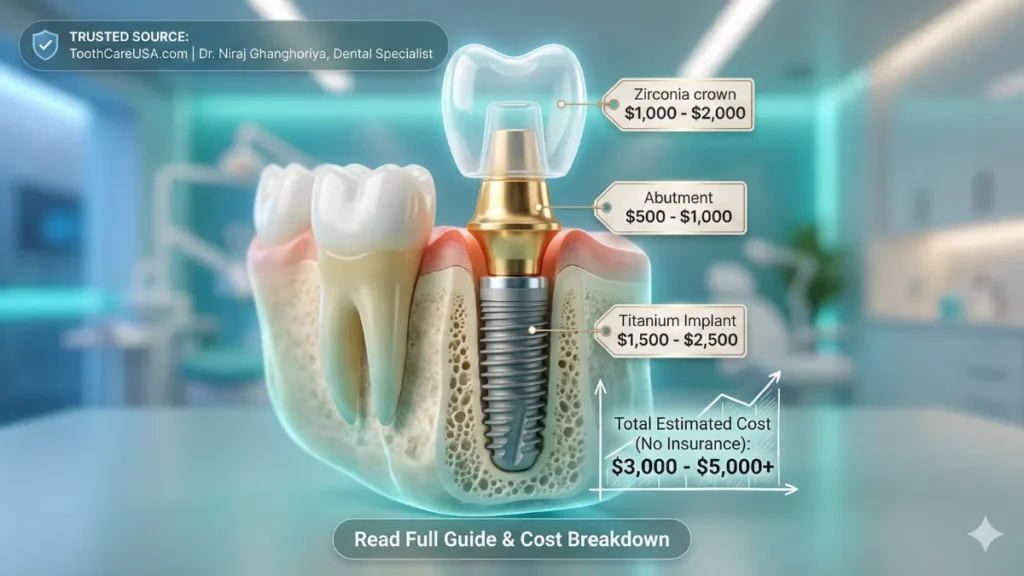
For a single tooth, the total cost of a dental implant without insurance typically ranges from $3,000 to $5,000. This “all-in” price includes the surgical placement of the implant body, the abutment (connector), and the final crown. However, if you have suffered bone loss, necessary preparatory procedures like bone grafting ($400–$800) or sinus lifts ($1,500–$3,000) will increase the final bill.
Introduction: The “Bargain Implant” Trap
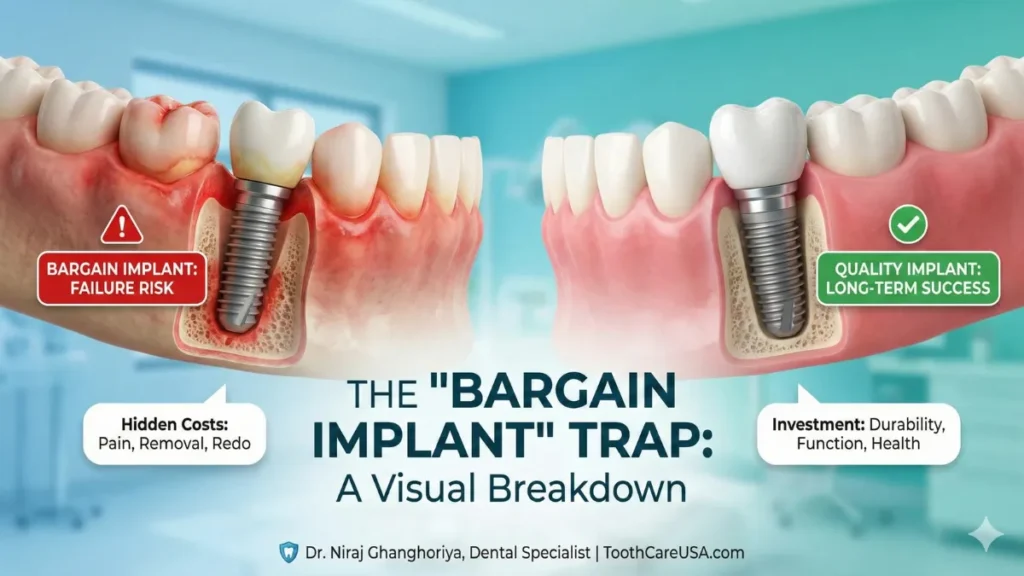
If you are currently scrolling through Google searching for “cheapest dental implants near me,” I need you to pause.
In my years of clinical experience at ToothCareUSA, I have found that the most expensive dental procedure a patient can undergo is not a dental implant—it is fixing a cheap one.
I see this scenario far too often in my consultation chair: A patient arrives in severe pain. Two years prior, they found a “bargain” deal online—perhaps a $999 implant special. Now, the gum tissue is red and swollen, the screw is loose, and they are unable to chew. Because the previous provider used substandard materials to cut costs, the bone failed to fuse to the metal. We are forced to remove the failing implant, graft new bone, wait months for healing, and start the entire process over.
That “bargain” ended up costing double the standard price, plus months of unnecessary physical pain and emotional stress.
When patients ask me about the price, I tell them the unvarnished truth: An implant isn’t just a screw; it is a sophisticated medical device designed to replace a living body part for the rest of your life.
Cost is a huge factor, and I understand the “sticker shock” families feel when they see the estimate. But understanding what you are paying for—and where it is safe to save money versus where it is dangerous—is critical for your long-term health. Here is the honest, transparent anatomy of your dental bill.
The Anatomy of Your Bill: Why is it So Expensive?
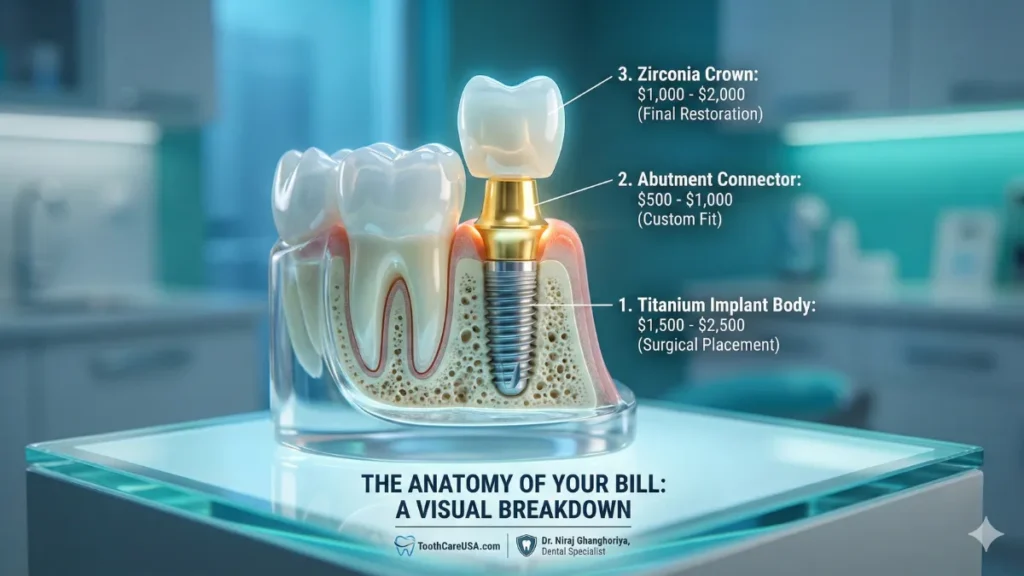
To the naked eye, a dental implant looks like a simple fake tooth. But biologically, it is a complex engineering system that requires surgical precision to function like a natural organ. When you receive a quote for $4,000, you are not paying for a single plastic item; you are paying for three distinct medical components, the sterilization of a surgical suite, and the specialized labor to place them safely near your nerves and sinuses.
Here is exactly where your money goes, broken down by component:
1. The Implant Body ($1,500 – $2,500)
This is the “root” of the new tooth. It is a threaded screw, usually made of medical-grade Titanium or Zirconia, that is surgically placed into your jawbone.
- The Clinical Reality: We pay a premium for top-tier implant brands (like Nobel Biocare, Straumann, or BioHorizons) because they have decades of research backing their Osseointegration rates. Osseointegration is the critical biological process where your living bone cells grow into the microscopic pores of the implant surface, locking it in place.
- Why Cost Matters: Cheaper, “clone” implants often have poor surface treatments. If the surface isn’t scientifically perfected, the bone cells may not attach, leading to mobility and eventual failure.
2. The Abutment ($500 – $1,000)
The abutment is the critical connector piece. It screws into the hollow center of the implant body and protrudes through your gums to hold the crown.
- Stock vs. Custom: A “stock” abutment is a one-size-fits-all factory part. A “custom” abutment is widely preferred (and slightly more expensive) because it is laser-milled to fit the unique “cuff” shape of your gum line.
- Why It Matters: A custom fit prevents food from getting trapped under the gum line. Food impaction is the leading cause of Peri-implantitis (destructive inflammation around the implant), which can destroy the bone holding your implant.
3. The Crown ($1,000 – $2,000)
This is the visible part—the white tooth that you chew with and smile with.
- Material Matters: In modern dentistry, we often use Monolithic Zirconia. It is incredibly strong and resistant to chipping, unlike older porcelain-fused-to-metal (PFM) crowns, which can look opaque or show a dark metal line near the gums over time.
- The Lab Fee: A master ceramist designs this tooth to match the color, shape, and translucency of your neighboring teeth. You are paying for artistry, ensuring your new tooth doesn’t look like a “Chicklet.”
“Can I Pay Monthly?” – The Phased Payment Reality
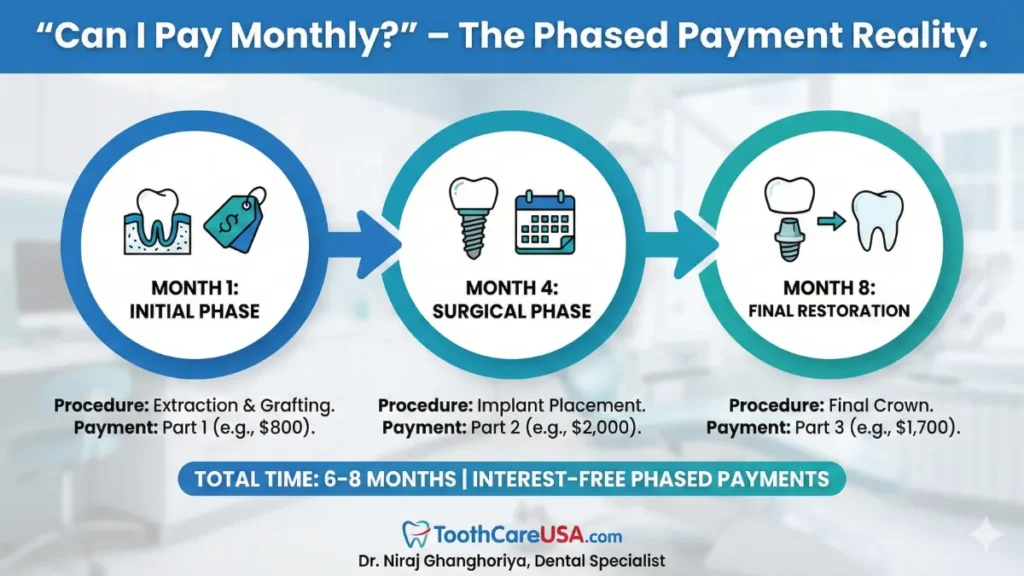
This is the most important financial secret that competitors rarely explain to uninsured patients: You almost never pay the full $5,000 on Day 1.
A safe, successful dental implant procedure is not a single event; it is a biological journey that spans 4 to 8 months. This timeline works in your favor financially. Because you pay for each stage as it happens, the process naturally creates an interest-free payment plan.
Here is how the “Pay-As-You-Go” timeline typically looks for my patients:
Phase 1: The Foundation (Day 1)
- Procedure: We remove the failing tooth (Extraction) and pack the socket with bone grafting material to keep the jaw architecture strong.
- Your Cost: You only pay for the extraction and graft ($300 – $800).
- The Wait: We wait 3-4 months for the bone to heal and harden.
Phase 2: The Surgery (Month 4)
- Procedure: I surgically place the titanium implant into the bone. This involves numbing the area, creating a small incision, and precisely drilling a pilot hole.
- Your Cost: You pay for the implant body and the surgical fee ($1,500 – $2,500).
- The Wait: We wait another 3-4 months for osseointegration.
Phase 3: The Restoration (Month 8)
- Procedure: We uncover the implant top, attach the abutment, and cement the final crown.
- Your Cost: You pay the remaining balance for the crown and abutment ($1,500 – $2,000).
By spreading the cost over nearly a year, the monthly impact on your family budget is far less drastic than the total sum suggests.
Hidden Variables: What Else Can Increase the Price?
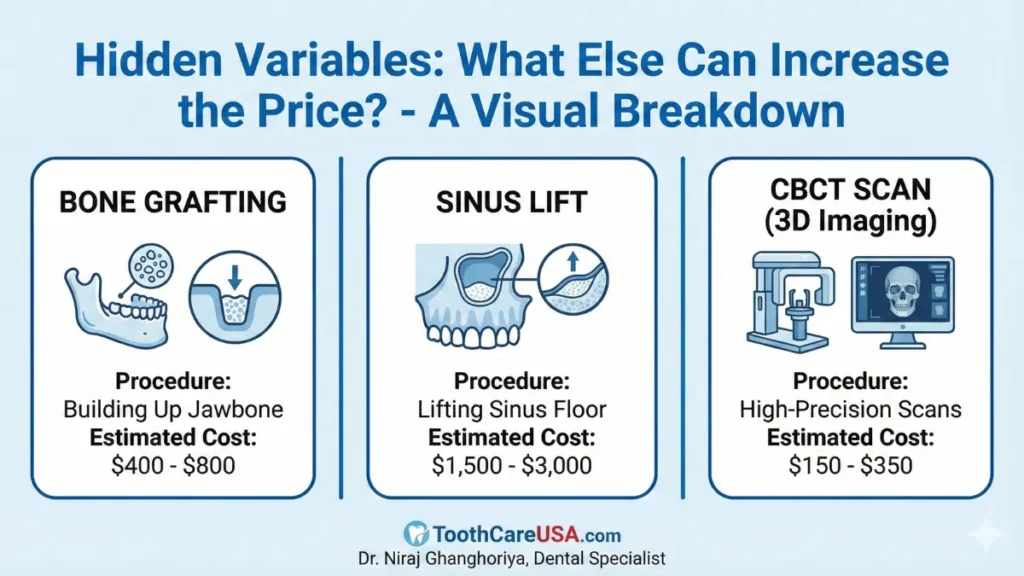
About 50% of the patients I see at ToothCareUSA cannot just “get an implant” immediately. Biology gets in the way. If you have been missing a tooth for a long time, or if you had a severe infection, your jawbone may have shrunk.
Ignoring these issues to save money is a recipe for failure. Here are the clinical necessities that might appear on your treatment plan, which you need to budget for.
1. Bone Grafting & Alveolar Ridge Preservation
- The Cost: $400 – $800
- The Clinical “Why”: When a tooth is pulled, the surrounding bone (the Alveolar Ridge) no longer receives stimulation from chewing pressure. As a result, the body reabsorbs that bone—a process called Resorption. If we don’t pack the socket with grafting material at the time of extraction, the bone can shrink by 40-60% within the first year. We simply cannot place an implant into thin air; it needs solid ground.
- Types of Grafts:
- Autograft: Your own bone (Gold standard, but requires a second surgical site).
- Allograft: Sterilized donor bone (Most common, safe, and effective).
- Xenograft: Bovine (cow) bone mineral (excellent for maintaining volume).
2. Sinus Augmentation (Sinus Lift)
- The Cost: $1,500 – $3,000
- The Clinical “Why”: Your maxillary sinuses are air-filled pockets above your upper back teeth. Over time, these sinuses can expand and drop down, leaving a paper-thin layer of bone between your mouth and your sinus cavity. To place an implant here, we must gently lift the sinus membrane and pack bone underneath it. It is a delicate, advanced procedure that requires high surgical skill to avoid puncturing the membrane.
3. CBCT Scan (3D Imaging)
- The Cost: $150 – $350
- The Clinical “Why”: A standard 2D dental X-ray is not enough. It creates a flat image. A CBCT (Cone Beam Computed Tomography) scan creates a 3D model of your jaw, showing us exactly where your nerves and sinuses are.
- My Rule: I refuse to perform implant surgery without a CBCT scan. Drilling into the jaw blindly is a risk I will not take with your health. The cost of the scan is the cost of safety.
Single Tooth vs. Full Mouth (All-on-4): Understanding the Scale
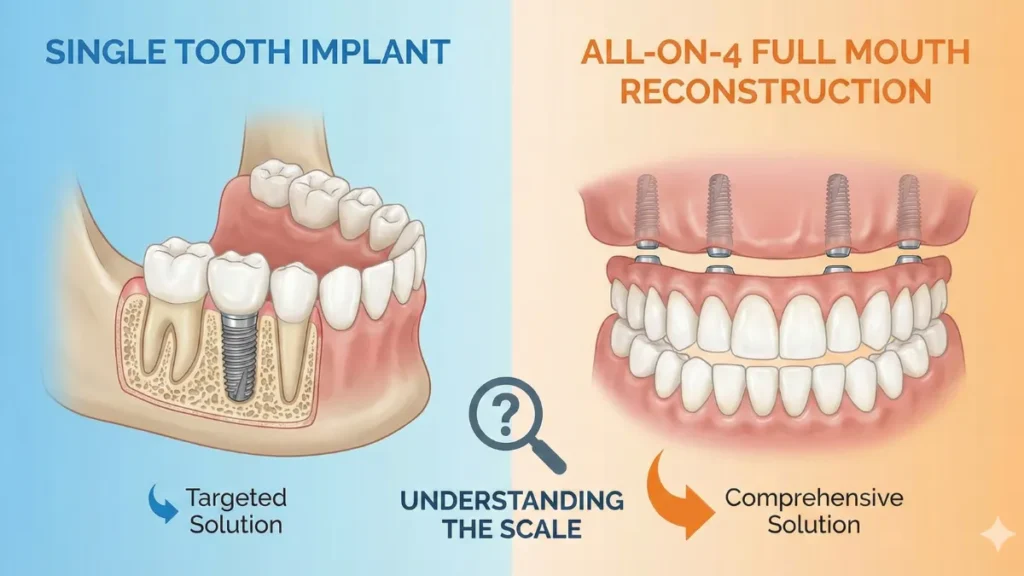
If you are missing all your teeth, or your remaining teeth are failing due to severe gum disease, you might be looking at full-mouth reconstruction options like “All-on-4” or “All-on-6.” The pricing model here is different.
All-on-4 uses four strategically placed implants to support a full arch of fixed teeth (a hybrid denture) that does not come out.
- The Economy of Scale: You are not paying $4,000 x 14 teeth ($56,000). Instead, the cost is typically $20,000 to $30,000 per jaw.
- Why the Variance? The price difference depends on the material of the final teeth.
- Acrylic (Plastic) over Titanium Bar: ~$20,000. Lighter, but teeth wear down faster.
- Full Zirconia: ~$25,000 – $30,000. Extremely durable, highly aesthetic, and resistant to stains.
The “Maintenance Tax” of All-on-4:
This is often ignored in sales pitches. While All-on-4 is a fantastic solution, these “fixed” teeth still need maintenance.
- Annual Removal: Once a year, you must visit the dentist to have the bridge unscrewed and professionally cleaned to prevent infection. This costs $200 – $500 annually.
- Repair Costs: If an acrylic tooth chips, the repair is simple. If a Zirconia bridge fractures (rare but possible), the entire arch may need replacing.
Cheap Implants vs. Brand Names: The “Orphan Implant” Risk
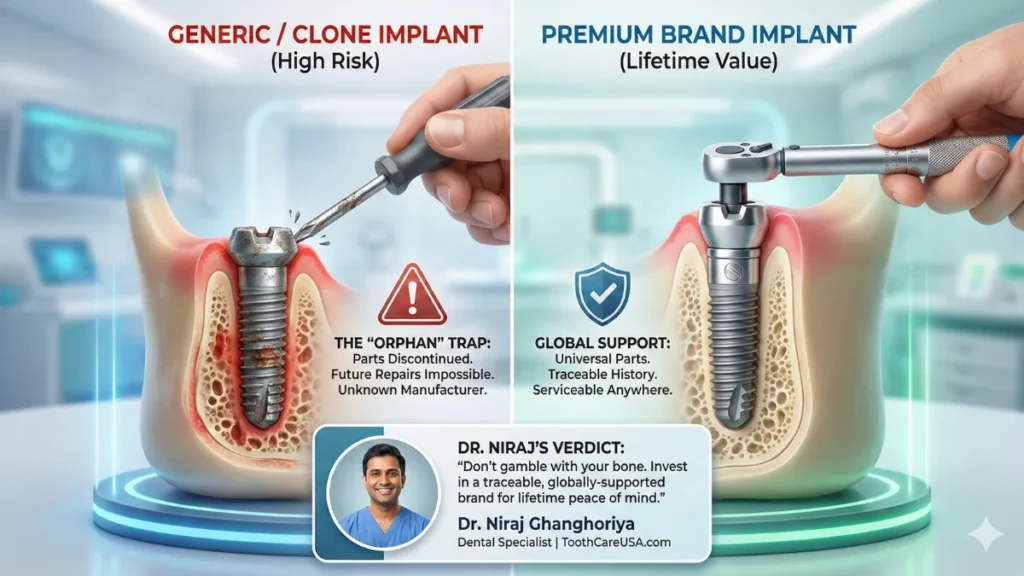
This section is vital for your long-term safety and is rarely discussed on general health blogs.
There are hundreds of implant manufacturers in the world. Some are massive, scientifically driven companies (like Nobel Biocare, Straumann, BioHorizons). Others are small “discount” manufacturers that produce clone parts to undercut the market.
If you go to a clinic offering a $999 Implant Deal, they are likely using a clone brand to cut costs.
The Danger of the “Orphan Implant”:
Imagine you get a cheap implant today. Five years from now, you move to a new city, or the small company that made your implant goes out of business. If a screw loosens or a part breaks, you will go to a new dentist for help.
That dentist will look at your X-ray and say, “I don’t know what brand this is. I don’t have the screwdriver that fits it. I can’t order parts for it.”
Your implant has become an orphan.
The Consequence: The only way to fix an orphan implant is often to drill it out of your bone—a traumatic and expensive removal (trephination)—and start all over.
Dr. Niraj’s Advice: Always ask your dentist, “What specific brand of implant are you using?” Ensure it is a major, globally recognized brand so that you can find parts for it anywhere in the world, decades from now.
Cheaper Alternatives: Are They Worth It?
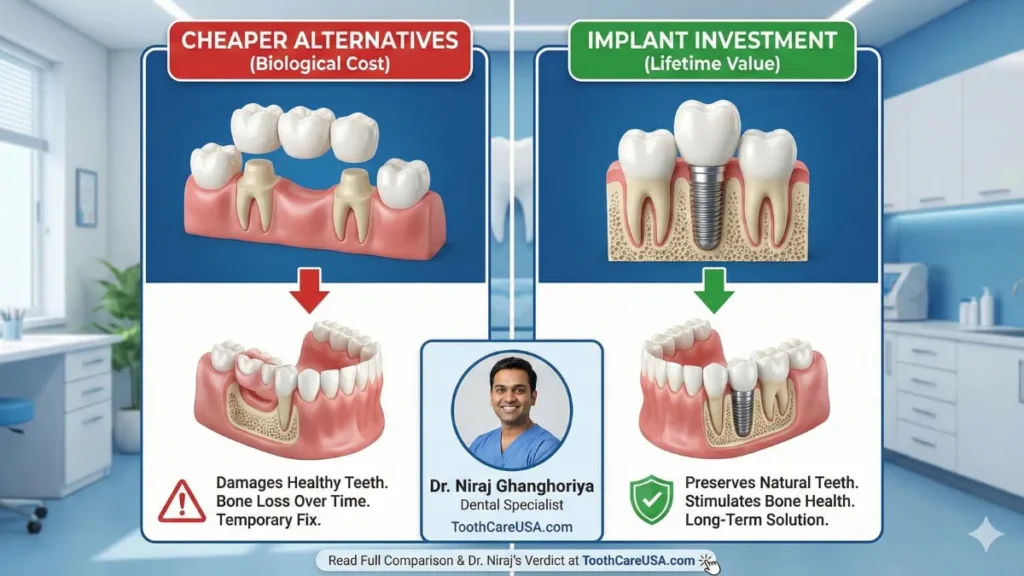
If the cost of an implant is simply out of reach, there are alternatives. However, as a specialist, I must warn you about the biological trade-offs. We call this the “Biological Cost.”
1. Dental Bridges ($2,500 – $3,500)
A bridge fills the gap by suspending a fake tooth between two crowns placed on the neighboring teeth.
- The Cons: To place a bridge, we must grind down the healthy enamel of the two neighboring teeth to stumps. This irreversibly damages healthy teeth.
- Lifespan: Bridges are harder to clean. If one of the supporting teeth gets a cavity (which is common), the entire bridge fails. The average lifespan is 10-15 years.
2. Removable Partial Dentures ($1,000 – $2,000)
A “flipper” or metal-framed denture that you take out at night.
- The Cons: It is often uncomfortable, bulky, and affects speech. Worse, it does nothing to stimulate the bone.
- The Hidden Cost: Because it rests on the gums, it accelerates Alveolar Ridge Resorption. Over time, your jawbone shrinks faster, eventually making it impossible to get implants later without massive bone grafting.
Critical Comparison Table: Implants vs. The Alternatives
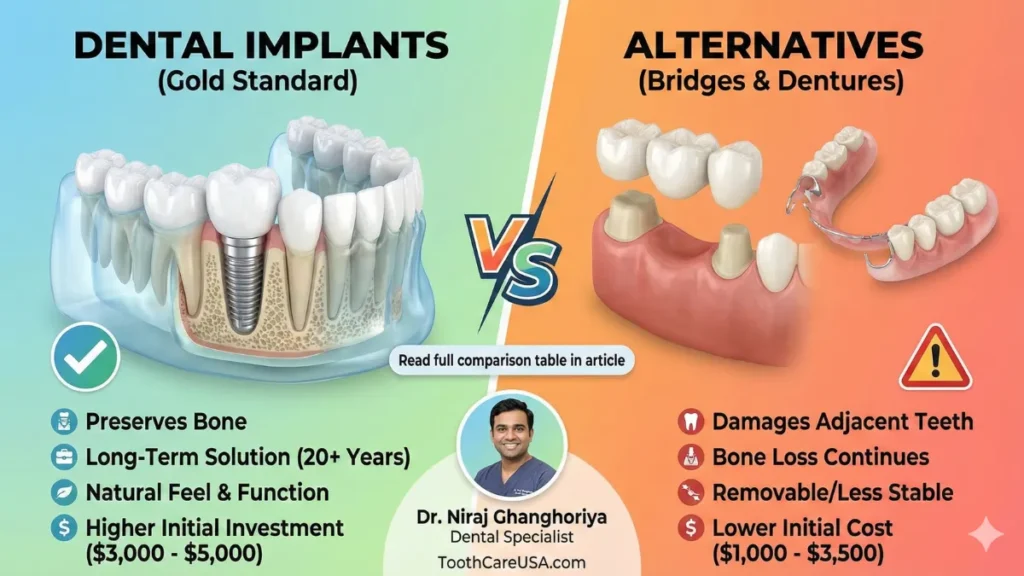
| Feature | Dental Implant | Dental Bridge | Partial Denture |
| Initial Cost (Est.) | $3,000 – $5,000 | $2,500 – $3,500 | $1,000 – $2,000 |
| Impact on Other Teeth | None (Preserves neighbors) | High (Grinds down healthy teeth) | Moderate (Clasps can torque teeth) |
| Bone Health | Excellent (Stimulates bone) | Poor (Bone continues to shrink) | Very Poor (Accelerates bone loss) |
| Comfort & Function | Feels like a natural tooth | Linked teeth make flossing hard | Can move/slip while eating |
| Long-Term Value | Lifetime potential | Replace every 10-15 years | Replace every 5-7 years |
| Risk Factor | Surgical infection (rare) | Decay under the caps | Gum irritation and bone loss |
Why Insurance Often Denies Implants (The “LEAT” Clause)
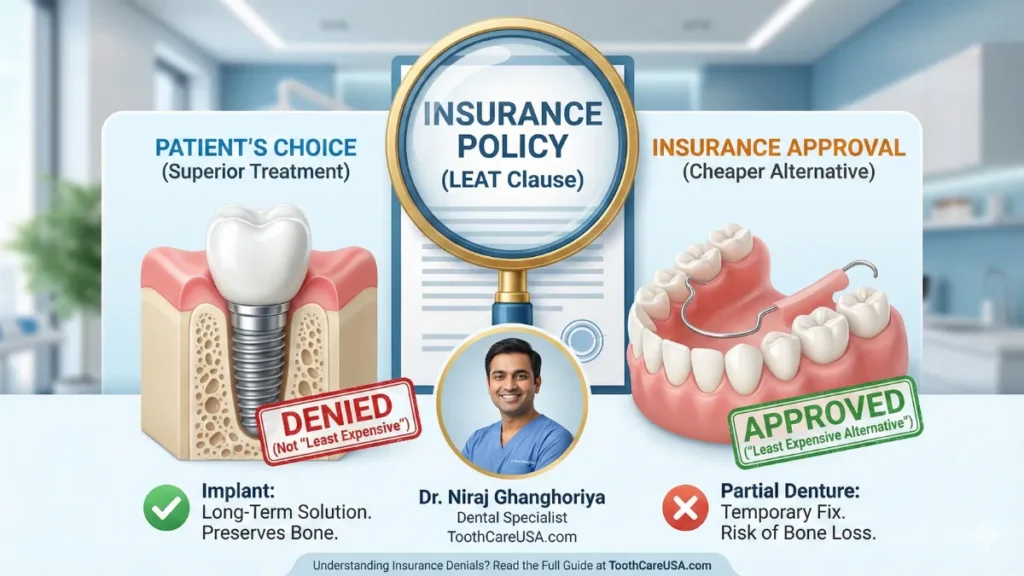
Patients often ask, “Why won’t my insurance cover this?”
The answer lies in a clause called LEAT: Least Expensive Alternative Treatment.
Most dental insurance plans classify implants as “cosmetic” or “elective” if a cheaper option exists. If a partial denture (costing $1,500) can technically fill the gap, the insurance company will only pay for that cheaper service, even if the implant is medically superior.
- The Exception: Some plans are starting to cover the crown portion of the implant, or a percentage of the total fee. Always ask your dental office to run a “Pre-Authorization” to see exactly what they will pay.
Dr. Niraj Ghanghoriya’s Verdict: How Much Does a Dental Implant Cost Without Insurance
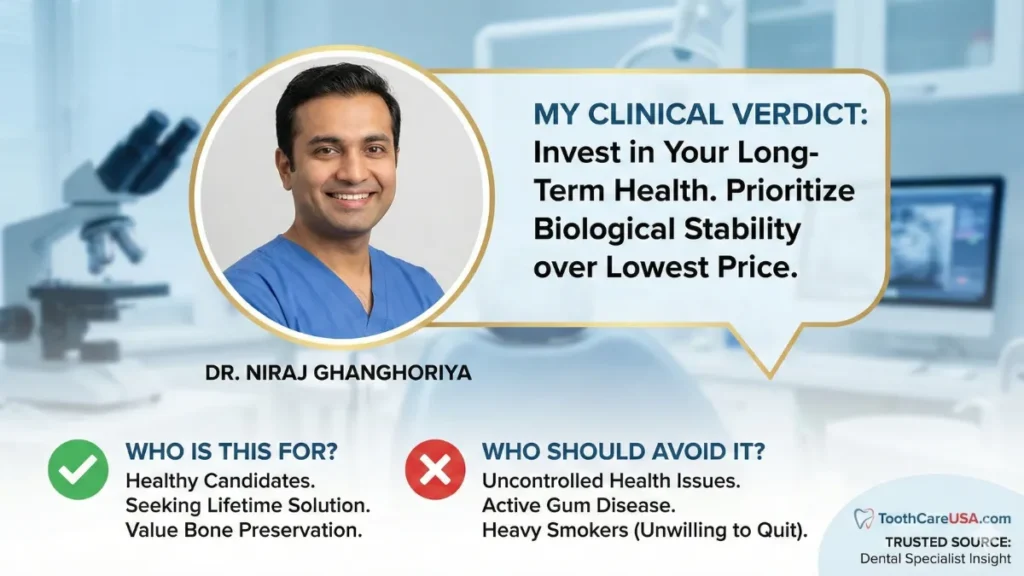
As a clinician, I treat patients, not price tags. However, I know that budget is a reality for families. Here is my direct professional advice:
Who is this for?
If you are a healthy candidate with a missing tooth, find a way to get the implant. It is the only option that preserves your jawbone and protects your neighboring teeth. Even if it takes you a year to pay it off, the 30+ years of function you get in return make it the smartest medical investment you can make. It is not just about looks; it is about keeping your jawbone alive.
Who should avoid it?
If you have uncontrolled diabetes (A1C > 7.5), are a heavy smoker who refuses to quit, or have active gum disease (Periodontitis), do not get an implant yet. Implants in these environments have a high failure rate. We must stabilize your health first. Spending $4,000 on an implant that falls out in two years is a tragedy we must avoid.
My final word on price:
Do not shop for the lowest number. In dentistry, you are not buying a toaster; you are buying the surgeon’s hands, their judgment, and their sterility protocols. If a quote seems too low, they are cutting a corner somewhere. Usually, that corner is your safety.
Conclusion & Next Steps
The cost of a dental implant without insurance is high—typically $3,000 to $5,000—but it is an investment in your long-term health, confidence, and ability to eat the foods you love.
Key Takeaways:
- Safety First: Avoid “bargain” implants (under $1,500) that risk using “orphan” parts.
- Split the Bill: Leverage the 4-8 month healing timeline to spread out your payments.
- Check the Extras: Always ask if the quote includes the abutment, crown, and necessary scans.
- Bone Health: Understand that ignoring the gap leads to bone loss, which costs more to fix later.
What should you do next?
Stop guessing at prices online. Every jaw is unique. I recommend scheduling a consultation with a specialist who uses 3D imaging (CBCT). Ask for a detailed, itemized treatment plan so you can see exactly what is required.
If you are unsure about a quote you have received, or if you want a second opinion on a treatment plan, please reach out. We are here to help you navigate these decisions with clarity and confidence.
References & Further Reading
- American Academy of Periodontology (AAP): Dental Implants: Procedures and Outcomes.
- Journal of Oral Implantology: Long-term survival rates of titanium dental implants and cost-benefit analysis.
- PubMed / NIH: Alveolar ridge preservation techniques and cost-effectiveness analysis.
- American Dental Association (ADA): Patient Guide to Dental Implants and Costs.
- https://toothcareusa.com/dental-implant-cost-chicago/International Journal of Oral & Maxillofacial Implants: The economic impact of maintenance therapy for dental implants.
Frequently Asked Questions about How Much Does a Dental Implant Cost Without Insurance
How much does a single dental implant cost without insurance in 2026?
The average total cost for a single dental implant without insurance ranges from $3,000 to $5,000. This price typically includes the surgical placement of the titanium post, the abutment connector, and the final porcelain crown. However, additional procedures like bone grafting can add $400–$800 to the final bill.
Dr. Niraj’s Take: “I always advise patients to ask for an ‘all-inclusive’ written quote to ensure the abutment and temporary crown are not billed as surprise extras.”
Can I pay for dental implants monthly if I don’t have insurance?
Yes, most dental specialists offer financing plans through third-party lenders like CareCredit or LendingClub. These services allow you to break the dental implant cost without insurance into manageable monthly payments, often with 0% interest for the first 6 to 24 months.
Dr. Niraj’s Take: “In my practice, the treatment timeline naturally splits the cost; you pay for the surgery on day one and the crown 4 months later, which helps cash flow.”
Is a dental implant worth the money compared to a cheaper dental bridge?
Yes, dental implants are considered more cost-effective long-term because they do not require grinding down healthy neighboring teeth. While a bridge has a lower upfront cost, it often needs replacement every 10–15 years, whereas a well-maintained implant can last a lifetime, offering better value.
Dr. Niraj’s Take: “I see bridges fail frequently due to decay under the caps; an implant is the only solution that preserves your jawbone density, preventing facial collapse.”
What hidden fees typically increase the price of dental implants?
The most common hidden costs are 3D CBCT scans ($150–$350), tooth extractions, and bone grafting. If you have experienced bone loss, these preparatory procedures are medically necessary for the implant to stabilize, significantly influencing the final dental implant cost without insurance.
Dr. Niraj’s Take: “Never try to save money by skipping the 3D scan; precise digital planning is non-negotiable for avoiding nerve damage during surgery.”
Does Medicare or medical insurance cover dental implants?
Generally, Medicare and standard medical insurance do not cover dental implants as they are classified as “elective” procedures. However, coverage may be available if the tooth loss is due to trauma, accident, or specific medical conditions requiring reconstructive surgery, though this is rare.
Dr. Niraj’s Take: “While medical insurance rarely pays, you can use funds from a Health Savings Account (HSA) or FSA to pay for implants with pre-tax dollars.”
Full Medical Disclaimer: The information provided in this article, including cost estimates and procedural descriptions, is for educational and informational purposes only and does not constitute medical advice, diagnosis, or treatment. Dental costs vary significantly based on geographic location, individual clinical needs, insurance coverage, and provider fees. The figures mentioned ($3,000-$5,000) are national averages and should not be taken as a guaranteed quote. Always consult with a qualified dental specialist for a professional examination and personalized treatment plan. ToothCareUSA.com assumes no liability for decisions made based on this content.

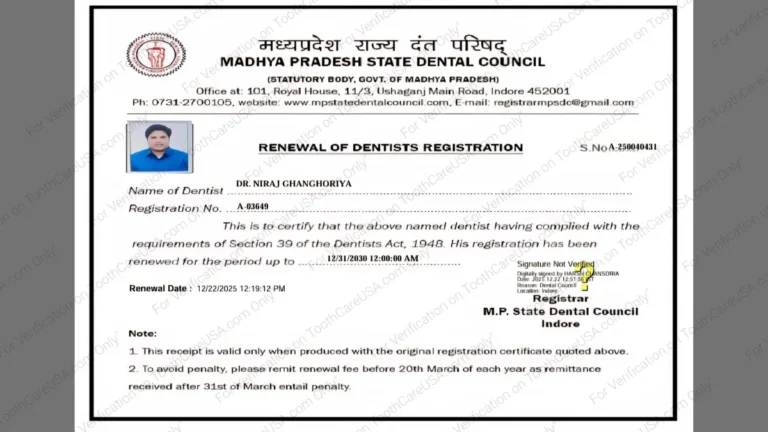
Dr. Niraj Ghanghoriya is a passionate dental surgeon with over 12 years of experience in clinical dentistry. He completed his BDS from the prestigious Sri Aurobindo Institute of Dentistry in 2012 and specializes in painless root canals, smile makeovers, and preventive oral care. He is the Founder of ToothCareUSA.com and a registered Dental Surgeon (Reg No: A-03649) based in Indore. Known for his patient-first approach and clear communication, Dr. Ghanghoriya aims to make dental knowledge accessible to everyone. When he’s not in the clinic, he enjoys writing informative dental blogs to help people take better care of their oral health. He reviews every article on this site to ensure medical accuracy and patient safety.