Author: Dr. Niraj Ghanghoriya, (Dental Specialist), Educational purposes only. See full medical disclaimer below.
Quick Answer:
The average price for a single mini dental implant ranges from $500 to $1,500 in the United States. For a full lower denture stabilization (usually 4 implants), expect to pay between $2,500 and $6,000. While significantly cheaper than traditional implants, total costs vary based on bone density, geographic location, and whether you require a new custom denture or a retrofit of your existing one.
Introduction
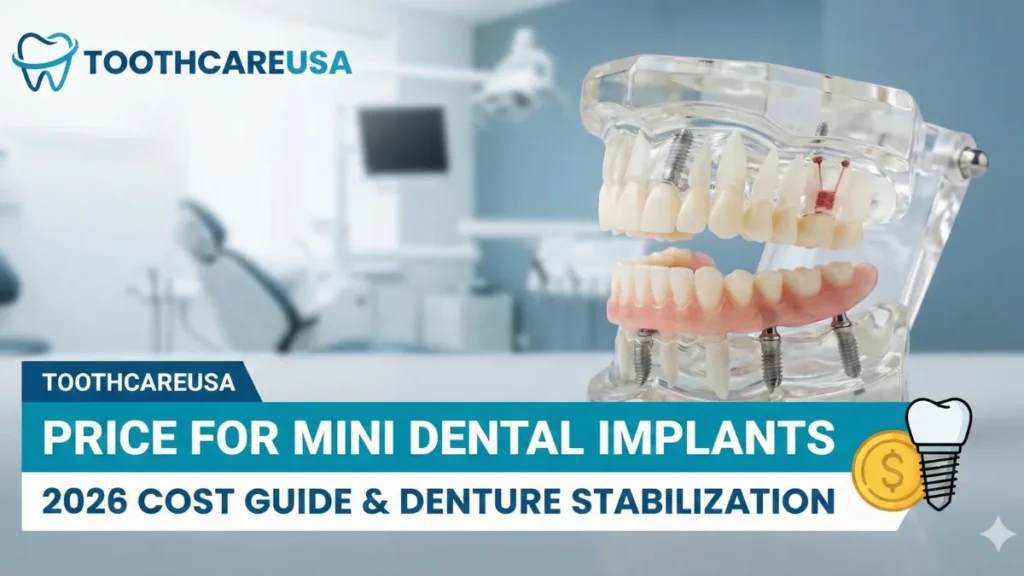
I see patients at my clinic every week who ask for mini dental implants for one reason: the lower price tag. It is true—they can be half the cost of traditional implants. But as a Dental Specialist, I sometimes have to refuse this treatment, even if it saves you money.
Why? Because a “cheap” implant that fractures under pressure isn’t a bargain—it’s a medical liability. Before we talk about the $500 to $1,500 price range, we need to talk about where in your mouth these belong.
In my clinical experience, cost is the biggest barrier to dental care. Patients are often choosing between “living with loose teeth” and “spending their retirement savings.” My goal with this guide is to be completely transparent about the price for mini dental implants, the hidden maintenance fees that most brochures won’t tell you about, and the biological reality of why paying less upfront might cost you more later.
What Are You Actually Paying For? (The Fee Structure Breakdown)
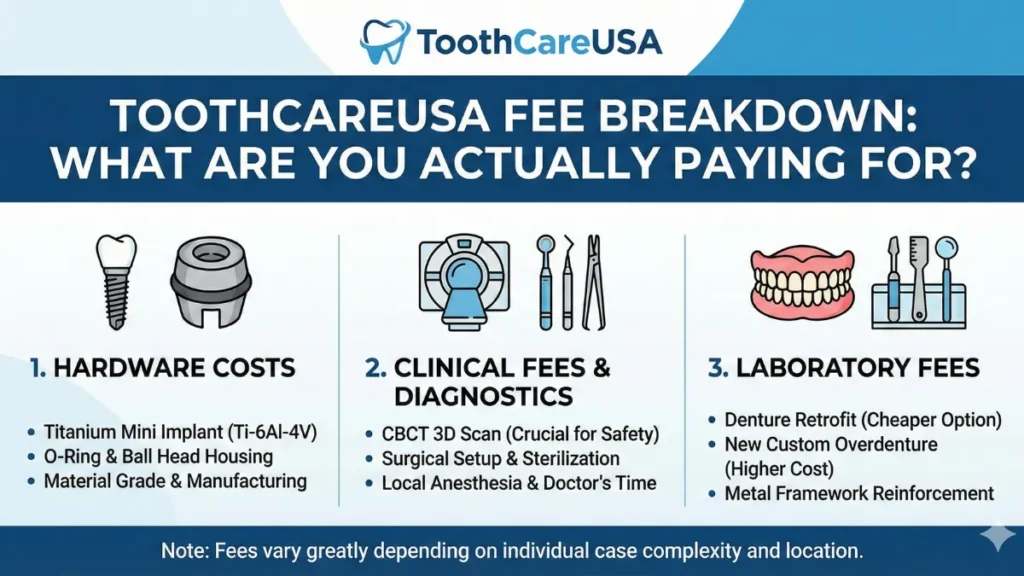
When you see a quote for a mini dental implant, it can be confusing to understand where the money is going. Unlike buying a product off a shelf, you are paying for a complex medical service. To understand the value, we have to look at the three pillars of the cost.
1. The Hardware Costs
The implant itself is made of a specific Titanium Alloy (Ti-6Al-4V). This is a medical-grade material designed to be biocompatible, meaning your body won’t reject it.
- Fixture Diameter: Mini implants are defined by their size, usually less than 3mm in diameter. Because they use less titanium than a standard implant, the material cost is lower.
- One-Piece Design: Standard implants often have two or three parts (the screw, the abutment, and the locking screw). Mini implants are usually a single solid piece with a ball-shaped head on top. This simpler manufacturing reduces the cost significantly.
2. Clinical Fees & Diagnostics
Before I even touch a dental instrument, we need to know exactly what your bone looks like.
- CBCT Scans: We often use Cone Beam Computed Tomography (3D X-rays) to map your nerves and bone width. This diagnostic step is non-negotiable for safety.
- Surgical Setup: This covers the sterilization, local anesthesia, and the surgical team’s time.
3. Laboratory Fees
This is the variable that changes the price the most.
- Retrofit: If your current denture is in good shape, we can drill holes in it and install metal housings to snap onto the implants. This is the cheaper option.
- New Overdenture: If your teeth are worn down or fit poorly, we need to fabricate a brand new denture reinforced with a metal framework. This adds a high cost to the laboratory bill.
Mini Implants vs. Traditional Implants: A Cost-Benefit Analysis
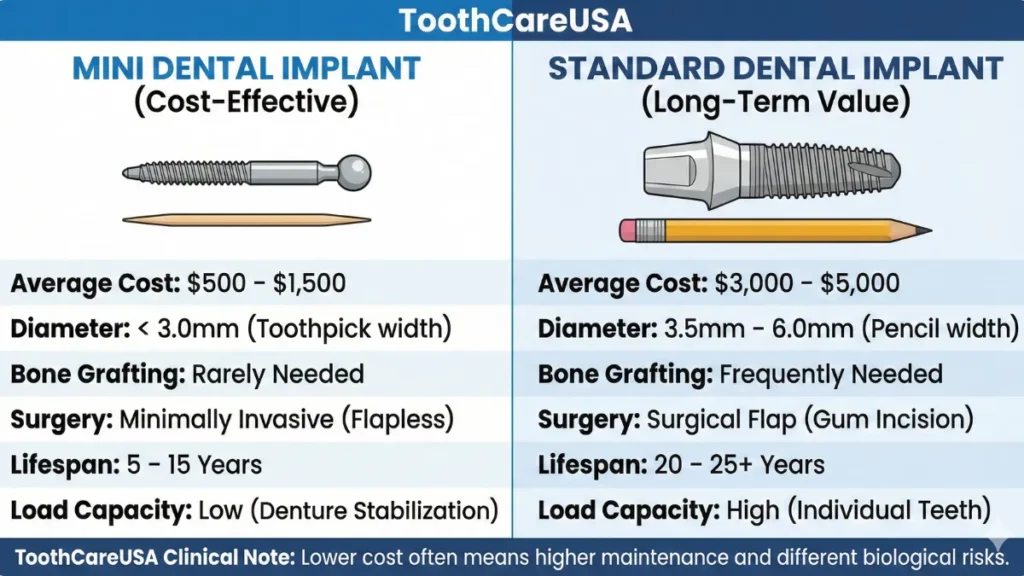
To truly evaluate the price, you have to compare it to the alternative: Standard Dental Implants.
| Feature | Mini Dental Implant | Standard Dental Implant |
| Average Cost (Per Unit) | $500 – $1,500 | $3,000 – $5,000 |
| Diameter | < 3.0mm (Toothpick width) | 3.5mm – 6.0mm (Pencil width) |
| Bone Grafting Needed? | Rarely | Frequently |
| Surgery Type | Minimally Invasive | Surgical Flap (Gum cutting) |
| Lifespan Estimate | 5 – 15 Years | 20 – 25+ Years |
| Load Capacity | Low (Denture stabilization) | High (Individual teeth) |
The “Hidden” Savings: Avoiding Bone Grafts
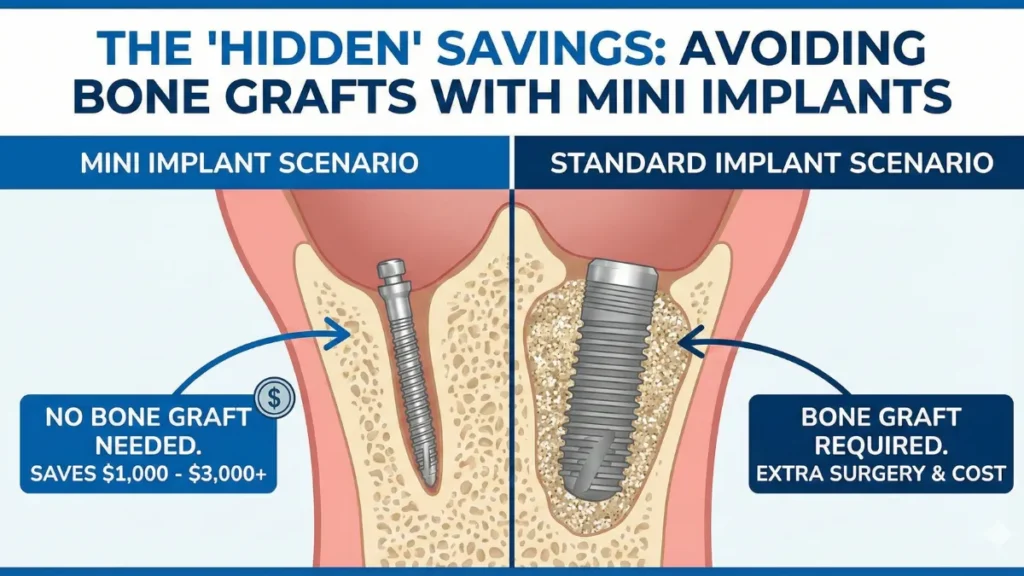
One of the biggest reasons mini implants are cheaper isn’t just the implant itself—it’s the surgeries you don’t need.
Many patients suffer from Alveolar Ridge Atrophy (severe bone loss) after missing teeth for years. To place a standard implant here, I would have to perform a bone graft or a sinus lift, which can cost an additional $1,000 to $3,000 per site.
Because mini implants are so thin, they can often be placed into this thin ridge without grafting. This saves you money on the procedure and months of healing time.
The Long-Term ROI
However, you must consider the Return on Investment (ROI). A standard implant is designed to last a lifetime. Mini implants, because they are thinner, are more prone to Fatigue Fracture (snapping) if placed in areas with high bite force. If a mini implant fails after 5 years and needs to be removed, the “savings” are lost.
How Much Does a Full Set of Mini Dental Implants Cost?
When patients ask this, they usually mean: “How much to snap my dentures in?” The price differs drastically depending on whether we are treating the upper jaw (Maxilla) or the lower jaw (Mandible).
Mandibular Stabilization (Lower Jaw)
- Typical Protocol: 4 Mini Implants.
- Estimated Cost: $2,500 – $6,000.
- Why: The lower jaw usually has very dense, strong bone (Cortical Bone). Four mini implants are usually sufficient to hold a floating lower denture steady. This is the most common and cost-effective procedure.
Maxillary Stabilization (Upper Jaw)
- Typical Protocol: 6 Mini Implants.
- Estimated Cost: $4,000 – $8,000.
- Why: The bone in the upper jaw is much softer (spongy). To ensure the implants don’t fail, we need to increase the surface area by placing more of them.
- Clinical Insight: In my practice, I rarely place fewer than six mini implants in the upper jaw. The risk of failure with only four is too high because gravity and softer bone work against us. If a dentist quotes you for only four upper minis to “save money,” be very cautious.
The “Hidden Costs” of Mini Implants: Maintenance & Repairs
This is the section most clinics won’t put on their pricing page. Mini implants utilize an O-Ring Retention System. Think of this like the rubber gasket on a jar—it creates the seal and the “snap.”
Rubber wears out.
1. The O-Ring Tax
The rubber O-rings inside your denture housing act as shock absorbers. Over time, taking your dentures in and out daily will chew up these rubber rings.
- Cost: $20 – $50 per set.
- Frequency: They typically need replacement every 6 to 12 months. If you don’t change them, the denture becomes loose, and the metal housing starts grinding directly against the implant ball, which can damage the implant head.
2. Housing Replacement
The metal cap (housing) that is glued into your denture can also loosen or break over time. Re-gluing or replacing these housings is a maintenance fee you should budget for every few years.
3. Denture Relines
Even with implants, your gum tissue changes shape over time. You will still need Denture Relines (reshaping the pink plastic base) every 2 to 3 years to ensure the denture sits evenly on your gums, not just on the implants. This typically costs $300 – $500.
Does Insurance Cover Mini Dental Implants?
This is a common question for voice search, and the answer is nuanced.
“Medically Necessary” vs. Cosmetic
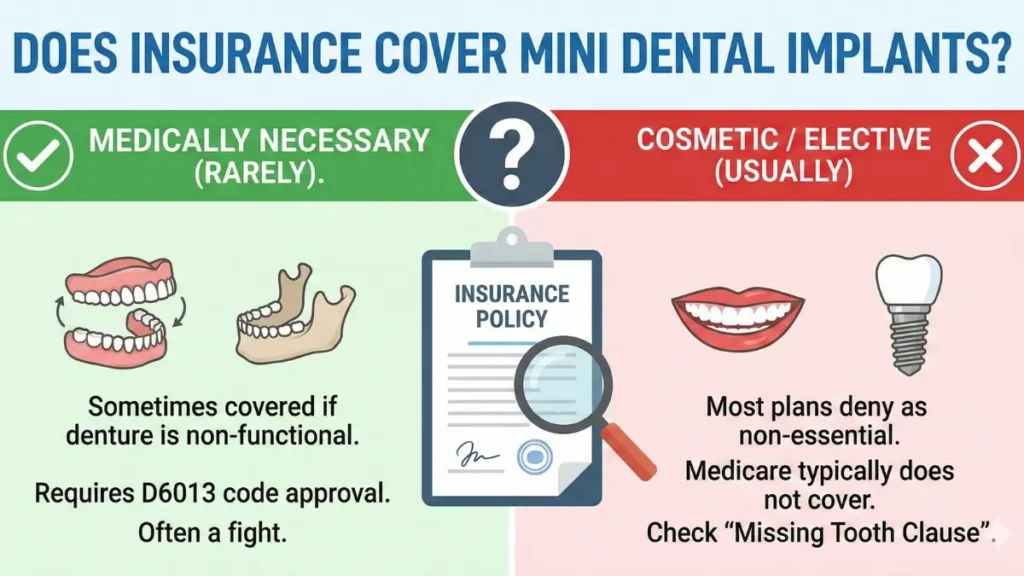
Most dental insurance plans categorize implants as “cosmetic” or “elective,” meaning they won’t cover them. However, if you are unable to eat (masticate) properly due to a loose denture, we can sometimes argue for medical necessity.
The Codes Matter
- D6010: Surgical placement of implant body (Standard).
- D6013: Surgical placement of mini implant. Some plans have a clause that specifically excludes D6013, even if they cover D6010.
The “Denture Split” Strategy
In many cases, insurance will cover 50% of the denture itself, but 0% of the implants.
- Scenario: If the total cost is $5,000 ($2,500 for implants + $2,500 for the denture), your insurance might pay $1,250 toward the denture. This brings your out-of-pocket down to $3,750.
Medicare/Medicaid Reality: Generally, standard Medicare does not cover dental implants of any kind. Some Medicare Advantage (Part C) plans may offer partial coverage, but you must check the fine print for “Missing Tooth Clauses” (which deny coverage if the tooth was lost before you got the insurance).
Who Is a Candidate? (Biology Affects Your Bill)
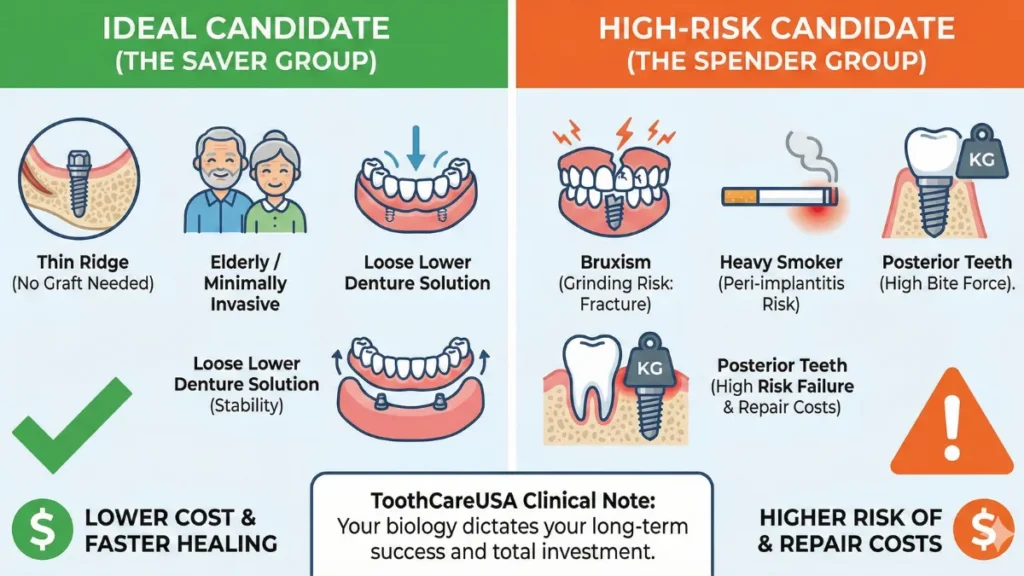
Your biology dictates your bill. Not everyone can simply choose the cheaper option.
Ideal Candidates (The “Saver” Group)
- Low Bone Volume: Patients with thin ridges who cannot afford or medically withstand bone grafting.
- Elderly Patients: Patients who want a less invasive procedure with easier recovery.
- Loose Lower Dentures: The classic “floating denture” problem is the #1 indication for this procedure.
High-Risk Candidates (The “Spender” Group)
- Bruxism (Teeth Grinders): If you grind your teeth at night, the sheer force can snap a mini implant. We call this a Fatigue Fracture. Fixing a broken implant inside the bone is difficult and expensive.
- Heavy Smokers: Smoking constricts blood vessels, increasing the risk of Peri-implantitis (gum infection around the implant) and failure.
- Posterior Teeth Replacement: Using a mini implant to replace a single back molar is risky. The biting force there is massive. I generally advise against this to protect your investment.
The Clinical Procedure: Why Less Chair Time Means Lower Cost
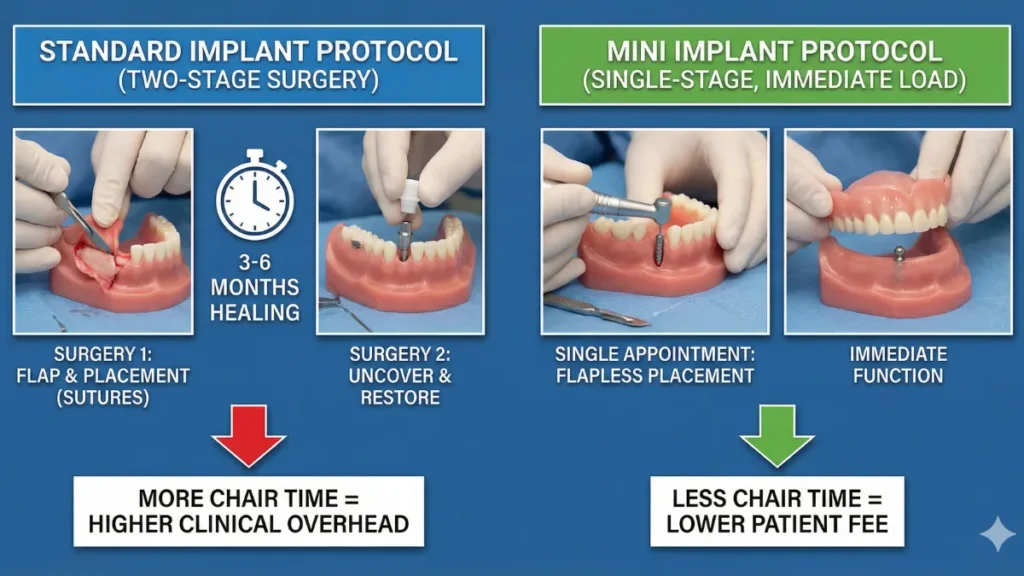
One of the main reasons mini implants are affordable is the speed of the procedure. Time is money in a dental clinic, and this procedure is efficient.
1. Immediate Loading Protocol
With standard implants, we often do surgery, wait 4 months for healing, and then do a second surgery to uncover the implant. This is two appointments, two setups, and double the time.
Mini implants often use an Immediate Loading Protocol. We place the implant and modify your denture to snap onto it the same day. This “teeth in a day” approach drastically reduces clinical overhead.
2. Transmucosal Placement (Flapless Surgery)
Because the implant is so small, we usually don’t need to cut open the gum (raise a flap). We can often punch a tiny hole directly through the tissue.
- Benefit: No sutures (stitches) required.
- Benefit: Less bleeding and faster healing.
- Benefit: Less need for expensive sedation; simple local anesthesia is usually enough.
Risks & Complications: Can “Cheap” Become Expensive?
I firmly believe in the philosophy of “Health First.” We must discuss the risks.
Integration Failure (Fibrous Encapsulation)
Sometimes, the bone doesn’t fuse to the titanium. Instead, soft tissue grows around it. This is called fibrous encapsulation. The implant becomes loose and must be removed. Because mini implants are immediately loaded (used right away), the risk of micromovement causing this failure is slightly higher than with standard implants left to heal for months.
The Removal Reality
If a standard implant fails, we can unscrew it. If a mini implant breaks or fails, removing it can be traumatic. We often have to “trephine” (drill a circle of bone around the implant) to get it out. This removes precious bone, meaning you might need a bone graft before you can try again. A failed $500 implant could lead to a $2,000 repair job.
Infographic on Price for Mini Dental Implants
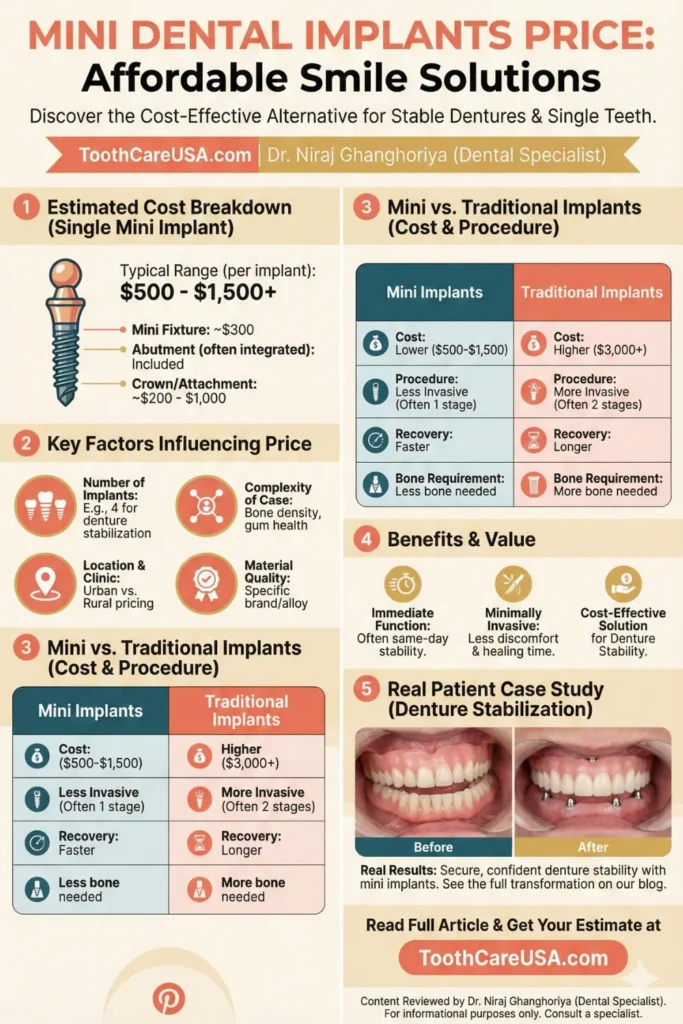
Mini Implants: An Affordable Solution for Denture Stabilization
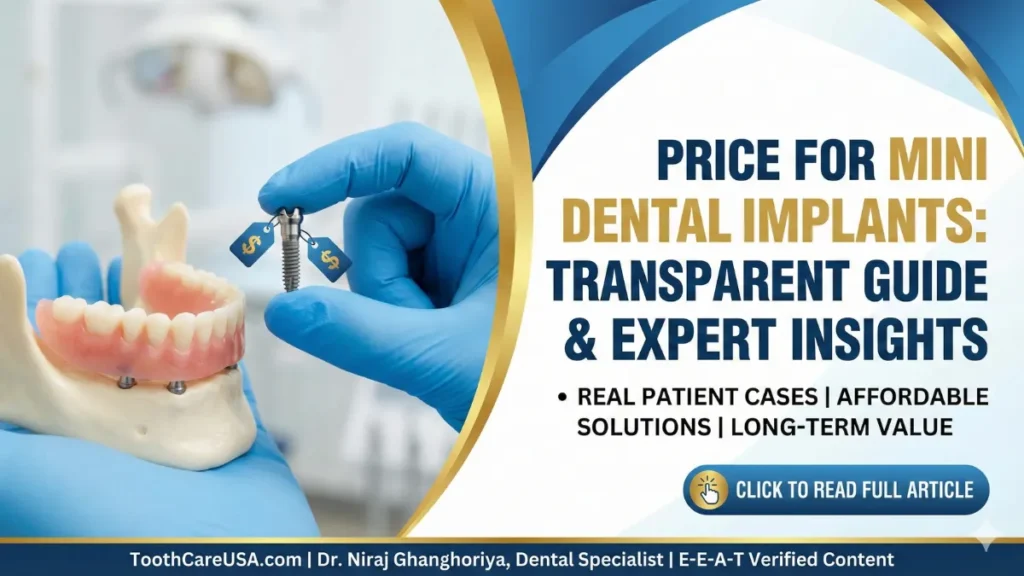
For patients struggling with loose dentures or those who have been told they lack the bone volume for traditional implants, mini dental implants (MDIs) offer a transformative and cost-effective alternative. As illustrated in the infographic, the price for mini implants is significantly lower, typically ranging from $500 to $1,500 per implant.
The lower cost is due to the simplified surgical protocol. MDIs are smaller in diameter (less than 3mm) and can often be placed in a single visit using a minimally invasive technique that requires no incisions or sutures. This reduces chair time and eliminates the need for expensive bone grafting procedures in many cases. Because they are often used to stabilize lower dentures, a patient might need 4-6 mini implants, bringing the total significantly below the cost of a full arch of traditional implants.
However, it is important to note that mini implants are not a universal replacement for standard implants. They are best suited for denture retention or replacing small teeth and incisors. At ToothCareUSA.com, we evaluate your specific bone density to ensure MDIs are a viable, long-term solution for your smile, balancing affordability with clinical success.
Dr. Niraj Ghanghoriya’s Verdict on Value
After years of clinical practice, here is my honest assessment.
Who is this for?
Mini dental implants are a life-changing solution for denture wearers who are struggling with loose lower teeth and have a limited budget or bone structure. If you are 70 years old, have a thin jawbone, and just want to eat an apple without your teeth falling out, this is the highest-value procedure in dentistry. The price-to-satisfaction ratio is incredible.
Who should avoid this?
If you are young (under 50), have strong biting forces, or are looking to replace single molars, I generally advise saving for standard implants. The long-term durability of a standard implant outweighs the upfront savings of a mini implant in these cases. Do not compromise your long-term health just to save $500 today.
Conclusion & Next Steps
The price for mini dental implants is attractive, but it shouldn’t be the only factor in your decision.
- Expect to pay: $500 – $1,500 per implant, or roughly $2,500 – $6,000 for a lower denture stabilization.
- Budget for maintenance: O-rings and housings will need replacing.
- Check your bone: Ensure you have the density to support them.
Don’t shop for the price; shop for the provider. A poorly placed mini implant is a waste of money, no matter how cheap it was.
Next Step: Consult a specialist for personal guidance. Request a CBCT scan to see if you are a candidate for this cost-effective solution.
References & Further Reading
- American Academy of Implant Dentistry (AAID): “What are Mini Dental Implants?”
- Journal of Oral Implantology: “Survival Rates of Mini Dental Implants in the Edentulous Mandible.”
- National Institutes of Health (NIH): “Mini dental implants: an adjunct for retention, stability, and comfort for the edentulous patient.”
Frequently Asked Questions (FAQ) on the price for mini dental implants
What is the average price for mini dental implants in 2026?
In the United States, the average price for mini dental implants ranges from $500 to $1,500 per single implant. This is significantly lower than standard implants ($3,000+), primarily because mini implants are a solid one-piece titanium screw that requires no complex bone grafting surgery.
Dr. Niraj’s Take: “If you see offers below $500, check the fine print—they often exclude the ‘O-ring’ housings needed actually to snap your denture onto the implant.”
Why is the price of mini dental implants so much lower than that of traditional ones?
The price for mini dental implants is lower because they utilize a ‘minimally invasive’ surgical technique that eliminates the need for expensive bone graft materials and sutures. Since the procedure is faster (often completed in one hour) and uses less titanium material, dentists can pass those overhead savings directly to the patient.
Dr. Niraj’s Take: “We don’t need to cut the gums open for minis; this saves me 45 minutes of chair time per patient, which is why I can charge you less.”
Does insurance cover the price for mini dental implants?
Most dental insurance plans cover up to 50% of the price for mini dental implants if they classify the procedure as ‘prosthodontic support’ for dentures. While the implant post itself might be denied as ‘cosmetic,’ many policies in 2026 will pay for the denture modification required to fit the implants.
Dr. Niraj’s Take: “Ask your insurer about code ‘D6013’ (mini implant)—if they deny that, ask if they cover ‘D5863’ (overdenture attachment), which is often the loophole to get paid.”
Are mini dental implants worth the price in terms of longevity?
Mini dental implants generally offer excellent value, with a success rate of over 95% when used strictly for stabilizing lower dentures or replacing small front teeth. However, they may not be cost-effective for replacing large back molars, as the heavy chewing force can cause the thinner screws to fatigue or loosen over 10–15 years.
Dr. Niraj’s Take: “Don’t use minis for back teeth just to save money; they are champions for denture stabilization, but they aren’t built for chewing steak like a standard implant.”
Are there hidden costs in the advertised price for mini dental implants?
Yes, advertised ‘teaser’ prices often exclude the cost of the final restoration (crown or denture) and the CT scan required for planning. A full ‘snap-on’ lower denture package typically costs between $3,500 and $6,000 total, which includes the placement of 4 mini implants and the modification of your existing denture.
Dr. Niraj’s Take: “Always bring your current denture to the consult; if it’s in good shape, we can retrofit it to the new implants and save you about $1,500.”
Medical Disclaimer: The information provided in this article is for educational purposes only and does not constitute medical advice, diagnosis, or treatment. Always seek the advice of your dentist or other qualified health provider with any questions you may have regarding a medical condition or treatment. Prices mentioned are national averages and can vary significantly by location and provider.

Dr. Niraj Ghanghoriya is a passionate dental surgeon with over 12 years of experience in clinical dentistry. He completed his BDS from the prestigious Sri Aurobindo Institute of Dentistry in 2012 and specializes in painless root canals, smile makeovers, and preventive oral care. Known for his patient-first approach and clear communication, Dr. Ghanghoriya aims to make dental knowledge accessible to everyone. When he’s not in the clinic, he enjoys writing informative dental blogs to help people take better care of their oral health.