By Dr. Niraj Ghanghoriya (Dental Specialist).Educational purposes only. See full disclaimer below.
Quick Answer: What is the Average cost of Dental Implants In Indiana ?
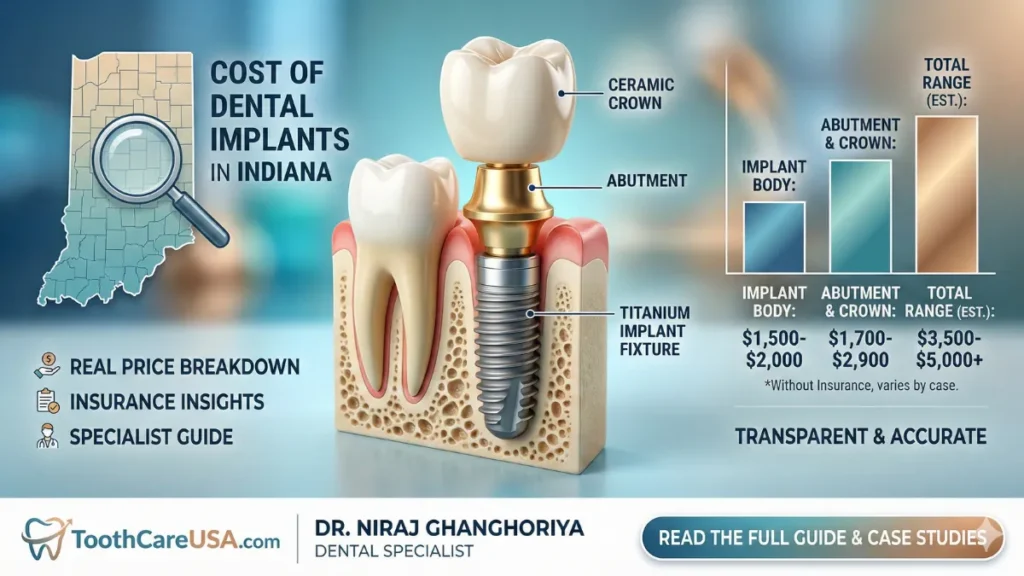
In 2026, the total cost for a single tooth implant in Indiana typically ranges from $3,500 to $5,000 without insurance. This “all-in” price includes the surgical post, the connector (abutment), and the final crown. While some ads promise implants for “$999,” this usually only covers the metal screw, not the tooth you actually chew with.
Why the $999 Dental Implant Advertisement is a Red Flag
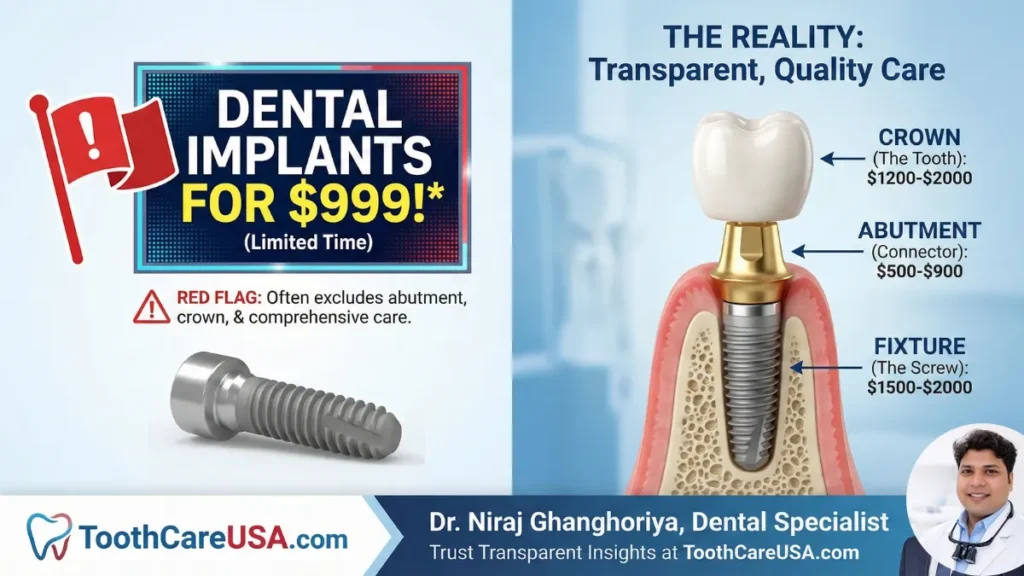
If you live in Indiana, you’ve likely seen billboards on I-65 or I-69 promising dental implants for under $1,000. As a dental specialist, I need to be honest with you: that price usually only covers the metal screw—not the tooth you actually chew with.
It is heartbreaking when I see patients come into my clinic halfway through treatment elsewhere, realizing they can’t afford the second half of the bill. They have a metal post in their jaw, but no tooth on top.
My goal today is to give you the real, transparent cost breakdown for patients in our state, so you don’t get hit with a surprise bill. I want you to know exactly what you are paying for, and why safe, long-lasting health is worth the investment.
Breaking Down the Bill: The 3 Costs You Actually Pay For
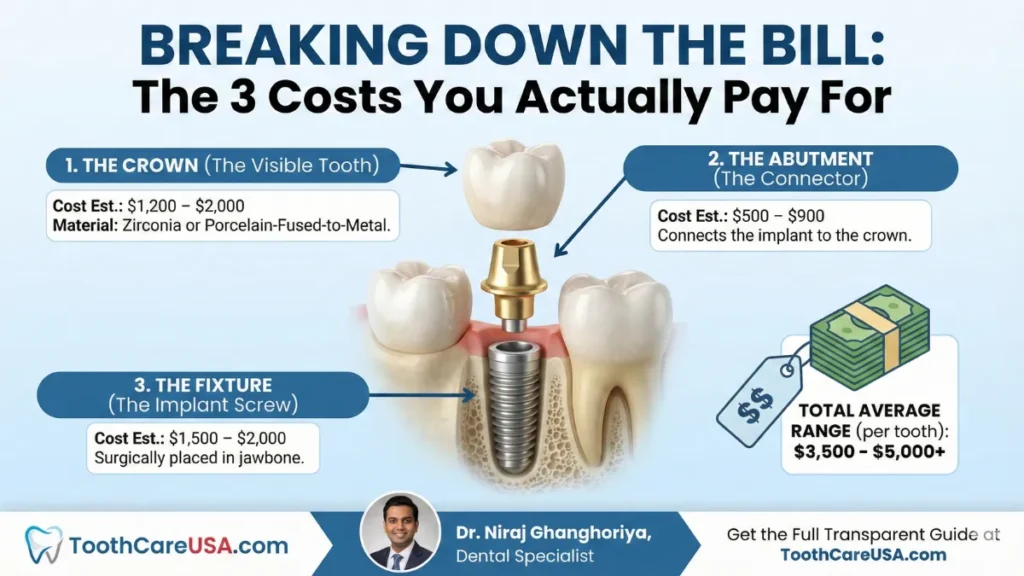
When we talk about a “dental implant,” we are actually talking about three separate parts. If a quote seems too good to be true, ask if it includes all three of these:
1. The Fixture (The Screw)
- Cost Estimate: $1,500 – $2,000
- What it is: This is the titanium post that I surgically place into your jawbone. It acts as the new root for your tooth.
- The “Generic” Risk: Some clinics use “knock-off” implant brands to save $200. I advise against this. If that company goes out of business, you may never find parts to fix your implant 10 years from now. At ToothCareUSA, we use established global brands (like Nobel Biocare or Straumann) for safety.
2. The Abutment (The Connector)
- Cost Estimate: $500 – $900
- What it is: This is a small connector piece that screws into the implant and sticks out of your gum. It holds the crown in place.
- Why it costs money: A standard stock abutment is cheaper, but a custom abutment (molded to your specific gum shape) prevents food from getting stuck and causing infection.
3. The Crown (The Tooth)
- Cost Estimate: $1,200 – $2,000
- What it is: The visible white tooth.
- Material Matters: You will likely choose between PFM (Porcelain Fused to Metal) or Zirconia. Zirconia is virtually indestructible and looks more natural, which is why it often costs slightly more.
Location Matters: Indianapolis vs. Rural Indiana Pricing
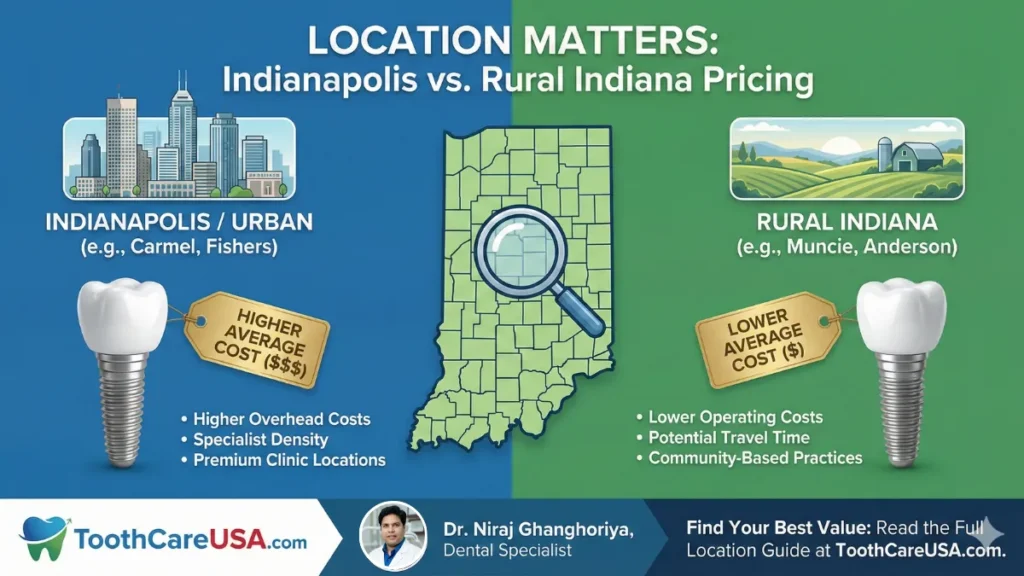
In my clinical experience, where you get your surgery done in Indiana, the price is significantly.
The “Carmel/Fishers” Premium
Clinics in high-rent areas like Carmel, Fishers, or downtown Indianapolis have higher overhead costs. You might pay 15-20% more here than in smaller towns. However, these areas also tend to have the highest concentration of Board Certified Specialists.
The “Rural Indiana” Discount
If you are willing to drive 45 minutes to cities like Anderson, Muncie, or darker rural counties, you might find fees are $500 to $800 lower per unit. The clinical quality can still be excellent, but the operating costs for the dentist are lower.
University Dentistry (IU School of Dentistry)
For the absolute lowest price, the Indiana University School of Dentistry in Indianapolis is a strong option.
- Pros: Prices are often 30-40% lower than private practice.
- Cons: Appointments take much longer (3-4 hours), and residents perform the work under supervision. If you have time but a limited budget, this is a safe path.
“Can I Use My Insurance?”: Navigating HIP 2.0 & Private Plans
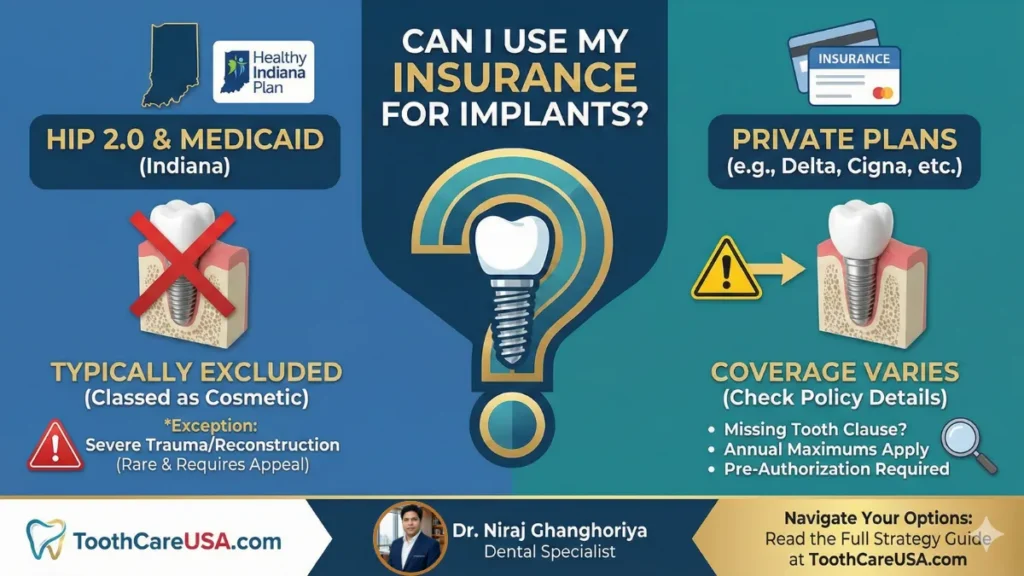
A common question I hear is, “Dr. Niraj, does Medicaid cover this?”
The Healthy Indiana Plan (HIP) Reality
Generally, no. Indiana Medicaid and HIP 2.0 classify dental implants as “cosmetic” procedures. They typically cover dentures and extractions, but not implants.
- The Exception: If the tooth loss was caused by severe trauma (like a car accident) and is reconstructive, coverage might be approved, but it is rare and requires a long appeal process.
Private Insurance & The “Missing Tooth Clause”
If you have private insurance (like Delta Dental or Cigna), check your policy for a “Missing Tooth Clause.” This is a rule where insurance refuses to pay to replace a tooth that was already missing before you bought the policy.
The “Two-Year” Strategy
If your insurance does cover implants (usually capped at $1,500 per year), I often help patients split the treatment. We do the surgery in December (using this year’s money) and place the crown in January (using next year’s money). This can double your insurance benefit.
Step-by-Step: The Clinical Procedure & Associated Costs
The price isn’t just for the parts; it’s for the medical procedure that ensures safety.
Phase 1: Diagnostics (The Hidden Upfronts)
Before we touch a patient, we need a CBCT Scan (Cone Beam Computed Tomography). This is a 3D X-ray that shows me exactly where your nerves are, so I don’t damage them.
- Cost: $300 – $500 (Often not covered by insurance).
Phase 2: The Foundation (Bone Grafting)
If you have been missing a tooth for a while, your bone has likely shrunk (a process called alveolar ridge resorption). We may need to add bone powder to rebuild the site.
- Procedure: Alveolar Ridge Preservation.
- Cost: $400 – $800.
Phase 3: The Surgery
This includes the sterile surgical setup and local anesthesia. If you are anxious and want IV Sedation (to sleep through it), expect to add $500 – $800 to the total bill.
Why One-Day Options (“Teeth in a Day”) Cost More
You may have heard of “Teeth in a Day” or “All-on-4®.” This is where we replace an entire upper or lower arch of teeth at once.
Immediate Load Protocol
“Teeth in a Day” uses an Immediate Load Protocol. This means we attach teeth to the implants the same day we place them. This is high-risk and high-reward. It requires specialized parts and more time from the surgeon, which increases the cost.
All-on-4® Pricing in Indiana
For a full arch (replacing all top or bottom teeth), the cost in Indiana generally ranges from $20,000 to $35,000 per arch.
- Acrylic Hybrid (Cheaper): A denture permanently screwed onto implants. Can wear down over time.
- Zirconia Bridge (Premium): A solid stone bridge. Highly resistant to chipping and staining, but costs $5,000+ more.
What If I Go Cheap? Risks & Revision Costs
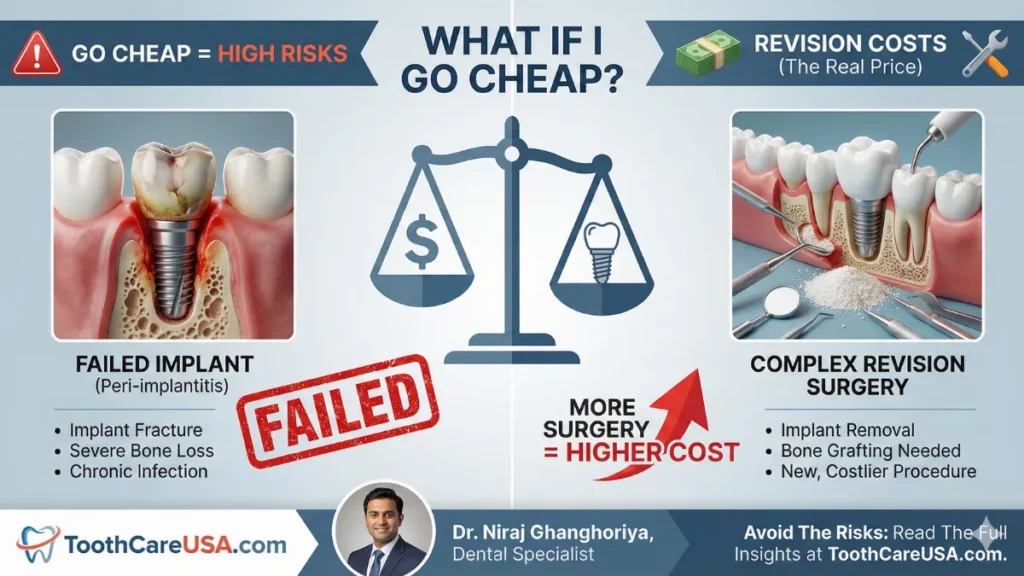
I often tell my patients, “The most expensive implant is the one you have to pay for twice.”
The Cost of Peri-implantitis
If an implant is placed poorly or with cheap materials, it can get infected. This condition is called Peri-implantitis (inflammation around the implant). Treating this often requires gum surgery or removing the implant entirely, which costs more than doing it right the first time.
“Discount” Implant Dangers
Be wary of “Mini-Implants” sold as regular implants. They are toothpick-thin and meant for stabilizing dentures, not for chewing like a regular tooth. If a doctor offers you a “standard” implant for a very low price, ask to see the size specifications.
Honest Alternatives: If Implants Are Out of Budget
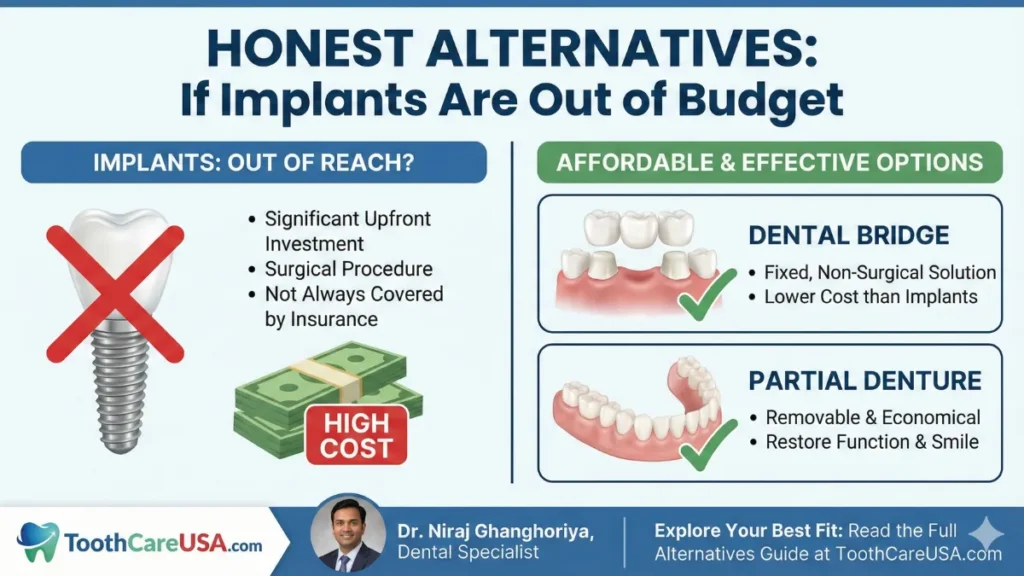
If the $3,500+ price tag is not feasible, you still have safe medical options.
1. Resin-Bonded “Maryland” Bridge
- Cost: ~$1,500
- Best for: Missing front teeth.
- How it works: We glue a fake tooth to the backs of your neighbors. No drilling, no surgery.
2. Traditional Partial Denture
- Cost: $800 – $1,500
- Best for: Multiple missing back teeth.
- How it works: A removable metal or plastic frame with teeth attached. It’s functional, though less stable than an implant.
3. Financing Options
Most dental offices in Indiana work with third-party lenders like CareCredit or Cherry. These allow you to pay off the surgery over 12-24 months, often interest-free if paid on time.
Critical Comparison: Implant vs. Bridge vs. Denture
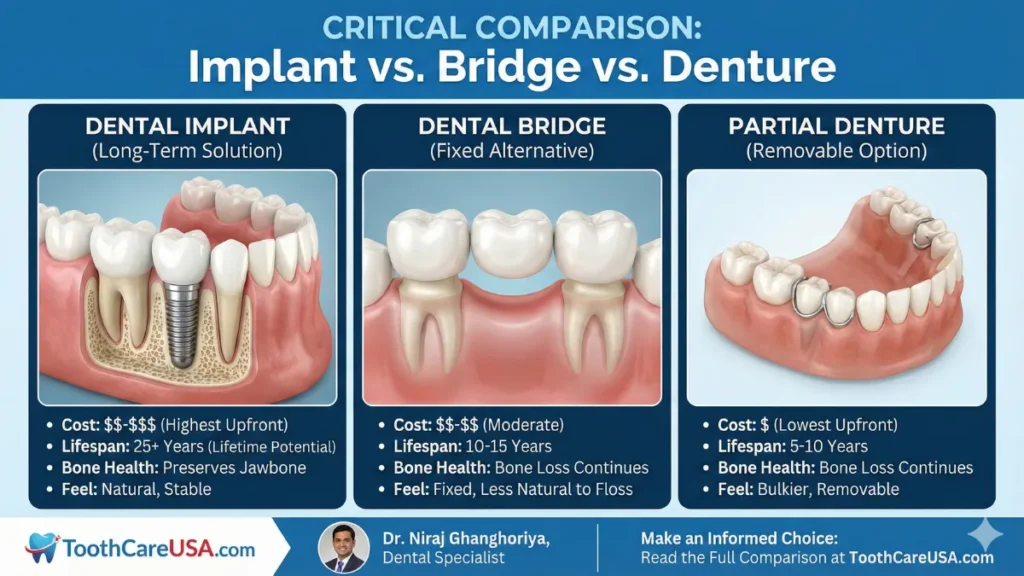
| Feature | Dental Implant | Dental Bridge | Partial Denture |
| Indiana Cost Est. | $3,500 – $5,000 | $2,500 – $4,000 | $800 – $1,500 |
| Lifespan | 25+ Years (Lifetime potential) | 10-15 Years | 5-10 Years |
| Bone Health | Preserves jawbone | Bone continues to shrink | Bone continues to shrink |
| Effect on Other Teeth | None (Independent) | Requires grinding down neighbors | Hooks can wear down neighbors |
| Feel | Like a real tooth | Fixed, but harder to floss | Removable / Bulky |
Dr. Niraj Ghanghoriya’s Verdict
Who is this for?
If you are generally healthy, have good bone density, and want a “one-and-done” solution that feels exactly like your natural tooth, an implant is the gold standard. It prevents your jawbone from melting away, which keeps you looking younger.
Who should avoid this?
If you are a heavy smoker or have uncontrolled diabetes, I might hesitate to recommend an implant immediately. Smoking restricts blood flow, which is vital for osseointegration (the bone fusing to the metal). In these cases, we must improve your health foundation first, or look at bridges as a safer alternative.
Health comes before hardware.
Infographic on Cost of Dental Implants in Indiana
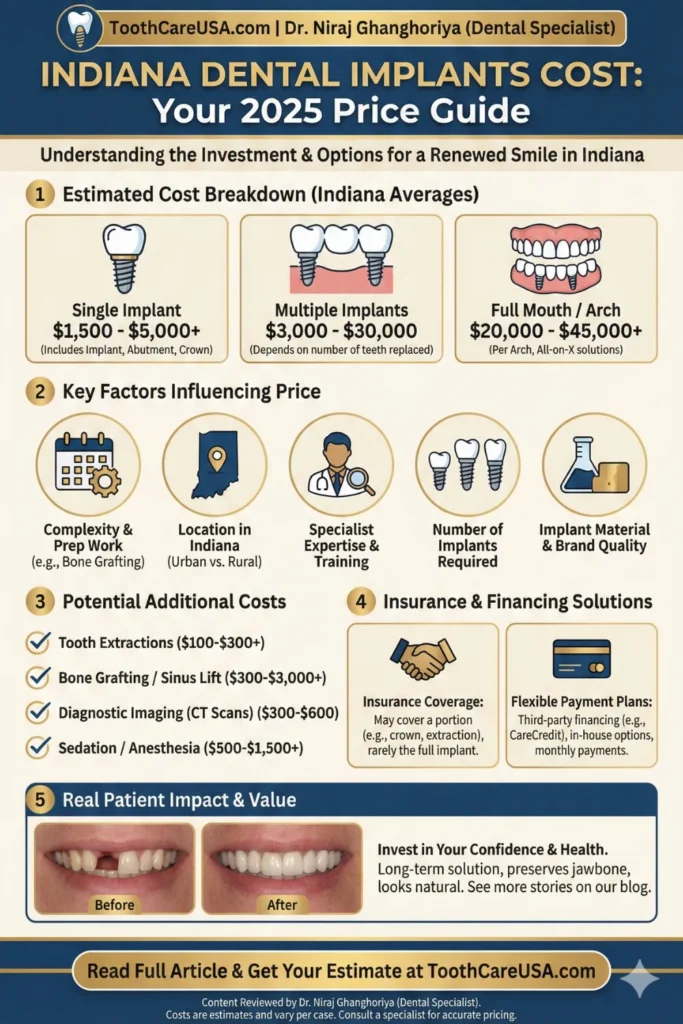
Regional Pricing Guide: Dental Implants in Indiana
The cost of dental care varies by region, and for our patients in Indiana, pricing tends to be slightly below the national average, offering excellent value for high-quality care. As highlighted in the infographic, a single dental implant in Indiana generally ranges from $1,500 to $5,000, depending on whether the procedure is performed in a metropolitan hub like Indianapolis or a rural clinic.
In Indiana, the “Hoosier” market is competitive, but patients must distinguish between “bargain” advertising and comprehensive specialist care. The lower end of the price spectrum ($1,500) often covers only the implant fixture, excluding the abutment and crown. A complete, restored implant is more likely to fall in the $3,500–$4,500 range.
Factors specific to the Midwest region affecting these costs include lab fees and overhead. Many Indiana clinics, including ToothCareUSA.com, work with local high-quality labs to keep costs manageable without sacrificing material quality. When budgeting for your procedure in Indiana, remember to ask if the quote includes the CT scan (3D imaging), surgery, and final restoration. Investing in a local specialist ensures you have ongoing support and maintenance for your implant close to home.
Interactive Assessment: Estimate Your Implant Cost & Complexity
Conclusion & Next Steps
- Don't trust the "teaser" rate: Always ask for the "Total Restoration Cost" (Implant + Abutment + Crown).
- Consider your location: Driving outside of Indianapolis could save you significant money.
- Check your insurance: Look for the "Missing Tooth Clause" before you book surgery.
If you are unsure about a quote you received or want a second opinion on whether your bone is ready for an implant, please consult a Board Certified Specialist.
References & Further Reading
- American Dental Association (ADA) – Patient Smart: Dental Implants.
- Journal of Oral Implantology – "Long-term Survival Rates of Endosteal Implants."
- Indiana Medicaid Provider Reference Module – Dental Services (2025).
Frequently Asked Questions (FAQ) on the cost of dental implants in Indiana
What is the average cost of dental implants in Indiana for 2026?
The total cost for a single dental implant in Indiana typically ranges from $3,000 to $5,000. This price includes the surgical placement of the titanium post ($1,500–$2,000), the abutment, and the final porcelain crown. Prices in urban hubs like Indianapolis may be slightly higher than in rural counties.
Dr. Niraj’s Take: "If you see a billboard in Indy offering implants for $999, tread carefully—that price usually pays for just the screw, not the tooth you actually chew with."
Does Indiana Medicaid or HIP Plus cover dental implants?
Generally, Indiana Medicaid and the Healthy Indiana Plan (HIP Plus) do not cover the cost of dental implants, classifying them as 'elective' or 'cosmetic' procedures. HIP Plus typically covers preventative care, fillings, and dentures, but implants are rarely approved unless deemed medically necessary for reconstructive surgery after severe trauma.
Dr. Niraj’s Take: "While HIP Plus won't pay for the implant, we can sometimes use it to cover the extraction and infection treatment, which lowers your total out-of-pocket expense."
Where can I find the lowest-cost dental implants in Indiana?
The most affordable options are often found at university clinics, such as the Indiana University School of Dentistry in Indianapolis. These programs may offer fees 30–50% lower than private practice because residents perform the work under faculty supervision, though appointments often take longer.
Dr. Niraj’s Take: "If you have more time than money, dental schools are a fantastic option; the quality is high because they are graded on perfection, not speed."
Is the dental implant procedure painful?
Most patients in Indiana report that the procedure is far less painful than a tooth extraction. The surgery is performed under strict local anesthesia or IV sedation. Post-operative soreness is usually manageable with over-the-counter medication like Ibuprofen and typically subsides within 3 to 5 days.
Dr. Niraj’s Take: "My patients are usually most surprised by how easy the recovery is—most go back to work in Indianapolis the very next day."
Are dental implants worth the investment compared to dentures?
Yes, because dental implants prevent jawbone loss, whereas dentures actually accelerate it over time. While the initial cost of dental implants in Indiana is higher, they are a lifetime solution (25+ years), whereas dentures often require costly relining or replacement every 5 to 7 years due to bone shrinkage.
Dr. Niraj’s Take: "I tell my patients: You can pay once for an implant, or you can pay 'rent' on dentures for the rest of your life with repairs and adhesives."
Medical Disclaimer: The content provided on ToothCareUSA.com, including text, graphics, and images, is for informational purposes only. It is not intended to be a substitute for professional medical advice, diagnosis, or treatment. Always seek the advice of your dentist or other qualified health provider with any questions you may have regarding a dental condition. Never disregard professional medical advice or delay in seeking it because of something you have read on this website.

Dr. Niraj Ghanghoriya is a passionate dental surgeon with over 12 years of experience in clinical dentistry. He completed his BDS from the prestigious Sri Aurobindo Institute of Dentistry in 2012 and specializes in painless root canals, smile makeovers, and preventive oral care. Known for his patient-first approach and clear communication, Dr. Ghanghoriya aims to make dental knowledge accessible to everyone. When he’s not in the clinic, he enjoys writing informative dental blogs to help people take better care of their oral health.