Author: Dr. Niraj Ghanghoriya (Dental Specialist)
Micro-Note: Educational purposes only. See full disclaimer below.
Quick Answer: What is the Real Price?
In the Chicago metropolitan area, the realistic “out-the-door” cost for a single complete dental implant typically ranges from $3,500 to $5,500. This total must include the fixture (screw), the abutment (connector), and the final crown. Full arch restorations, such as the All-on-4® Protocol, generally average between $20,000 and $30,000 per arch. Patients should be cautious of advertised prices under $1,500, as these often exclude the abutment, crown, and necessary diagnostics.
Introduction
If you are driving down the Kennedy Expressway and see a billboard promising “Dental Implants for $999,” I want you to keep driving.
In my clinical analysis of the Chicago dental market, that price is often mathematically impossible for a complete, medical-grade procedure using top-tier materials. As a dental specialist, I see the confusion this marketing causes every day. Patients come in expecting a simple bill, only to be hit with “sticker shock” when they realize the advertised price only covered the screw, not the tooth you actually see.
You deserve transparency. A dental implant is not just a product; it is a complex medical procedure that essentially rebuilds a part of your body. In this guide, I am going to break down Dental Implant Cost Chicago, exactly where your money goes, the specific clinical terms you need to know to avoid being overcharged, and why prices in the Loop differ from the suburbs.
The Quick Answer: What is the Real Price?
When we talk about the cost of an implant, we have to look at the total package. Many clinics in Chicago engage in “à la carte” billing. This means they list the price of the Endosteal Implant (the titanium screw that goes into the bone) separately from the rest of the parts.
To get a tooth that functions and looks natural, you are paying for three distinct components:
- The Implant Fixture: The anchor in the jaw ($1,500 – $2,500).
- The Abutment: The connector piece ($500 – $900).
- The Crown: The visible white tooth ($1,200 – $2,000).
When you add these up, along with the necessary exams, the realistic average in 2026 for a top-rated Chicago specialist is roughly $4,500 per tooth. If you require a full mouth reconstruction, the costs scale significantly due to the complexity of surgical planning and the number of implants required to support the bridge.
Breaking Down the Bill: Why Quotes Vary by $2,000
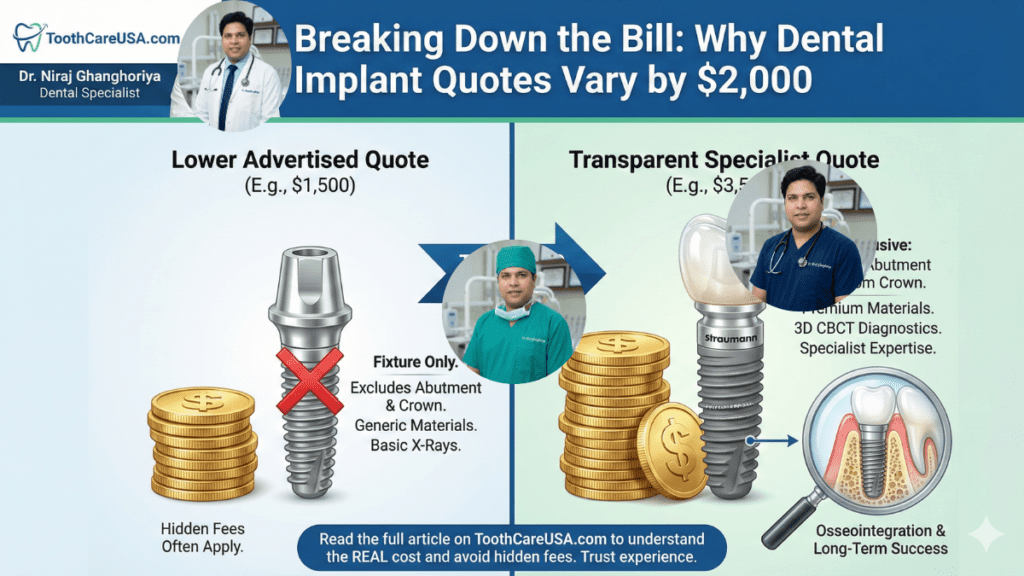
You might visit two dentists within five miles of each other—one in River North and one in Lincoln Park—and get quotes that differ by thousands of dollars. Why does this happen? It usually comes down to three factors: hardware, diagnostics, and the provider’s expertise.
1. The Hardware: Brand Name vs. Clones
Not all titanium is created equal. Premium implant manufacturers like Straumann or Nobel Biocare invest millions in research and peer-reviewed studies. These implants have high rates of Osseointegration (the biological process where your bone fuses to the implant).
Some discount clinics use “clone” implants manufactured with less rigorous quality control to cut costs. In my clinical experience, using a premium brand adds about $300-$500 to the material cost, but it offers peace of mind regarding long-term stability and part availability if you ever need a repair.
2. The Diagnostics: CBCT Scans
Standard 2D X-rays are often insufficient for placing implants safely. A specialist will almost always require CBCT Diagnostics (Cone Beam Computed Tomography). This is a 3D scan that allows us to map your nerves and sinus cavities with sub-millimeter accuracy.
- Cost Impact: A CBCT scan typically costs between $300 and $600.
- Why pay it? It prevents nerve damage and ensures the implant is placed in the strongest bone available.
3. The Human Factor: Specialist vs. General Dentist
In Chicago, fees for Periodontists (gum and bone specialists) and Oral Surgeons are typically 15-20% higher than those of general dentists. You are paying for their additional 3+ years of residency training and their ability to handle complex complications.
The “Hidden” Variables: Procedures That Inflate the Cost
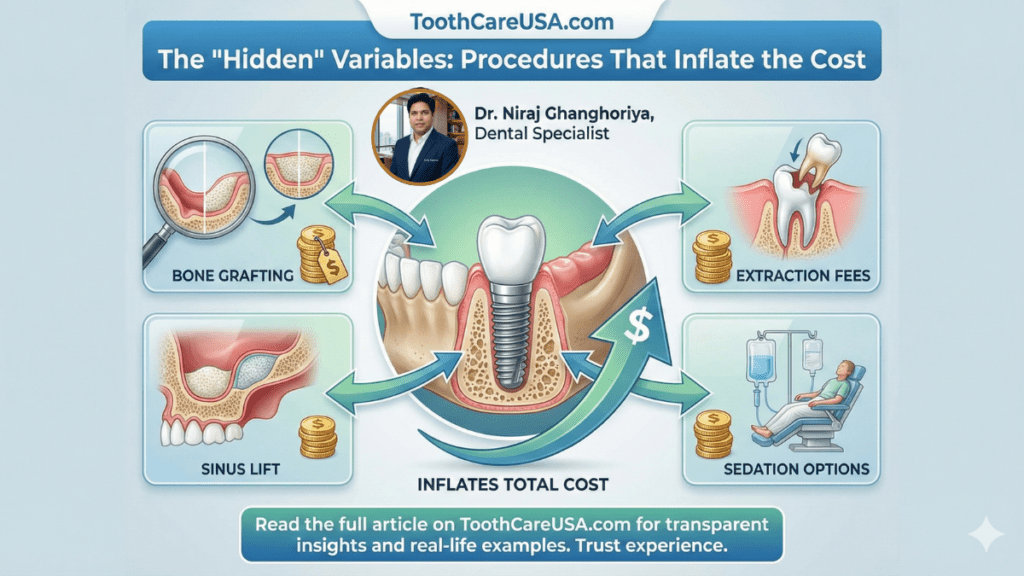
The base price of the implant is rarely the final price. The condition of your mouth dictates the prep work needed. If you have been missing a tooth for a long time, your jawbone may have shrunk—a condition we call Alveolar Ridge Resorption.
Bone Grafting & Sinus Lifts
If there isn’t enough bone to hold the screw, we must build it back up.
- Bone Grafting: This involves placing bone material into the socket or ridge to create a solid foundation. This is necessary for about 40% of patients.
- Estimated Cost: $400 – $1,200 per site.
- Sinus Augmentation (Sinus Lift): For upper back teeth, the sinus cavity is often too close to the jaw. We have to lift the sinus membrane and place bone underneath it gently.
- Estimated Cost: $1,500 – $3,000.
Extraction Fees
If the failing tooth is still in your mouth, it must be removed. Surgical extraction of a broken or infected tooth is billed separately from the implant placement.
- Estimated Cost: $250 – $600 per tooth.
Sedation Options
Your comfort level also has a price tag.
- Local Anesthesia: (Numbing shots) – Usually included.
- IV Sedation (Twilight Sleep): You are awake but unaware.
- Estimated Cost: $600 – $1,200, depending on duration.
- General Anesthesia: Fully asleep (usually in a hospital or surgery center).
- Estimated Cost: $1,500+.
Geographic Pricing: Downtown Loop vs. Chicago Suburbs
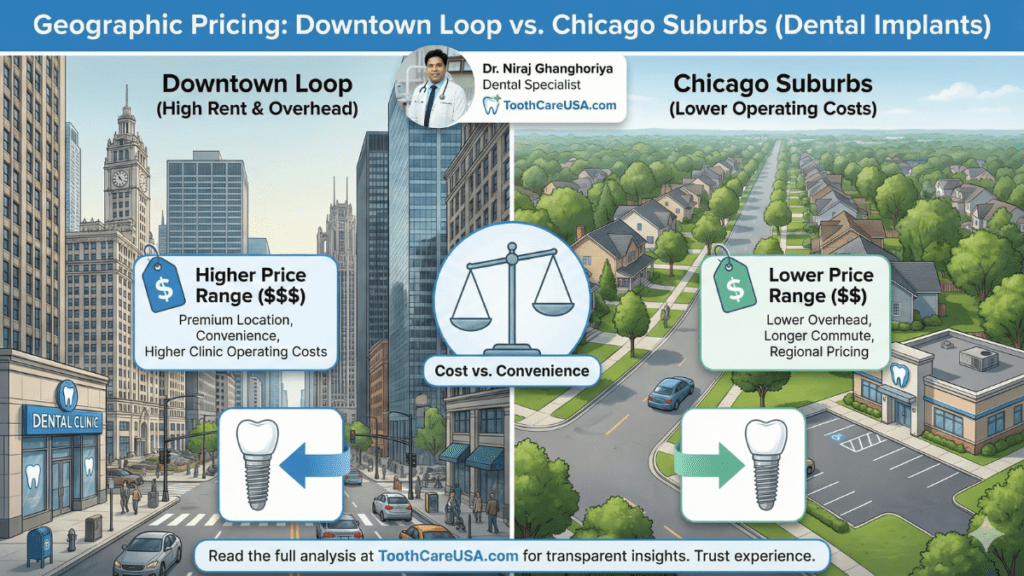
Real estate in Chicago drives medical costs. Clinics located in The Loop, Streeterville, or River North pay some of the highest commercial rents in the country. To cover this overhead, their procedure fees are often 15-20% higher than those of clinics in the suburbs.
The Suburban Difference
If you are willing to drive 30 to 45 minutes to suburbs like Naperville, Oak Brook, or Schaumburg, you can often find top-tier specialists with slightly lower fees.
- The Trade-off: Dental implants require multiple visits (Consult, Surgery, Post-op check, Abutment placement, Impressions, Final Crown). You must calculate if the gas money and time off work justify the $500 savings.
Corporate Chains vs. Private Practice
Chicago is home to many corporate dental chains (“Dental Depots”). These high-volume clinics often offer lower prices due to bulk purchasing of materials. However, you may not see the same doctor at every visit. Private boutique practices cost more but offer continuity of care, which is vital for monitoring Peri-implantitis (inflammation around the implant) over time.
Insurance, Medicare, and Payment Plans in Illinois
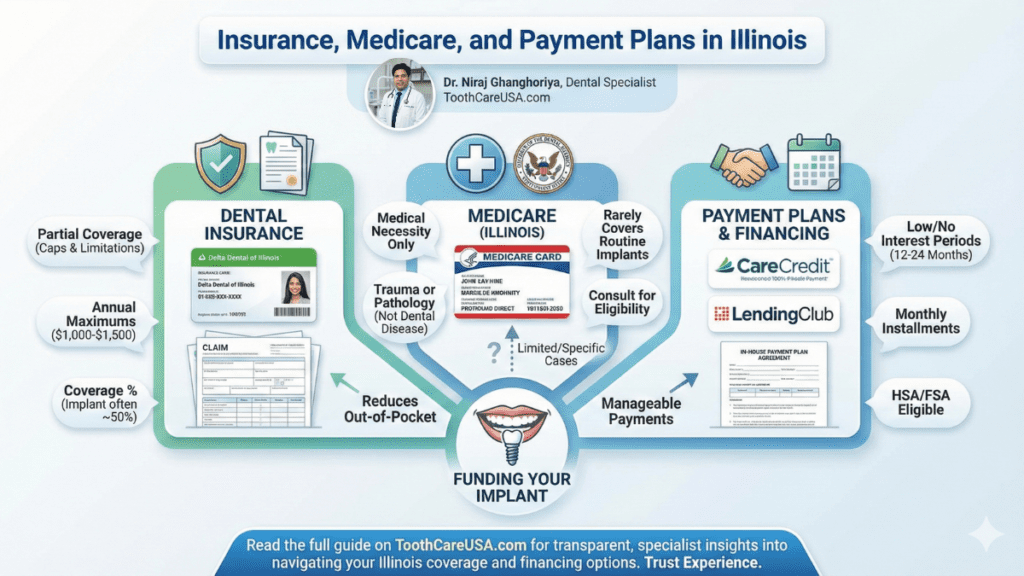
A common question I hear is, “Why won’t my insurance cover this?”
The “Medically Necessary” Loophole
Standard medical insurance and Medicare generally do not cover dental implants. However, there are exceptions. If the tooth loss is due to trauma (like a car accident) or a pathology (like a cyst or tumor), medical insurance might cover the surgical portion.
Dental Insurance Reality
Most dental plans have an “Annual Maximum” benefit of $1,000 to $1,500. Since a single implant costs $4,000+, insurance acts more like a coupon than full coverage. It might cover the extraction or the crown, but you will likely max out your benefits quickly, leaving you with significant out-of-pocket expenses.
Financing Options
Because of the high cost, most reputable Chicago clinics offer financing.
- CareCredit / LendingClub: Third-party lenders that offer interest-free periods (e.g., 12-24 months) if paid in full.
- In-House Plans: Some offices allow you to pay a portion upfront and the rest over the 4-6 months of healing time.
The “Cheap Implant” Trap: Risks of Discount Dentistry
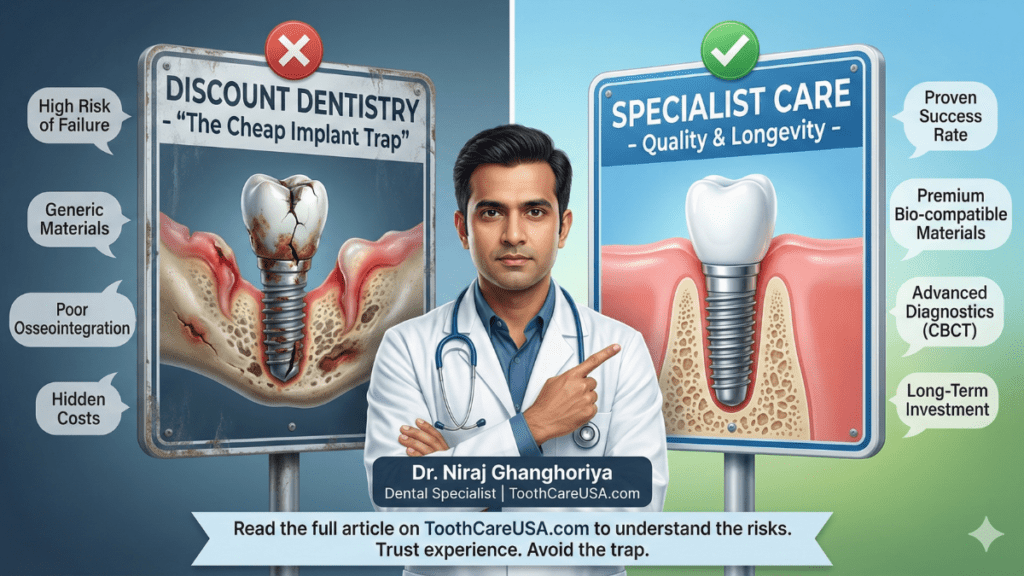
When you see a quote that looks too good to be true, safety shortcuts are often taken.
1. Material Failures
Cheap implants may use lower-grade titanium alloys that are prone to fracture. Even worse, the Transmucosal Abutment (the connector) might not fit perfectly, creating a micro-gap where bacteria can hide, leading to infection and bone loss.
2. Placement Errors
Discount centers may skip the Computer-Guided Surgery. This technology uses a 3D printed guide to ensure the implant is placed at the exact angle. Freehand placement is cheaper but carries a higher risk of hitting a nerve or perforating the sinus.
3. The “Bait and Switch”.
That $999 ad usually gets you in the door. Once you are in the chair, you find out the $999 is just for the screw. By the time they add the consultation fee, X-rays, sterility fee, and the crown, the price is back up to $4,000.
Step-by-Step: What You Are Paying For (The Procedure)
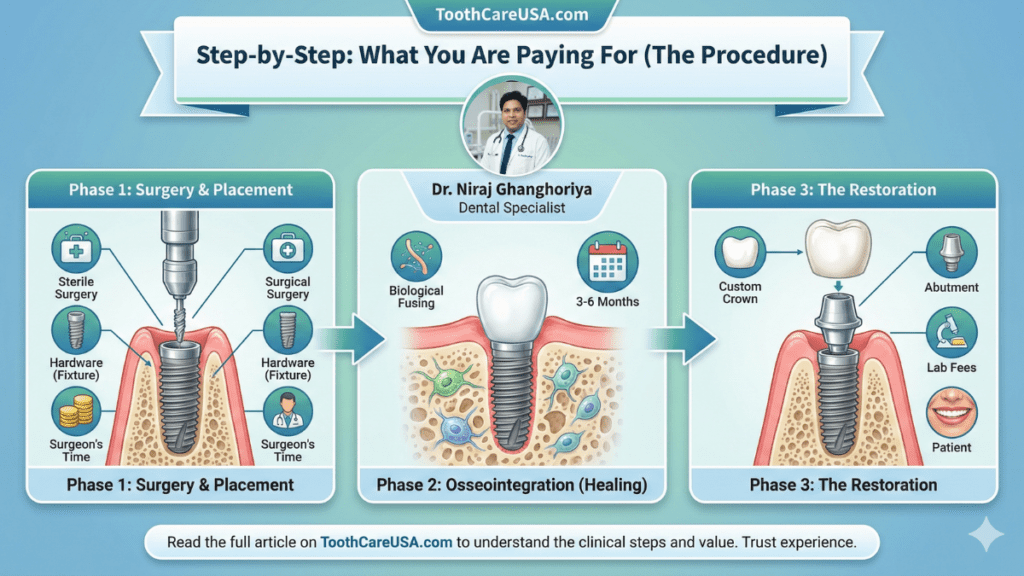
To understand the cost, you must understand the labor and biology involved.
Phase 1: Surgery & Placement
This is a sterile surgical appointment. We numb the area, reflect the gum tissue, and precisely drill a channel into the jawbone. The Endosteal Implant is torqued into place. If immediate stability is good, we place a healing cap.
- What you pay for: Surgeon’s time, sterility, anesthesia, and the titanium hardware.
Phase 2: Osseointegration (Healing)
This is the waiting game. For 3 to 6 months, your bone cells grow and attach to the surface of the implant. This biological fusing is critical. If we rush this, the implant will fail.
Phase 3: The Restoration
Once healed, you return for the final steps. We remove the healing cap and attach the Transmucosal Abutment. Then, we take impressions (digital or mold) to create your custom Zirconia Prosthesis (crown).
- What you pay for: Lab fees for the custom tooth, the abutment hardware, and the dentist’s time for fitting and adjustments.
Alternatives to Implants: Cost vs. Longevity Comparison
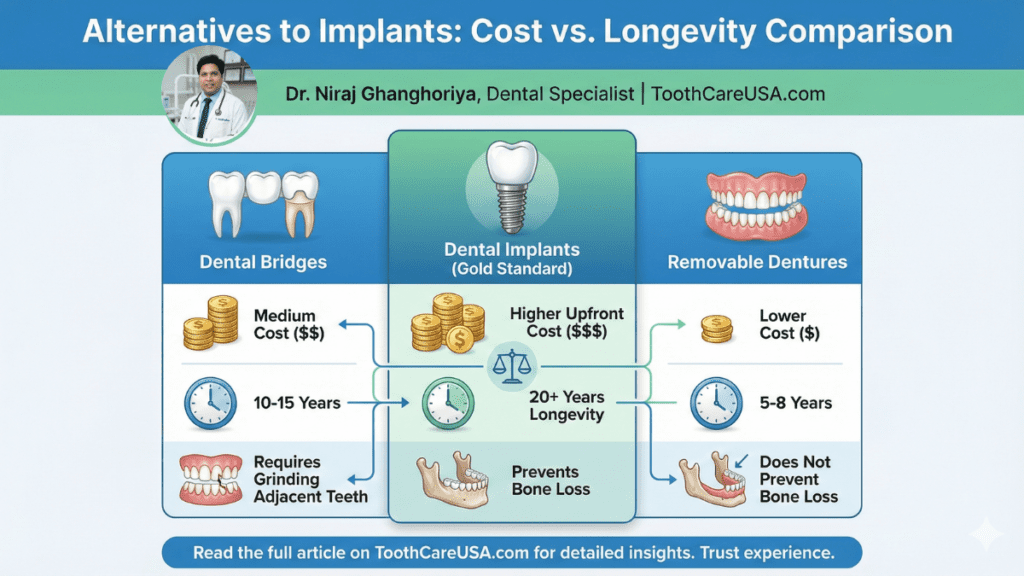
If implants are outside your budget, there are other ways to restore your smile, though they come with compromises.
1. Dental Bridges ($2,500 – $4,000)
A bridge uses the teeth on either side of the gap as anchors.
- Pros: Cheaper upfront; faster (done in 2 weeks).
- Cons: We have to grind down healthy enamel on the neighbor’s teeth. It does not stop bone loss.
2. Removable Dentures ($1,000 – $3,000)
- Pros: Most affordable option.
- Cons: Can be unstable; must be removed at night; does not prevent alveolar ridge resorption (jawbone shrinking).
3. Resin-Bonded Bridges (Maryland Bridge)
- Pros: Cheap; minimally invasive.
- Cons: Weak bond; only suitable for front teeth that don’t do heavy chewing; high long-term failure rate.
Dr. Niraj’s Checklist: What to Ask Your Chicago Dentist
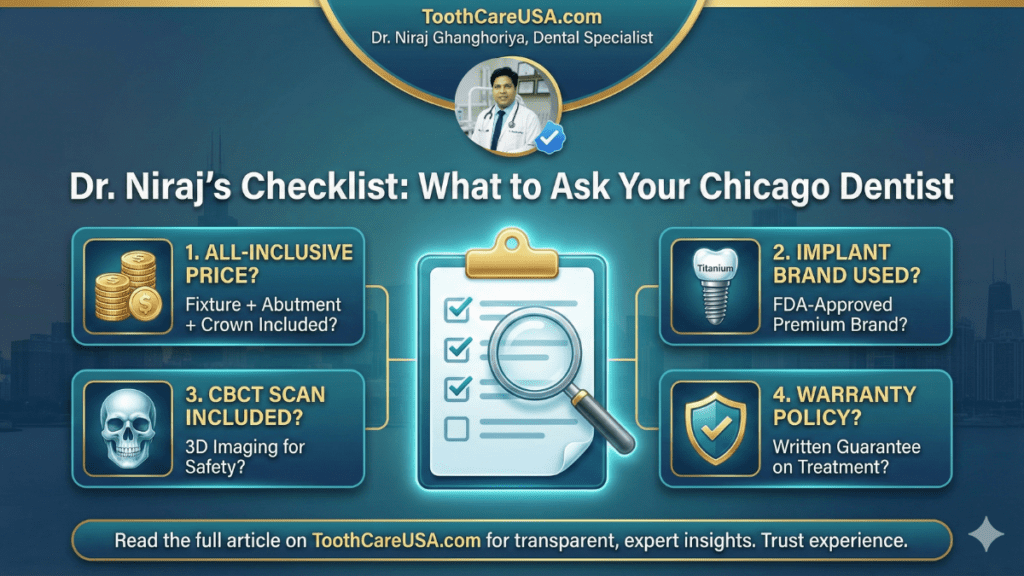
Before you sign any treatment plan, use these questions to protect your wallet and your health.
- “How much does a single dental implant cost in Chicago with insurance?”
- Ask for a “pre-determination of benefits” so you know exactly what the insurance pays before surgery.
- “Is this quote ‘all-inclusive’?”
- Verify it includes the fixture, abutment, crown, and all post-op visits.
- “What brand of implant do you use?”
- Look for major FDA-approved brands. If they can’t tell you the brand name, that is a red flag.
- “Does this price include the CT Scan?”
- Ensure there are no surprise radiology fees.
Critical Comparison Table: Chicago Dental Options
| Feature | Discount/Chain Clinic | Private General Dentist | Private Specialist |
| Est. Cost (Single Tooth) | $1,900 – $2,800 | $3,500 – $4,500 | $4,500 – $6,000 |
| Implant Brand | Generic / Clones | Standard / Premium | Premium (Straumann/Nobel) |
| Diagnostics | 2D X-Ray (Often) | 2D or 3D CBCT | 3D CBCT (Standard) |
| Surgical Method | Free-hand | Free-hand or Guided | Computer-Guided Surgery |
| Continuity of Care | Low (Rotating doctors) | High (Same doctor) | High (Expert follow-up) |
| Warranty | Varies (Read fine print) | Usually Included | Comprehensive |
Infographic on Dental Implant Cost Chicago
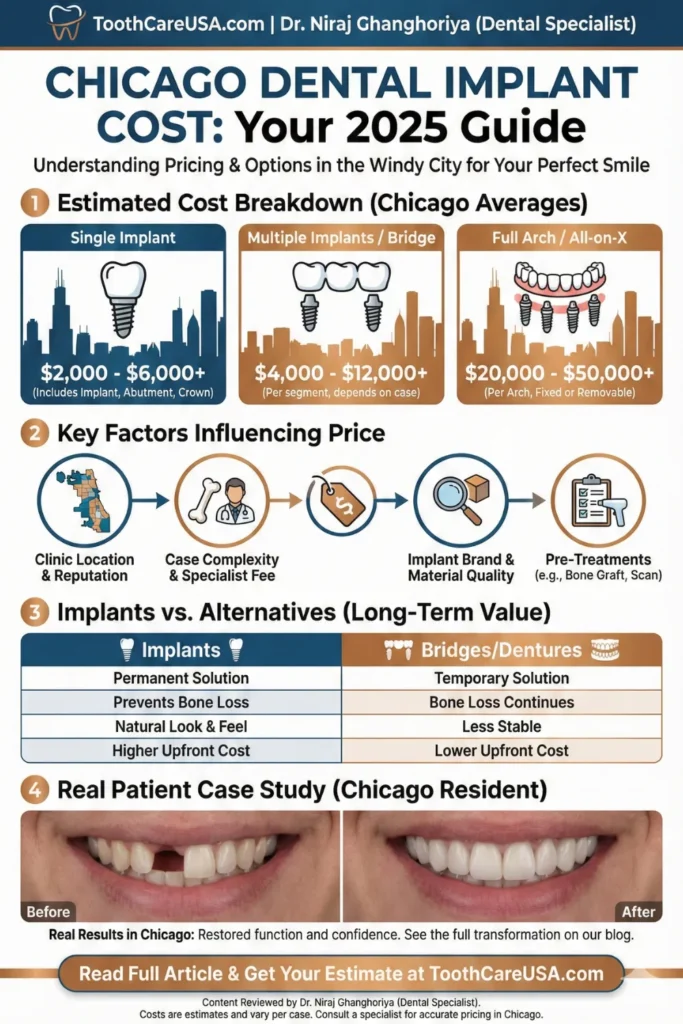
Navigating Dental Implant Costs in the Chicago Market
Chicago is a hub for world-class medical and dental professionals, but this expertise often comes with a metropolitan price tag. As detailed in our infographic, the cost for a single dental implant in the Chicago area typically ranges from $2,000 to $6,000+. This range is slightly higher than rural Midwest averages due to higher operational costs and the concentration of specialized prosthodontists and oral surgeons in the city.
In neighborhoods like the Loop, Gold Coast, or Lincoln Park, pricing may reflect the premium real estate and advanced technology available in these clinics. However, the benefit of seeking treatment in Chicago is access to cutting-edge techniques, such as immediate-load implants and computer-guided surgery, which can improve success rates and recovery time.
For full-arch restorations (like All-on-4), Chicago prices can range from $20,000 to $30,000 per arch. While this is a significant investment, Chicago patients benefit from a competitive market where financing options are widely available. At ToothCareUSA.com, we advise patients to look for “transparent pricing” that includes all follow-up visits and warranty information, ensuring that your investment in a Chicago smile is protected for the long haul.
Dr. Niraj Ghanghoriya’s Verdict
Who is this for?
If you have a healthy jawbone (or are willing to undergo grafting), value a permanent solution that feels exactly like a natural tooth, and want to protect your remaining teeth from shifting, a dental implant is the gold standard. It is an investment in your long-term health.
Who should avoid this?
If you are currently a heavy smoker, have uncontrolled diabetes, or are undergoing radiation therapy to the jaw, the risk of failure increases drastically. In these cases, we might look at bridges or dentures until your health is optimized.
My Advice: Do not shop for surgery as you shop for a TV. You cannot return a failed implant. Prioritize the skill of the surgeon and the quality of the materials over the lowest possible price tag.
Conclusion & Next Steps
The cost of dental implants in Chicago reflects the complexity of the technology and the expertise required to place them safely. While the upfront cost is high, an implant that lasts 20+ years is often cheaper in the long run than a bridge that needs replacing every 7 years.
Your Next Step: If you are considering an implant, I recommend getting a consultation with a specialist who uses CBCT Diagnostics and transparent pricing. Ask for a written breakdown of the Total Out-of-Pocket cost before you begin.
References & Further Reading
- American Academy of Periodontology: “Dental Implants: Costs and Procedures.”
- Journal of Oral Implantology: “Success Rates of Titanium vs. Zirconia Implants.”
- National Institutes of Health (NIH): “Alveolar Ridge Preservation: Rationale and Techniques.”
Frequently Asked Questions (FAQ) on dental implant cost Chicago
What is the average dental implant cost in Chicago for 2026?
The average dental implant cost in Chicago ranges from $3,500 to $6,000 per tooth. This wide gap depends on location; clinics on the “Magnificent Mile” or downtown often charge 15-20% more than providers in suburbs like Oak Park or specialized centers in Evergreen Park.
Dr. Niraj’s Take: “Chicago prices vary wildly—driving just 30 minutes out of the Loop to a suburban clinic can sometimes save you over $1,000 per implant.”
Where can I find the lowest-cost dental implants in Chicago?
The University of Illinois at Chicago (UIC) College of Dentistry often offers fees 30–50% lower than those in private practice. Because residents perform the surgery under faculty supervision, the cost is significantly reduced, though appointments may take longer and have waiting lists.
Dr. Niraj’s Take: “If you have time but a tight budget, university clinics are the gold standard for affordable care without sacrificing safety or quality.”
Does Illinois Medicaid cover the cost of dental implants?
Generally, Illinois Medicaid (including HIP Plus) does not cover dental implants, classifying them as ‘elective’ cosmetic procedures. However, coverage is sometimes approved for ‘medically necessary’ reconstructive cases caused by severe trauma or oral cancer, though this requires extensive documentation and prior authorization.
Dr. Niraj’s Take: “Don’t count on Medicaid for the implant itself, but we can often use it to cover the extraction and infection control, lowering your overall private bill.”
Why are dental implant quotes in Chicago so different?
The difference lies in ‘teaser rates’ versus ‘all-inclusive’ pricing. Many Chicago ads promoting “$395 implants” only charge for the screw itself; once you add the abutment (connector), CT scan, and final porcelain crown, the total price often aligns with the standard $3,000+ market rate.
Dr. Niraj’s Take: “Bring the advertisement to your consultation and ask, ‘Does this price include the abutment and crown?’—if they say no, walk away.”
Is the dental implant procedure painful?
Most patients report that implant surgery is less painful than a tooth extraction. Chicago dentists strictly use local anesthesia or IV sedation options. Post-operative discomfort is typically mild, manageable with over-the-counter Ibuprofen, and resolves within 3 to 5 days.
Dr. Niraj’s Take: “The fear of pain is always worse than the reality; my patients are usually eating dinner comfortably the same night.”
Medical Disclaimer: The information provided in this article is for educational purposes only and does not constitute medical advice, diagnosis, or treatment. Always seek the advice of your dentist or other qualified health provider with any questions you may have regarding a medical condition or treatment. Costs mentioned are estimates based on 2026 market analysis and may vary by provider.

Dr. Niraj Ghanghoriya is a passionate dental surgeon with over 12 years of experience in clinical dentistry. He completed his BDS from the prestigious Sri Aurobindo Institute of Dentistry in 2012 and specializes in painless root canals, smile makeovers, and preventive oral care. Known for his patient-first approach and clear communication, Dr. Ghanghoriya aims to make dental knowledge accessible to everyone. When he’s not in the clinic, he enjoys writing informative dental blogs to help people take better care of their oral health.