Author: Dr. Niraj Ghanghoriya (Dental Specialist)
Micro-Note: Educational purposes only. See full disclaimer below.
Quick Answer: How Much Do Dental Implants Cost in Texas
In Texas, the total out-of-pocket cost for a single dental implant typically ranges from $3,000 to $5,500. This price includes the surgery, the abutment (connector), and the final crown. For a full arch rehabilitation (like All-on-4), costs in Texas generally span from $20,000 to $30,000 per jaw, depending on whether you choose acrylic or zirconia materials.
Introduction: The Truth About Those Billboards
If you are driving down I-35 or Loop 610 and see a billboard promising a dental implant for “$599,” I want you to do one thing: keep driving.
In my years as a specialist, I have had to fix too many “bargain” surgeries that ended up costing the patient double the price and triple the pain. It is a common frustration I hear in my consultation room: patients are confused by the massive range in quotes they receive. One office says $1,000, another says $5,000.
The truth is, how much do dental implants cost in Texas varies wildly based on location, materials, and the skill of your surgeon. But there is a huge difference between “affordable” and “cheap.”
In my clinical practice at Toothcareusa.com, I act as a patient advocate. My goal today is to translate the complex line items of a Texas dental bill, so you understand exactly why high-quality implantology costs what it does, and where you should never cut corners.
The “Texas Price Tag”: Detailed Cost Breakdown by Procedure
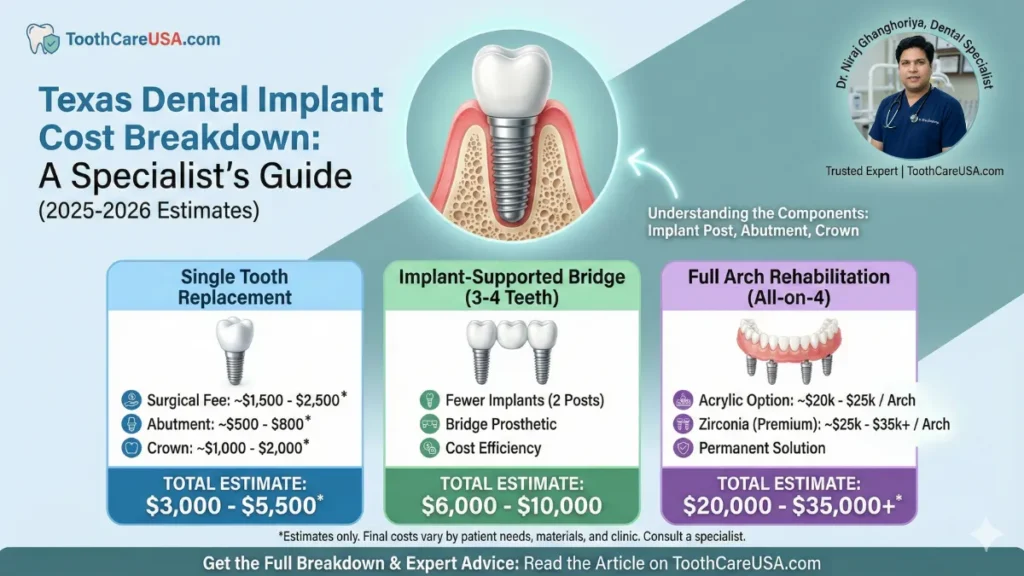
When we talk about the cost, we need to break it down by the type of procedure. A single missing tooth is a very different financial conversation than replacing a full set of teeth.
1. Single Tooth Replacement
For a single missing tooth, the industry standard in Texas (covering cities like Dallas, Houston, and Austin) generally falls into the $3,000 to $5,500 range. Here is how that breaks down:
- The Surgical Fee ($1,500 – $2,500): This pays for the titanium screw and the surgeon’s time to place it into your jawbone.
- The Abutment ($500 – $800): This is the crucial connector piece that links the screw inside your gum to the tooth you see.
- The Crown ($1,000 – $2,000): This is the prosthodontic restoration—the actual “tooth” made of porcelain or zirconia that you chew with.
2. Implant-Supported Bridge (3-4 Teeth)
If you are missing three or four teeth in a row, you do not necessarily need an implant for every single tooth. We can often use two implants to support a bridge of three or four teeth.
- Estimated Cost: $6,000 to $10,000.
- Why it saves money: You are paying for fewer surgical posts, which significantly lowers the surgical fees and trauma to the bone.
3. Full Arch Rehabilitation (All-on-4)
This is for patients who are missing all their teeth on the top or bottom jaw. We use 4 to 6 implants to anchor a permanent set of teeth.
- Acrylic Option (The Standard): $20,000 – $25,000 per arch. This uses a denture-like material over a metal bar. It looks good, but it can wear down over time.
- Zirconia Option (The Premium): $25,000 – $35,000+ per arch. Zirconia is incredibly strong and looks exactly like natural tooth enamel. It resists staining and chipping much better than acrylic.
Why Does the Price Vary? (Understanding Your Quote)
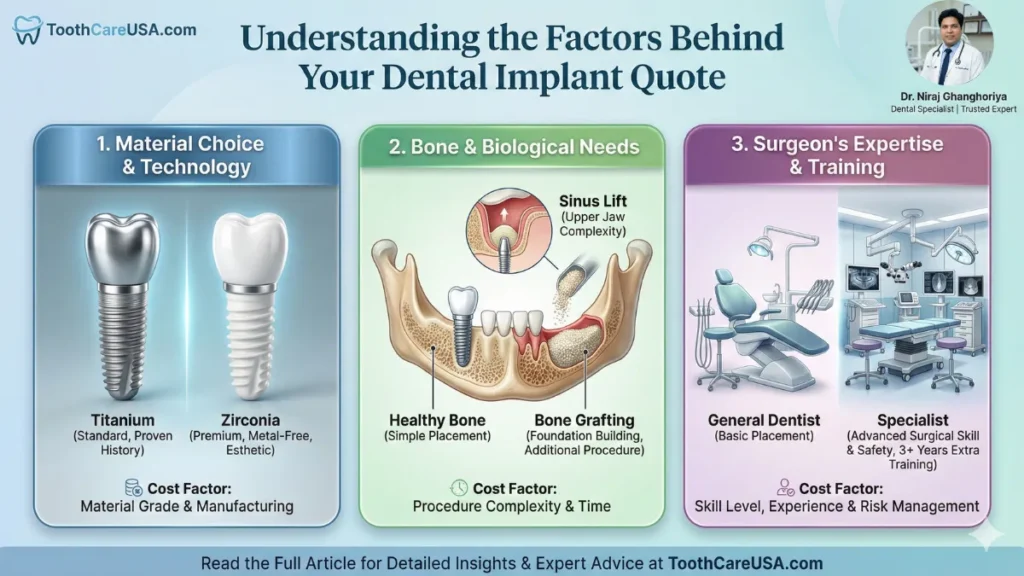
You might ask, “Dr. Niraj, why does the dentist in rural West Texas charge less than the specialist in downtown Dallas?” Geography plays a role, but the biggest factors are usually biological and material.
1. Material Choice: Titanium vs. Zirconia
- Titanium Alloy: This is the gold standard for endosteal implants (implants placed in the bone). It has a decades-long track record of success.
- Zirconia (Ceramic): Some patients prefer a metal-free option due to allergies or aesthetic concerns. Zirconia implants are white (not grey), so they don’t show a dark line at the gum, but they are significantly more expensive to manufacture.
2. Bone Biology: The Foundation
You cannot build a house on a swamp. Similarly, you cannot place an implant in soft or missing bone.
- Alveolar Ridge Preservation: If you lost your tooth years ago, you likely have “bone loss.” We may need to perform a bone graft to build that ridge back up before we can even place the implant. This can add $500 to $2,000 to your bill.
- Sinus Augmentation: For upper teeth, your sinus cavity might be too close to the jawbone. We have to gently lift the sinus membrane and add bone underneath it. This is a delicate, advanced procedure that increases costs.
3. The “Specialist” Factor
General dentists can place implants, and many do a great job. However, specialists like Periodontists or Oral Surgeons have 3+ additional years of residency training specifically in surgery and soft tissue management.
- My advice: For a simple back tooth, a general dentist might be fine. For a front tooth (where looks matter) or a complex full-mouth case, the specialist’s higher fee is often an insurance policy against failure.
Hidden Costs: What the “$599 Implant” Billboards Don’t Tell You
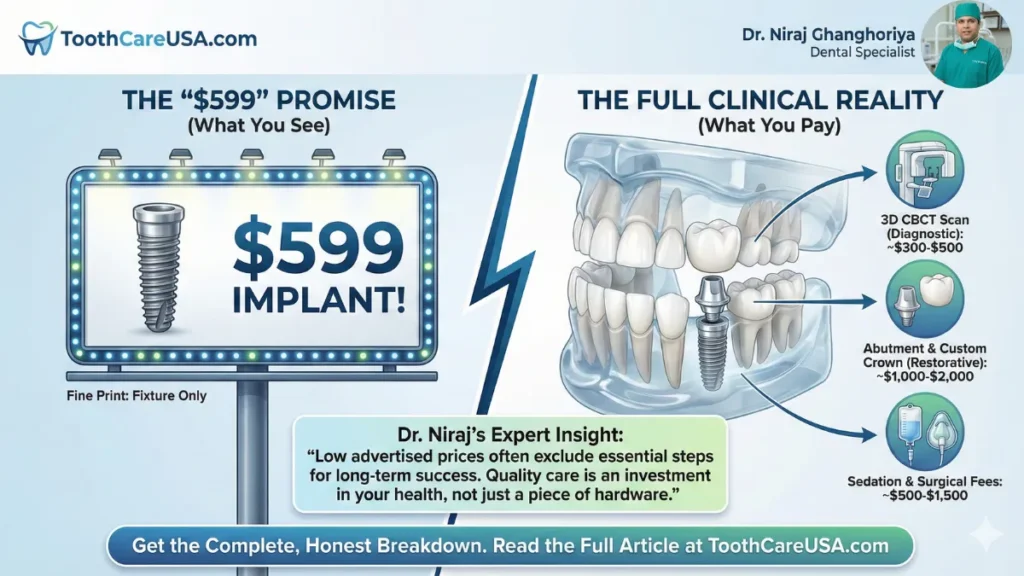
Let’s address the elephant in the room: the “teaser rates.” When you see a low-cost ad, read the fine print. Usually, that price covers only the implant fixture (the screw). It rarely includes:
1. Diagnostic Tech (CBCT 3D Imaging)
We cannot guess where your nerves are. We need a CBCT 3D scan to map your anatomy precisely to avoid nerve injury.
- Hidden Cost: $300 – $500.
- Why it’s non-negotiable: Without this, the surgeon is operating partially blind. Never skip this to save money.
2. Sedation Fees
Are you anxious about dental work? Local anesthesia (numbing shots) is usually included, but if you want to be “asleep” (IV Sedation) or relaxed with “laughing gas,” that is extra.
- Hidden Cost: $500 – $1,500.
3. Abutment and Crown
As mentioned earlier, the screw is useless without the tooth on top. The discount centers often charge standard or even inflated rates for the abutment and crown to make up for the cheap surgical fee. By the time you walk out, your $599 implant often costs $4,000.
Does Dental Insurance Cover Implants in Texas?
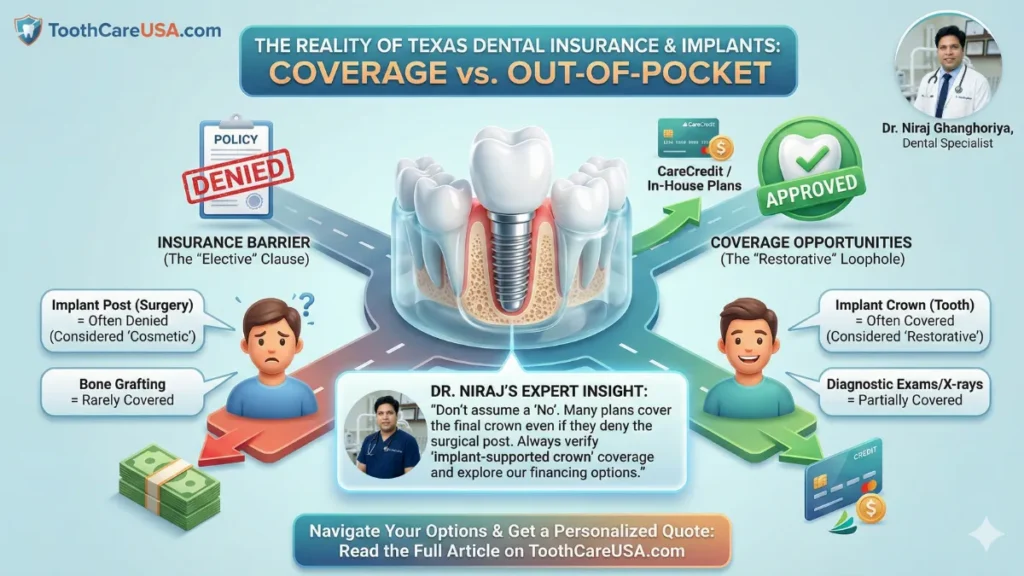
This is the most common question I get at the front desk. The answer is frustratingly mixed.
The “Elective” Clause
Many basic dental insurance plans in Texas classify implants as a “cosmetic” or “elective” procedure, meaning they won’t cover the surgery itself. They argue that a denture or bridge is a “cheaper alternative” that restores function, so they will only pay for that.
The “Crown Loophole”
However, there is good news. Even if your insurance denies the implant post, they will often cover the crown that goes on top of it, because that is considered “restorative.”
- Tip: Ask your insurance provider specifically about “implant-supported crowns” (CDT code D6058).
Financing Options
Because insurance is unreliable here, most Texas practices offer financing:
- CareCredit / LendingClub: These are healthcare credit cards that often offer 0% interest for 12-24 months.
- In-House Plans: Many offices have their own membership plans that give a 15-20% discount on implants.
AEO FAQ: Common Questions About How Much Do Dental Implants Cost in Texas
“How much is a full mouth of dental implants in Texas?”
A full mouth restoration (replacing all top and bottom teeth) typically ranges from $40,000 to $60,000 total. This is often referred to as “All-on-4” or “All-on-X.” The price depends heavily on whether you choose a final bridge made of acrylic (cheaper) or zirconia (more expensive/durable).
“Does Medicaid cover dental implants for adults in Texas?”
Generally, no. Texas Medicaid for adults usually covers only emergency extractions and pain relief. It rarely covers implants unless they are deemed “medically necessary” due to severe trauma or reconstructive jaw surgery, which is very difficult to prove.
“What is the cheapest way to replace a tooth in Texas?”
The cheapest option is a removable partial denture (often called a “flipper”). This can cost between $300 and $800. However, it is not a permanent solution. It clips onto other teeth and does not stop bone loss. A dental bridge is the next step up in cost and stability.
Clinical Risks: The Cost of “Bargain Hunting”
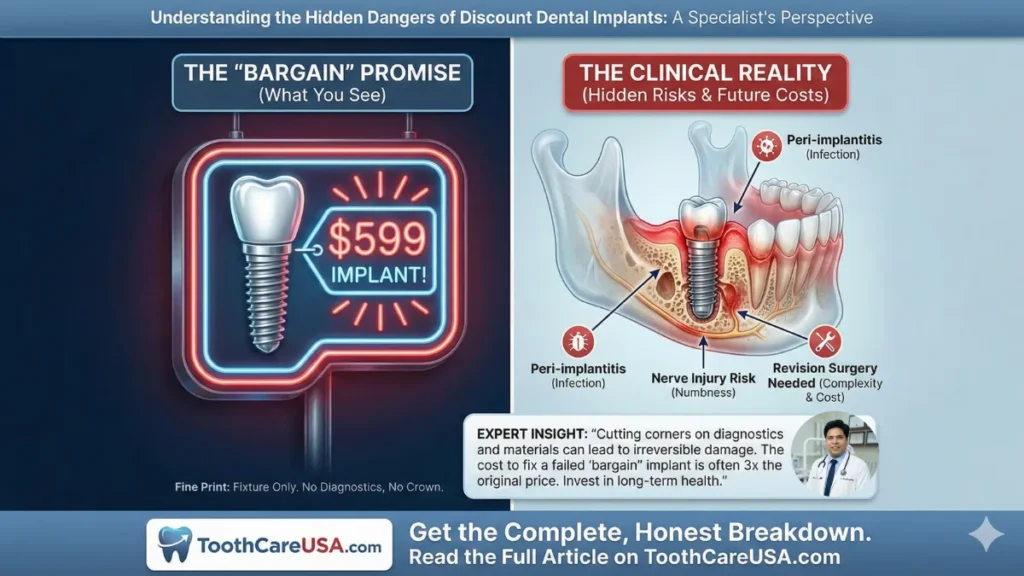
In medicine, you often get what you pay for. Choosing the cheapest provider can lead to serious biological complications that cost much more to fix.
Peri-implantitis (The Infection Risk)
This is a destructive, inflammatory process affecting the soft and hard tissue around the implant. It is similar to gum disease but happens around the metal post. Cheap implants often have poor surface treatments or loose connections that trap bacteria, leading to peri-implant mucositis and eventual bone loss.
Nerve Injury
I mentioned the CBCT scan earlier. If a dentist places an implant too deeply in the lower jaw because they didn’t use 3D imaging, they can compress the alveolar nerve. This can cause permanent numbness or tingling in your lip and chin.
Revision Surgery
I have had to remove failed implants placed by discount centers. Removing a fused metal screw from bone is traumatic and difficult.
- The Reality: The cost to remove a failed implant, graft the bone, heal for 6 months, and place a new one is often 3x the cost of doing it right the first time.
Critical Comparison: Premium vs. Budget Implants
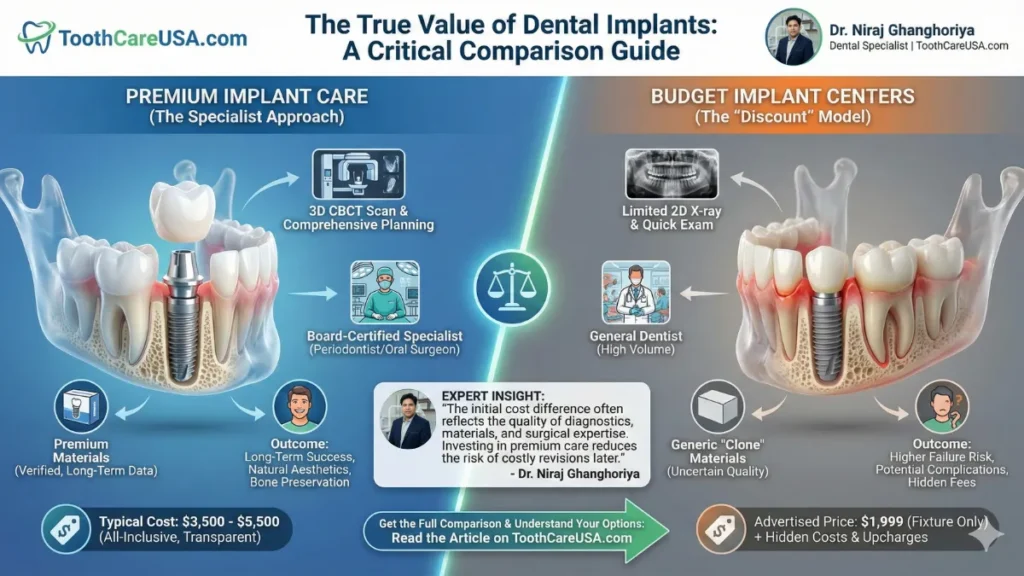
| Feature | Premium Implant Care | “Discount” Implant Centers |
| Total Cost (Single) | $3,500 – $5,500 | $1,999 – $2,500 (Hidden fees likely) |
| Consultation | Includes 3D CBCT Scan & Perio Exam | Often just a Panoramic X-ray (2D) |
| Materials | Top-tier Titanium/Zirconia (Straumann, Nobel) | Generic “Clone” Implants (Hard to find parts for) |
| Surgeon | Specialist (Periodontist/Oral Surgeon) | General Dentist or High-Volume Surgeon |
| Aftercare | Personalized follow-up for 6+ months | “Assembly line” style; quick dismissal |
| Longevity | Designed for 20+ years / Lifetime | Higher risk of screw loosening/failure |
Infographic on How Much Do Dental Implants Cost in Texas
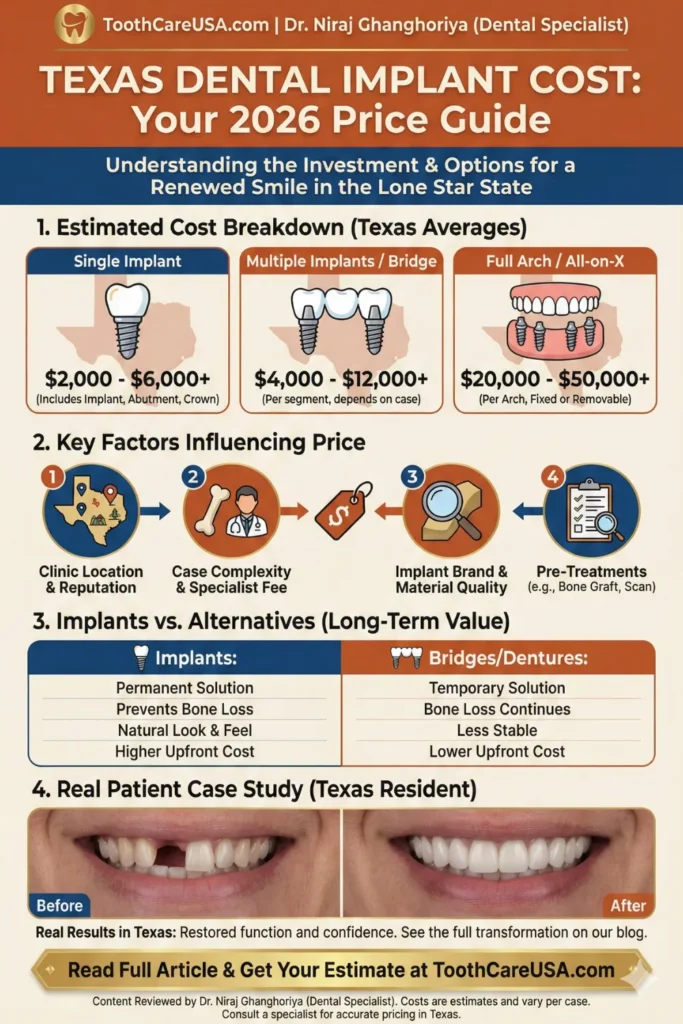
The Cost of a New Smile in the Lone Star State
“Everything is bigger in Texas,” but does that apply to dental implant costs? As our infographic details, the cost of dental implants in Texas varies widely, typically ranging from $3,500 to $5,500 per single implant. This price fluctuation is largely driven by the specific market—costs in Austin or Dallas-Fort Worth may be higher than in smaller West Texas communities.
Texas is a unique market because of its proximity to international borders, but we strongly advise patients to prioritize safety and regulation compliance found within US-based clinics. A Texas-based specialist adheres to strict sterilization and board-certified standards that guarantee your safety. The cost range mentioned usually includes the consultation, surgery, and the final custom-made crown.
For full-mouth reconstruction (All-on-4), Texas averages are competitive, often ranging between $20,000 and $28,000 per arch. Many Texas practices offer robust financing plans to make this life-changing procedure accessible. At ToothCareUSA.com, we emphasize that choosing a local Texas specialist ensures you have a partner for the lifetime of your implant, providing regular check-ups and hygiene care essential for protecting your investment.
Dr. Niraj Ghanghoriya’s Verdict onHow Much Do Dental Implants Cost in Texas
Who is this for?
Dental implants are for patients who value longevity and health over short-term savings. If you have a healthy jawbone (or are willing to graft), want to eat steak and apples without fear, and want to preserve your facial structure from collapsing, this is the best investment you can make in your body.
Who should avoid this?
If you are currently a heavy smoker or have uncontrolled diabetes, I often advise pausing. Osseointegration (the fusing of bone to metal) fails at a much higher rate in smokers because nicotine constricts blood vessels. We need to get your health under control first. Also, if you are looking for the absolute “cheapest” fix and are not concerned about bone loss, a removable partial denture might be a temporary financial compromise.
Conclusion & Next Steps
When you ask “how much do dental implants cost in Texas,” you are really asking about the value of your smile and your ability to eat comfortably for the rest of your life.
While the price tag of $3,000 to $5,500 per tooth can be a “sticker shock,” remember that you are purchasing a complex medical device and the surgical expertise to install it safely.
Key Takeaways:
- Always ask for the “Out-the-Door” price (Implant + Abutment + Crown).
- Verify the materials (ask for brand names like Nobel Biocare or Straumann).
- Never skip the 3D Scan.
Next Step:
Do not let the cost scare you away from getting a professional opinion. Most offices offer a consultation to give you an exact quote. If you are in doubt about a quote you received, seek a second opinion from a specialist who prioritizes safety over speed.
References & Further Reading
- American Academy of Periodontology (AAP): Dental Implants: Procedures and Benefits.
- Journal of Oral Implantology: Long-term survival rates of titanium vs. zirconia implants.
- American Dental Association (ADA): Patient Guide to Dental Implants and Insurance Coding.
Medical Disclaimer: The content provided in this article, including costs and medical information, is for educational purposes only and does not constitute medical advice, diagnosis, or treatment. Always seek the advice of your dentist, physician, or other qualified health provider with any questions you may have regarding a medical condition or treatment. Prices listed are estimates based on Texas market averages as of 2025-2026 and vary by provider.

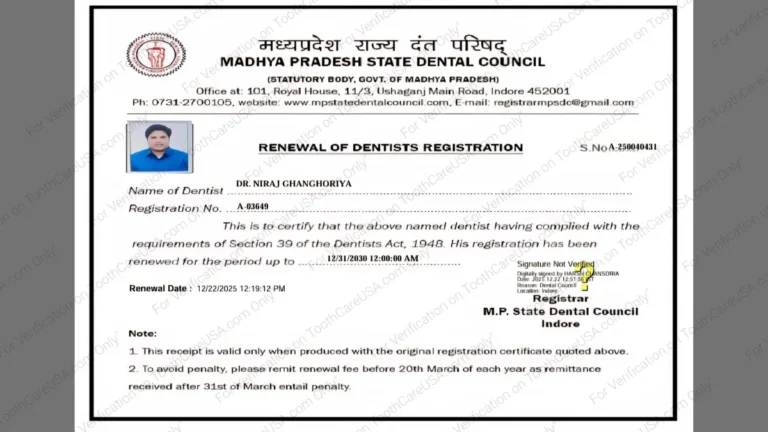
Dr. Niraj Ghanghoriya is a passionate dental surgeon with over 12 years of experience in clinical dentistry. He completed his BDS from the prestigious Sri Aurobindo Institute of Dentistry in 2012 and specializes in painless root canals, smile makeovers, and preventive oral care. He is the Founder of ToothCareUSA.com and a registered Dental Surgeon (Reg No: A-03649) based in Indore. Known for his patient-first approach and clear communication, Dr. Ghanghoriya aims to make dental knowledge accessible to everyone. When he’s not in the clinic, he enjoys writing informative dental blogs to help people take better care of their oral health. He reviews every article on this site to ensure medical accuracy and patient safety.