Author: Dr. Niraj Ghanghoriya (Dental Specialist)
Micro-Note: For educational purposes only. See full medical disclaimer below.
Quick Answer: How Much Do One Day Dental Implants Cost?
The average cost for full arch “One Day” dental implants typically ranges from $20,000 to $35,000 per jaw. This price usually includes the surgery, 4-6 implants, and the immediate temporary bridge. For a single tooth, immediate load implants range from $3,000 to $5,000. However, the final price depends heavily on whether you choose a high-end Zirconia final prosthesis or a standard acrylic hybrid bridge.
Introduction: Why I Sometimes Refuse “Teeth in a Day”
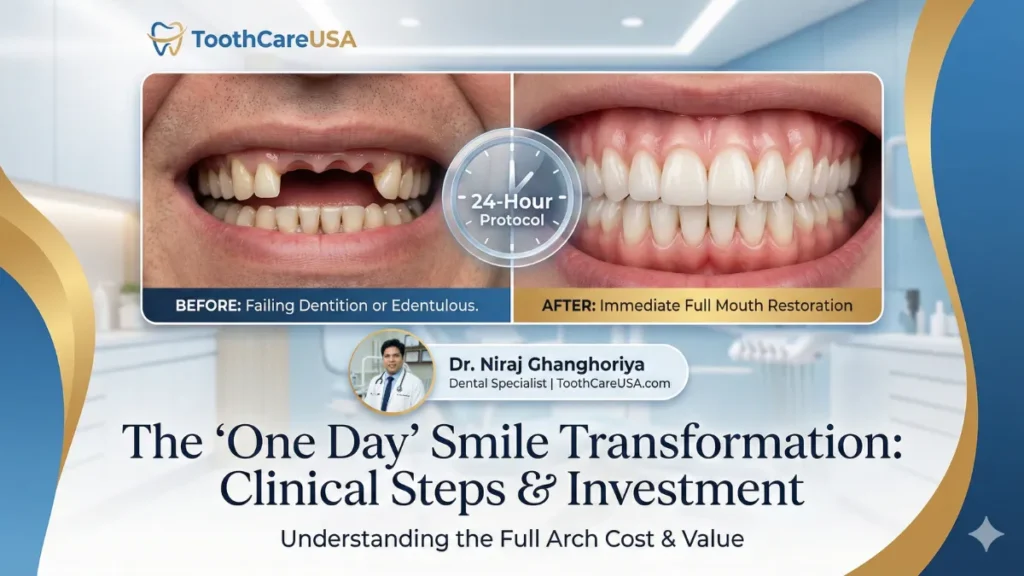
You’ve likely seen the billboards or the Facebook ads: “Brand new smile in 24 hours!” It sounds like magic. For many patients suffering from loose dentures or failing teeth, it is a life-changing reality. But as a specialist, I need to be honest about the one thing the advertisements rarely mention: Bone Density.
In my clinical practice at ToothCareUSA, I often have difficult conversations with patients who are ready to pay the full one day dental implants cost, only for me to tell them we have to wait. Why? Because if the bone is too soft, loading teeth immediately is a recipe for failure.
In this guide, I’m going to break down the real financial and biological cost of immediate-load implants. We will look beyond the “sticker price” to understand the clinical risks, the hidden fees, and the specific “torque test” we use to ensure your investment lasts a lifetime, not just a few months.
The “Quick Answer”: What is the Average Cost?
When patients ask about the one day dental implants cost, they are usually looking for a single number. However, in dentistry, a single number is rarely accurate because every mouth is unique.
Based on 2026 national averages and my experience in the field, here is what you can expect:
- Single Immediate Implant: $3,000 – $5,000 (Includes implant post, abutment, and crown).
- All-on-4 (One Arch): $20,000 – $30,000 (Upper or Lower jaw only).
- Full Mouth (Both Arches): $40,000 – $60,000+.
Dr. Niraj’s Note: Be very careful with “bargain” quotes (e.g., “$14,999 per arch”). In my experience, these low-ball offers often exclude essential fees like IV sedation ($1,500+ value), extractions, or the final permanent teeth. They get you in the door, but the final bill is much higher.
How Much Do Full Mouth Dental Implants Cost for One Day?
This is the most common question I receive during consultations. “Full mouth” usually refers to replacing all teeth in both the upper and lower jaws using a system often called “All-on-4” or “All-on-6.”
Here is how the pricing models generally work:
- The “Teeth-in-a-Day” Phase: You pay for the surgery and the temporary teeth you wear home. This is often the base price quoted in ads.
- The “Final Restoration” Phase: About 4-6 months later, once the bone has healed, we replace the temporary plastic teeth with the permanent set.
The Material Matters:
- Acrylic (PMMA) Bridge: This is the standard, lower-cost option. It looks good, but it can stain and wear down over time.
- Zirconia Bridge: This is the “Gold Standard.” It is incredibly strong, does not stain, and looks exactly like natural enamel. Upgrading to Zirconia usually adds $5,000 to $7,000 to the total cost.
Breaking Down the Bill: Where Does Your Money Actually Go?
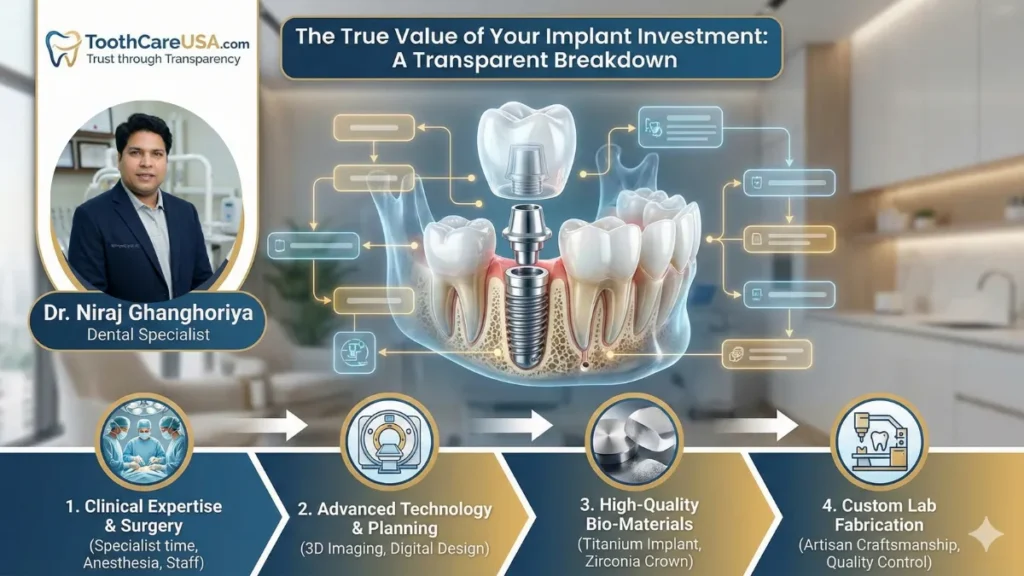
It is natural to wonder why tiny titanium screws cost as much as a new car. Transparency is key to trust. When you pay for immediate load implants, you aren’t just paying for a product; you are paying for a complex surgical team and bioengineering.
Here is the line-item breakdown:
1. The Hardware
We use medical-grade titanium posts and specific connectors called Multi-Unit Abutments. These special connectors allow us to screw the bridge onto the implants at an angle, which is essential for the “One Day” procedure.
- Cost Factor: High-quality, name-brand implants (like Nobel Biocare or Straumann) have decades of research behind them. Generic “clones” are cheaper but have higher fracture risks.
2. The Surgery Team
This isn’t a standard filling. A full-arch surgery often involves:
- The Implant Surgeon: To place the hardware.
- The Anesthesiologist: For IV Sedation (twilight sleep), so you wake up with no memory of the procedure.
- Surgical Assistants: To manage sterile protocols.
3. The Lab (The Artists)
You are paying for a custom-designed smile. A master technician uses digital design software to craft your temporary bridge (PMMA), so it is ready the moment surgery is done.
The Hidden Costs Most Quotes Leave Out
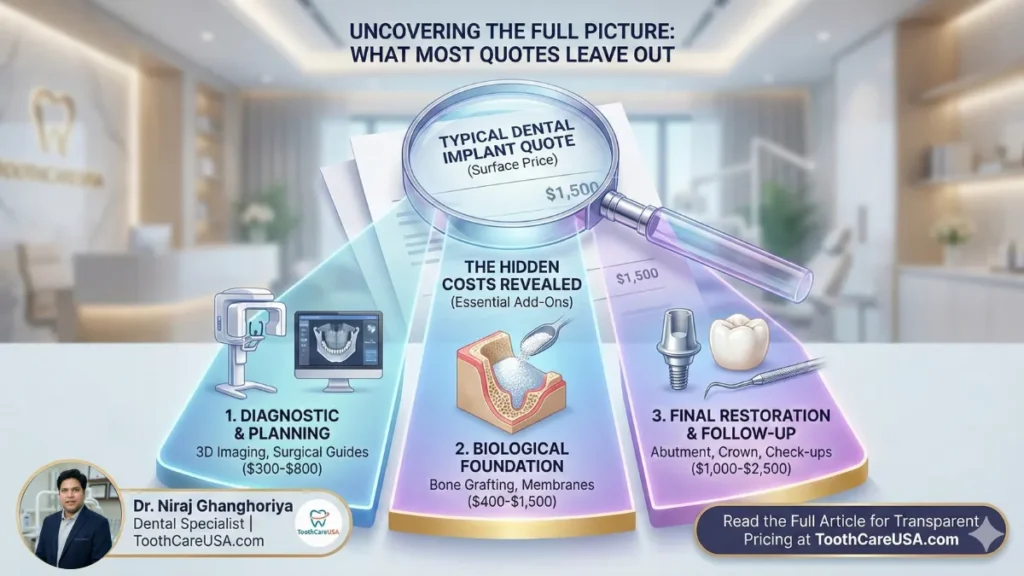
In my years of practice, I have seen many patients surprised by “add-ons” that weren’t in their initial consultation. To protect your budget, ask about these three specific things:
1. CBCT Scans (3D X-Rays)
We cannot plan this surgery with a regular 2D dental X-ray. We need a Cone Beam Computed Tomography (CBCT) scan to see nerves and sinus cavities in 3D.
- Average Cost: $300 – $600.
2. Alveoloplasty (Bone Leveling)
To make your new smile look natural, we often need to smooth out the jagged jawbone after extracting teeth. This procedure, called Alveoloplasty, ensures your gums heal flat and pink, rather than bumpy.
- Average Cost: $500 – $2,000 (often bundled, but check to be sure).
3. The “Foundation” Work
If you have had missing teeth for a long time, you may suffer from Alveolar Ridge Resorption (bone loss). If the bone is too thin, we may need bone grafting or sinus lifts before we can even place the implant.
- Average Cost: $500 – $3,000.
What Are “One Day” Implants?
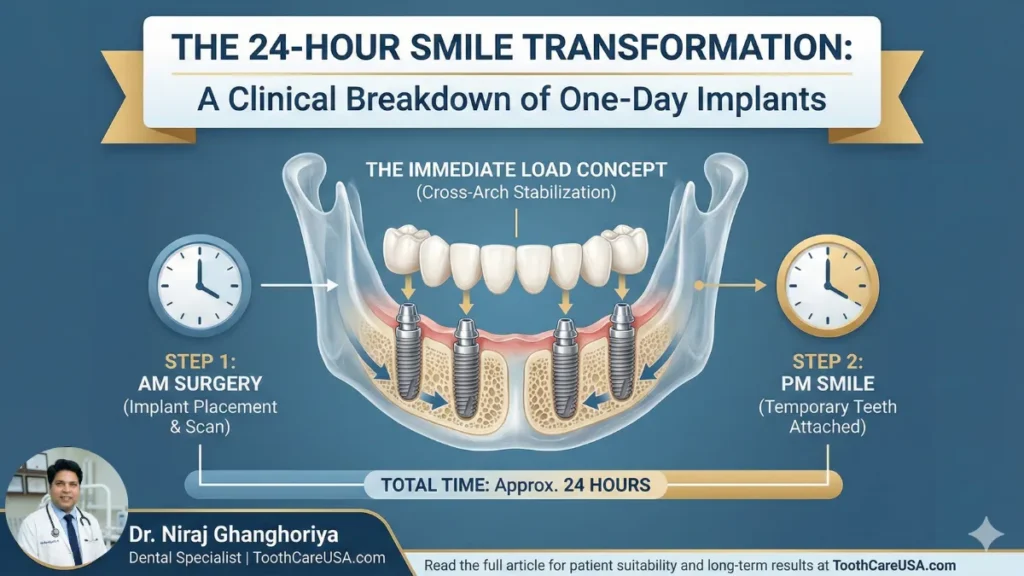
Let’s clarify the medical definition. In clinical terms, we call this the Immediate Loading Protocol.
Traditionally, when an implant is placed, we wait 4 to 6 months for Osseointegration—the biological process where your bone fuses to the titanium surface. During this time, the implant usually stays buried under the gum, and you wear a removable denture.
The “One Day” Difference:
By linking 4 or more implants together with a rigid bridge, we create Cross-Arch Stabilization. Think of it like a table: one leg is wobbly, but four legs connected by a frame are solid. This stability allows the implants to handle chewing pressure immediately, allowing us to attach teeth on the same day as surgery.
The Procedure: From Surgery to Smile in 24 Hours
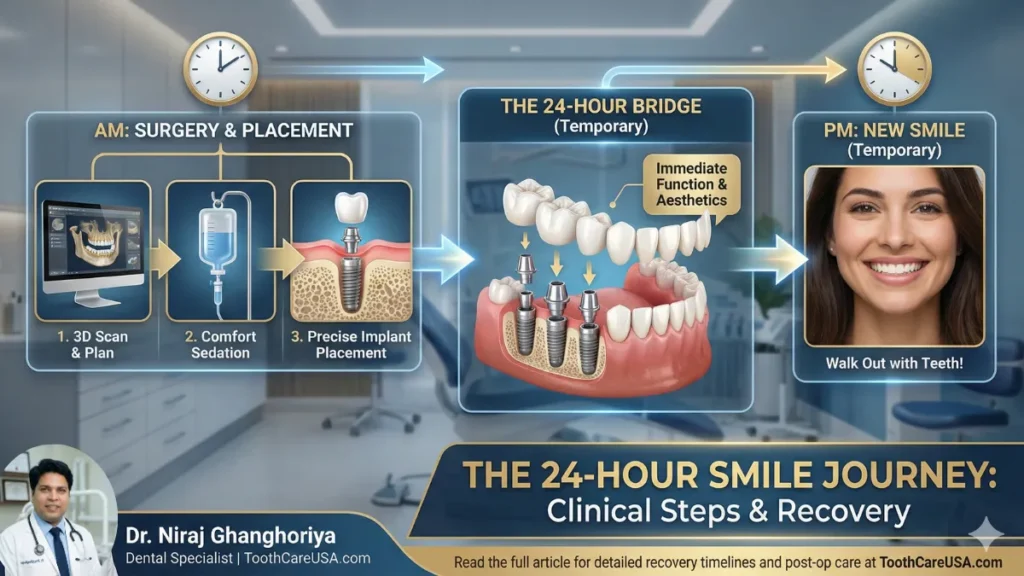
How do we actually do it? Here is a step-by-step look at the day of the procedure:
Step 1: The Blueprint
Before you ever sit in the chair, we use digital software to map out exactly where every nerve and sinus cavity is. We often print a “Surgical Guide” to ensure the implant is placed with sub-millimeter accuracy.
Step 2: The Surgery
You are placed under sedation. We remove any remaining failing teeth and perform the Alveoloplasty (bone smoothing). The implants are then placed into the jawbone.
Step 3: The “Torque Test” (Crucial Safety Check)
This is the most critical moment. As I screw the implant into the bone, I measure the resistance, known as Primary Stability. We measure this in Newton Centimeters (Ncm).
- The Rule: The implant must achieve a torque value of >35 Ncm.
- The Reality: If the bone is soft and the implant spins loosely (below 35 Ncm), I will not load the tooth. It is unsafe. In this scenario, the patient must wear a traditional denture for a few months while the bone heals. A doctor who ignores this rule risks total implant failure.
Does Insurance Cover Same-Day Dental Implants?
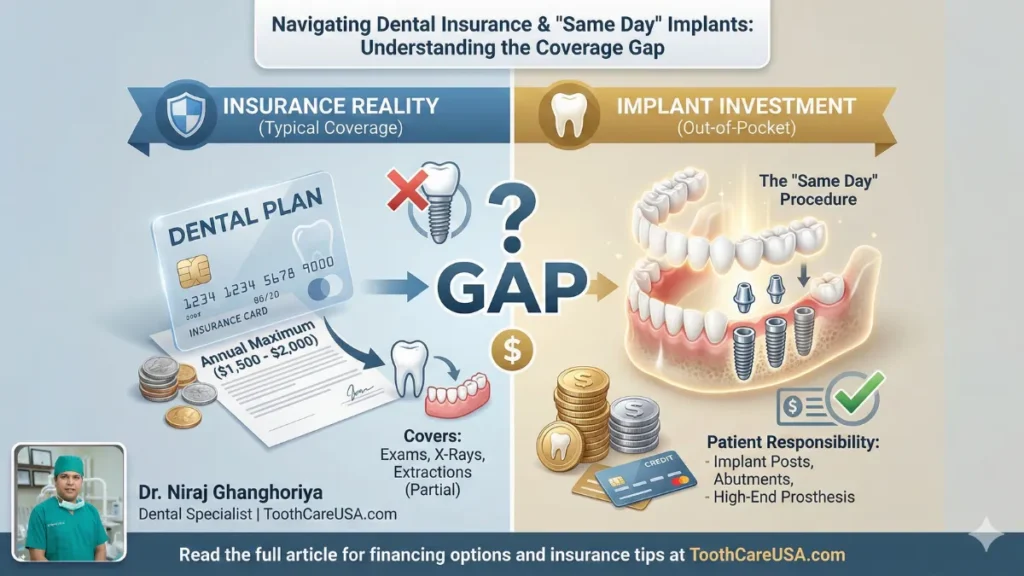
This is a major frustration for patients. The short answer is: Rarely.
- The Annual Maximum: Most dental insurance plans have an annual maximum of $1,500 to $2,000. Given that the procedure costs $20,000+, insurance acts more like a small discount coupon than true coverage.
- The “Medical Necessity” Loophole: In rare cases—such as tooth loss due to a severe accident, trauma, or oral cancer—medical insurance might cover a portion of the reconstruction. It is worth asking your provider.
- HSA/FSA: You can use your Health Savings Account (HSA) or Flexible Spending Account (FSA) to pay for implants with pre-tax dollars, which can save you a significant amount in taxes.
Financing Options: How to Afford the Smile
Since most patients do not have $25,000 sitting in a checking account, financing is the standard way to pay.
- Third-Party Financing: Companies like CareCredit or LendingClub specialize in healthcare loans. They often offer 0% interest for 12-24 months, or extended plans out to 60 months with interest.
- Payment Plans: Monthly payments generally range from $300 to $600, depending on your credit score and the loan term.
- Retirement Savings: Some patients choose to borrow against their 401k. While I am a dentist, not a financial advisor, many view this as investing in their health. However, always consult a financial expert before touching retirement funds.
One Day Implants vs. Traditional Dentures: A 10-Year Cost Analysis
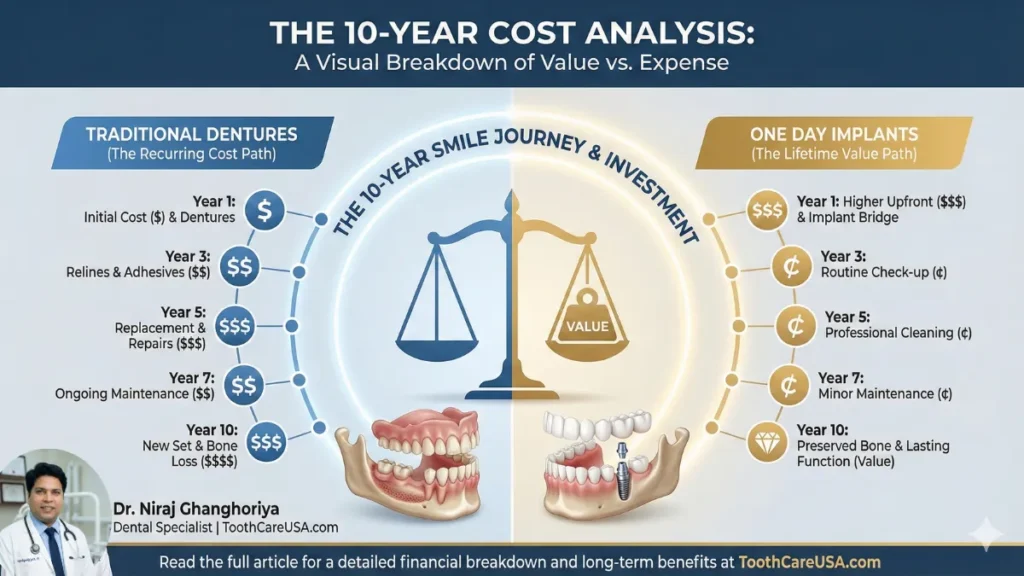
When you look at the upfront price, dentures seem like the winner ($1,000 vs. $20,000). But let’s look at the 10-Year Real Cost:
| Feature | Traditional Dentures | One Day Implants (All-on-4) |
| Initial Cost | Low ($1k – $3k) | High ($20k – $30k) |
| Bone Health | Bone Loss Continues: Face may look sunken over time. | Bone Preserved: Implants stimulate the jawbone. |
| Maintenance | Relines every 2 years; Replacement every 5-7 years; Adhesives monthly. | Annual check-ups; Professional cleaning. |
| Function | 20% chewing power (Diet restrictions). | 90% chewing power (Eat steak/apples). |
| Comfort | Can slip, cause sores, or gag reflex. | Fixed in place. No slipping. |
| Long-Term Value | Low: Recurring costs and biology loss. | High: One-time investment for life. |
The Hidden Cost of Dentures: The most expensive part of dentures isn’t the plastic; it’s the resorption (shrinkage) of your jawbone. Once that bone is gone, it is incredibly expensive and difficult to rebuild.
Risks & Safety: When “One Day” Becomes “One Disaster”
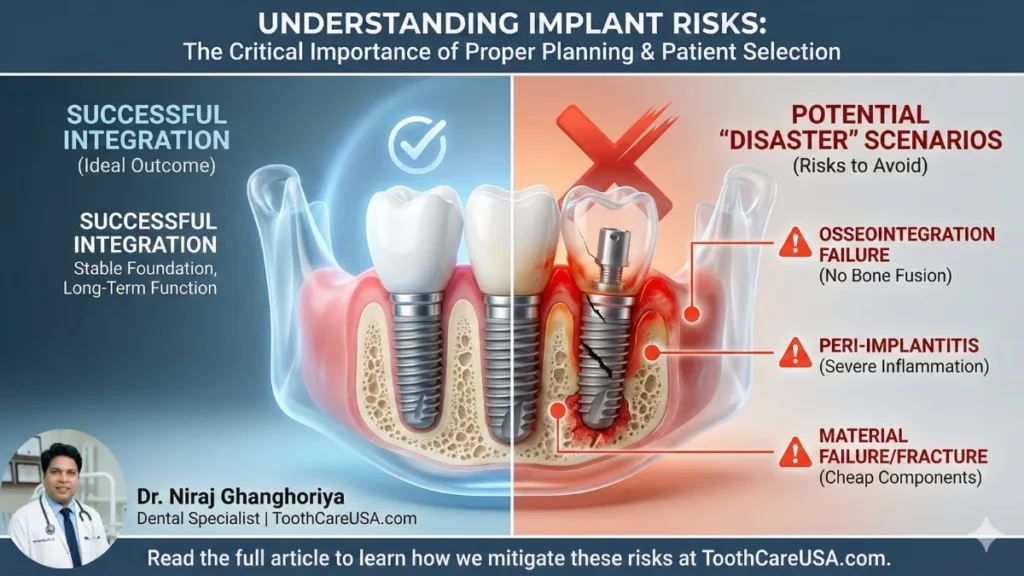
High cost does not guarantee success. There are real risks involved.
- Osseointegration Failure: This is when the bone fails to fuse to the implant. It can happen if there is micromotion (wiggling) during the healing phase. This is why following a soft-food diet for 4 months is non-negotiable.
- Peri-implantitis: This is a gum disease that attacks implants, similar to periodontitis in natural teeth. If you don’t clean under the bridge with a water flosser, bacteria can destroy the bone around the implant.
- The Cheap Material Trap: If a clinic uses “knock-off” implant brands to lower the one day dental implants cost, finding replacement parts in 5 or 10 years might be impossible. Always ask for the brand name of your implants (e.g., Nobel, Straumann, BioHorizons).
Dr. Niraj’s Warning: Smokers and patients with uncontrolled diabetes have a significantly higher failure rate. Nicotine constricts blood vessels, stopping the oxygen needed for bone healing. If you smoke, you are risking your $20,000 investment.
Infographic on One Day Dental Implants Cost
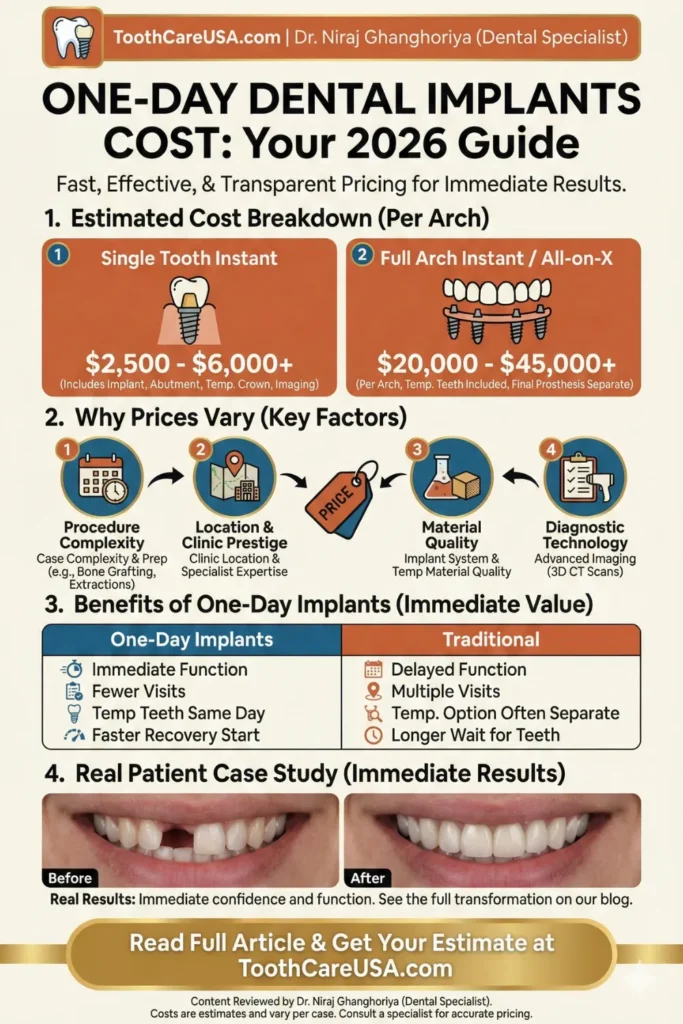
Same-Day Smiles: The Cost of Immediate Function Implants
“Teeth in a Day” or “Same-Day Implants” are a revolutionary option for patients who need immediate results. As shown in the infographic, this premium service typically commands a higher price, with single immediate implants ranging from $4,000 to $6,000 and full-arch immediate solutions ranging from $25,000 to $40,000.
The higher cost is justified by the advanced logistics and technology required. In a standard procedure, there is a waiting period of months. For One Day Implants, the surgeon, prosthodontist, and lab technician often work simultaneously to fabricate a temporary set of teeth that you walk out with immediately after surgery. This requires high-resolution 3D CT scanning and precise surgical guides.
While the upfront cost is higher, the value lies in the immediate restoration of aesthetics and function—you don’t have to go without teeth or wear an uncomfortable removable denture during the healing phase. At ToothCareUSA.com, we carefully screen candidates for this procedure, as sufficient bone density is non-negotiable for immediate loading. It is an investment in speed, convenience, and immediate quality of life.
Self-Check: One Day Implants Assessment
Dr. Niraj Ghanghoriya’s Verdict
So, is the high price tag worth it?
Who is this for?
This procedure is ideal for patients who have failing dentition (severe gum disease or decay) or those currently wearing dentures who hate them. If you are a busy professional or active individual who cannot afford to go “toothless” for months, the immediate loading protocol is a fantastic solution.
Who should avoid this?
If you have severe bone loss that requires massive grafting, “One Day” implants might be risky. You might be better served by a staged approach—building the bone first, placing implants later. It takes longer, but it is safer. Also, if you are a heavy smoker unwilling to quit, I generally advise against this procedure due to the high risk of failure.
Conclusion & Next Steps
Understanding the one day dental implants cost requires looking past the initial quote. You are investing in bioengineering that restores your ability to eat, speak, and smile with confidence.
Key Takeaways:
- Expect to pay between $20,000 and $30,000 per arch.
- Verify that your quote includes the anesthesia, extractions, and the final permanent prosthesis.
- Understand that if your bone is soft during surgery, you may not get teeth that specific day—and that is a good thing for your safety.
If you are tired of dental pain or loose dentures, the next step is a 3D scan to see if you are a candidate.
Consult a Specialist: Do not rely on Google alone. Book a consultation with a certified dental specialist to get a personalized treatment plan and a firm cost breakdown.
References & Further Reading
- American Academy of Implant Dentistry (AAID): Dental Implants Facts and Figures.
- Journal of Oral and Maxillofacial Surgery: Long-term outcomes of immediate loading protocols.
- PubMed / NCBI: Comparison of All-on-4 vs. Traditional Dentures regarding patient satisfaction.
Medical Disclaimer: The content provided in this article, including costs and medical information, is for educational purposes only and does not constitute medical advice, diagnosis, or treatment. Always seek the advice of your dentist or other qualified health provider with any questions you may have regarding a medical condition or treatment. Never disregard professional medical advice or delay in seeking it because of something you have read on this website. Individual costs and results may vary.
Frequently Asked Questions (FAQ) on one day dental implants cost
How much do the average one day dental implants cost in 2026?
The average one day dental implants cost ranges from $4,000 to $5,500 for a single tooth and $20,000 to $30,000 per arch for full-mouth restoration. This premium price reflects the advanced immediate-load technology, the on-site laboratory fees, and the specialized surgical expertise required to deliver teeth in 24 hours.
Dr. Niraj’s Take: “Speed costs money—you are paying for the convenience of walking out with a smile the same day, which requires an entire team working exclusively on you.”
Why is the one day dental implants cost higher than traditional implants?
The cost is higher because it requires an ‘All-Inclusive’ surgical and prosthetic team to be available instantly. Unlike traditional methods spread over months, ‘Same Day’ implants involve expedited lab fabrication, specialized high-stability titanium screws, and 3D computer-guided surgery, all of which increase overhead expenses.
Dr. Niraj’s Take: “We condense 6 months of work into 6 hours; that intensity requires expensive resources, but it buys you immediate quality of life.”
Are one day dental implants worth the cost in terms of success rate?
Yes, one day dental implants have a high success rate of 94% to 98%, comparable to traditional delayed implants. However, success depends heavily on bone density; if the implant doesn’t achieve ‘primary stability’ (tightness) immediately, the risk of failure increases, making patient selection critical.
Dr. Niraj’s Take: “I only approve ‘Same Day’ if the bone is rock solid—if it’s soft, I will refuse to load it immediately to save your investment from failing.”
Does insurance cover the one day dental implants cost?
Most dental insurance plans cap their coverage at $1,500–$2,000 per year, covering only a fraction of the total one day dental implants cost. However, third-party financing options like CareCredit or LendingClub are standard, often allowing patients to pay monthly installments over 24 to 60 months.
Dr. Niraj’s Take: “Don’t rely on insurance for the bulk of this; look into 0% interest financing plans, which make the $25,000 price tag feel like a manageable monthly car payment.”
Is the procedure for one day implants more painful?
Surprisingly, patients often report less pain with one day implants because the procedure is flapless (minimally invasive) and requires fewer visits. Sedation is used during surgery, and because the implants are stabilized immediately by the new teeth, there is less movement and irritation to the gums during healing.
Dr. Niraj’s Take: “You walk out with teeth, not open wounds—psychologically and physically, this makes the recovery feel much faster and easier.”

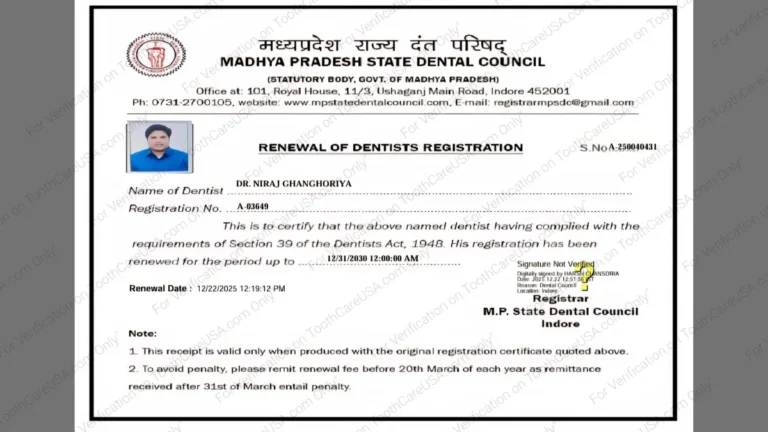
Dr. Niraj Ghanghoriya is a passionate dental surgeon with over 12 years of experience in clinical dentistry. He completed his BDS from the prestigious Sri Aurobindo Institute of Dentistry in 2012 and specializes in painless root canals, smile makeovers, and preventive oral care. He is the Founder of ToothCareUSA.com and a registered Dental Surgeon (Reg No: A-03649) based in Indore. Known for his patient-first approach and clear communication, Dr. Ghanghoriya aims to make dental knowledge accessible to everyone. When he’s not in the clinic, he enjoys writing informative dental blogs to help people take better care of their oral health. He reviews every article on this site to ensure medical accuracy and patient safety.