A Dental Specialist’s Breakdown of Pricing, Hidden Fees, and Financial Aid
Author: Dr. Niraj Ghanghoriya (Dental Specialist)
Micro-Note: Educational purposes only. See full disclaimer below.
Quick Answer: The Real Price in Ohio
In Ohio, the total cost for a single dental implant typically ranges from $3,000 to $5,500 per tooth. This includes the surgery, the abutment (connector), and the final crown. While some clinics advertise “implants for $999,” this usually covers only the surgical screw, leaving you with thousands in additional fees for the actual tooth and necessary diagnostics.
Introduction
If you are driving through Ohio and see a billboard advertising “Dental Implants for $999,” I want you to keep driving.
In my clinical experience, that price usually pays for the screw, but not the tooth that goes on top of it. It’s a marketing tactic that has confused countless patients who walk into a clinic expecting a deal, only to walk out with a treatment plan that costs five times as much.
Today, I’m going to show you the real invoice—line by line about the cost of Dental Implants in Ohio—so you don’t get blindsided at the checkout desk.
As a dental specialist, I know that losing a tooth is emotional. It affects how you eat, how you smile, and how you feel about yourself. But fixing it shouldn’t bankrupt you. Whether you are in downtown Columbus or a rural county, you deserve transparent answers about what you are paying for, why the costs vary so wildly across our state, and how to spot a “too good to be true” offer before you sit in the chair.
Quick Answer: How Much Does a Single Dental Implant Cost in Ohio Without Insurance?
When patients ask me this, I tell them we have to look at the “All-In” price tag. You aren’t buying a car without tires; you shouldn’t buy an implant without the crown.
The “All-In” price includes three critical phases: the diagnostics (scans), the surgery (placing the screw), and the restoration (the new tooth).
- The Ohio Average: Between $3,000 and $5,500 for one complete tooth.
- The Low End: You might find prices closer to $2,500 in rural areas or university clinics like OSU.
- The High End: Complex cases in major metro areas like Cleveland or Cincinnati requiring bone grafting can easily push $6,000+.
In my analysis of treatment plans across different states, I, Dr. Niraj Ghanghoriya, have noticed that Ohio presents a unique pricing landscape—where costs in metro hubs can be 20-30% higher than in rural counties due to higher overheads and lab fees.
Why the “Unbundled” Price is Dangerous
The “Unbundled” quote is the most common trick in the industry. A clinic quotes you $1,000 for the implant. You agree. Then, after the surgery is done, you find out the abutment is $600, and the crown is $1,500. By then, the screw is already in your jaw. Always ask for the “Total Restoration Cost.”
Anatomy of the Bill: What Are You Actually Paying For?
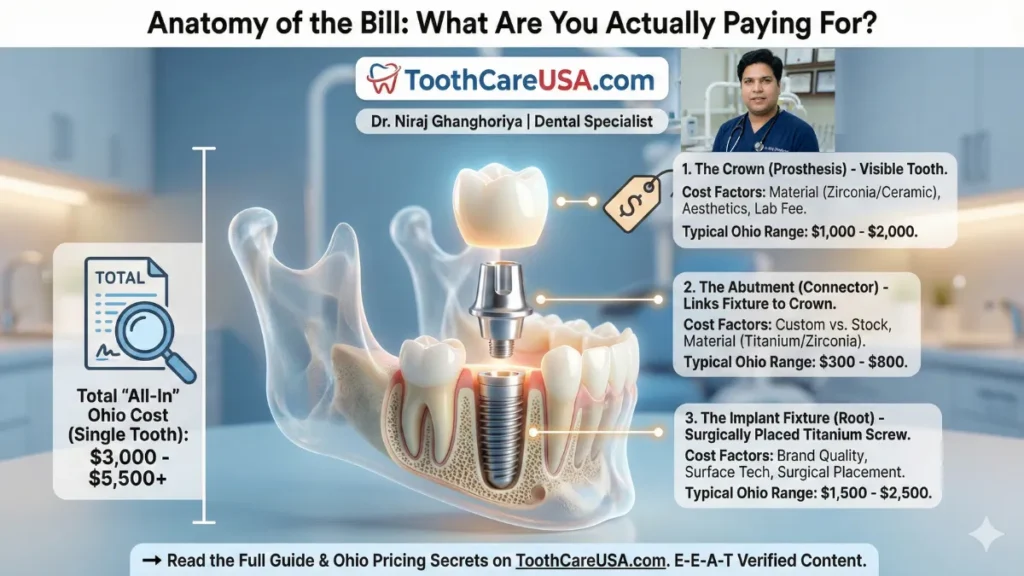
To understand the price, you have to understand the hardware. You aren’t just paying for “a fake tooth.” You are paying for a sophisticated medical device designed to fuse with your body.
1. The Implant Fixture (Endosteal Implant)
This is the titanium screw that acts as the artificial root. It is surgically placed into your jawbone.
- Cost Impact: Premium brands like Straumann or Nobel Biocare invest millions in research to ensure faster healing and lower failure rates. Generic “clones” are cheaper but may not have the same long-term success data.
- Clinical Note: Most modern implants are Endosteal (placed “in the bone”).
2. The Abutment
This is the connector piece that screws into the implant fixture and holds the crown.
- Titanium Abutment: Standard, strong, and silver-colored. Cheaper.
- Zirconia Abutment: White and tooth-colored. This is essential for front teeth so no grey metal shows through your gums.
- Cost Difference: A custom Zirconia abutment can add $300–$600 to your bill compared to a stock titanium one.
3. The Crown (Prosthesis)
This is the visible part—the tooth itself.
- Porcelain Fused to Metal (PFM): Durable, but can look opaque.
- Full Ceramic/Zirconia: Highly aesthetic and incredibly strong. Most of my patients prefer this for a natural look.
Step-by-Step: The Clinical Process & Associated Costs

A dental implant isn’t a single appointment; it’s a journey. Here is exactly what happens and what each step costs in Ohio.
Phase 1: Diagnostics (CBCT Scans)
Before I touch a patient with a scalpel, I need a map. We use CBCT (Cone Beam Computed Tomography) scans to see your bone density, nerve location, and sinus cavities in 3D.
- Safety First: Attempting an implant with just a regular 2D X-ray is risky. We need to avoid hitting nerves.
- Cost: In Ohio, a CBCT scan typically costs between $200 and $500. Some offices bundle this into the treatment plan if you proceed with surgery.
Phase 2: The Surgery (Osseointegration)
This is the appointment where the implant is placed.
- Anesthesia: Local anesthesia (numbing shots) is usually included. However, if you are anxious and want IV Sedation (“twilight sleep”), expect to pay an additional $500–$800.
- The Biology: We rely on a process called Osseointegration, where your bone cells actually grow into the microscopic pores of the titanium surface. This biological fusion is what makes implants so stable.
Phase 3: The Healing Period
You cannot put a heavy tooth on a fresh implant immediately (in most cases). You need 3–6 months for the bone to heal.
- The “Flipper”: If the missing tooth is in the front, you won’t want to walk around with a gap for months. A temporary partial denture, or “flipper,” is used for aesthetics.
- Hidden Cost: A flipper costs roughly $300–$600.
Why Are Dental Implants So Expensive in Columbus & Cleveland?
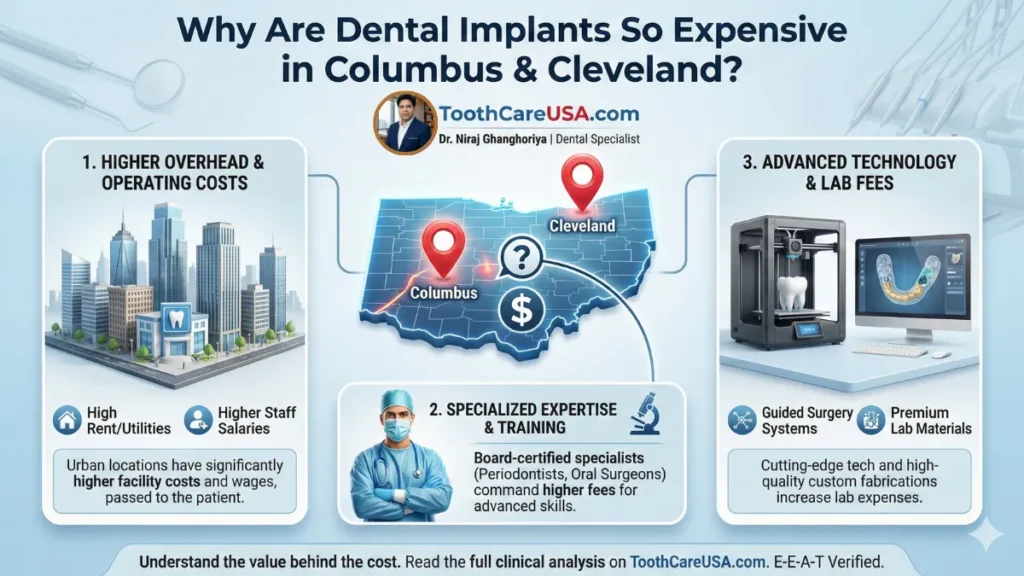
I often hear patients ask, “Why is my quote in Columbus so much higher than my cousin’s quote in rural Ohio?” The answer lies in the overhead.
Overhead & Lab Fees
Running a state-of-the-art clinic in a major metro area like Columbus, Cleveland, or Cincinnati costs significantly more in rent, utilities, and staff salaries than in smaller towns. These costs are naturally passed down to the patient.
Specialist vs. General Dentist
Who is placing your implant?
- General Dentist: Many general dentists take weekend courses to learn implants. They often charge less.
- Specialist (Periodontist/Oral Surgeon): A specialist has 2-3 extra years of residency focused solely on surgery and gums. Their fees are higher because you are paying for their expertise in handling complications and complex anatomy.
Technology Investments
Clinics that use “Guided Surgery” (where a 3D printed guide ensures the implant goes exactly where planned) have higher lab bills. This technology increases safety and precision but adds to the total fee.
Hidden Variables That Inflate the Quote
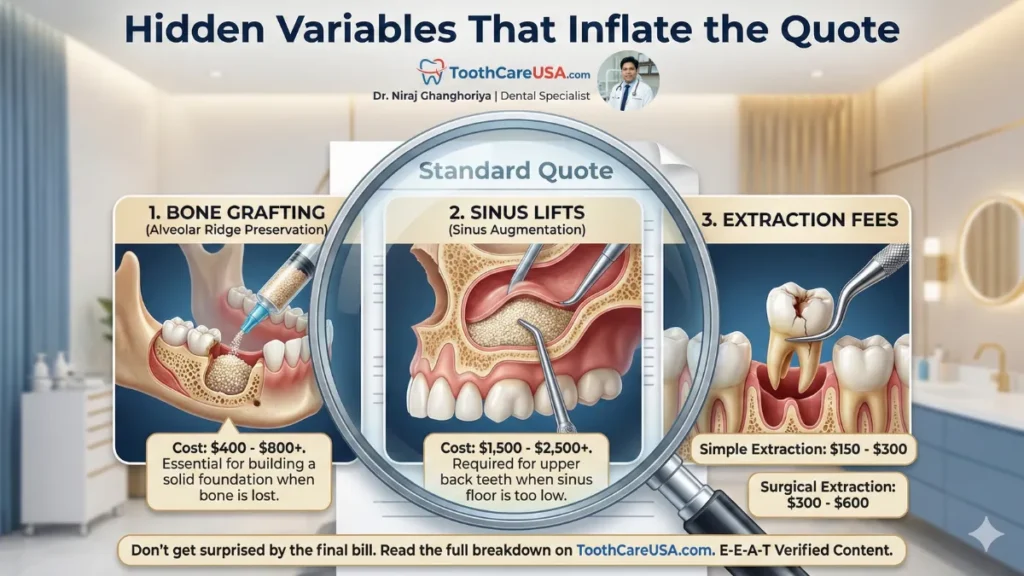
The standard price usually assumes you have plenty of healthy bone. But if you lost your tooth years ago, you might face additional “prep work.”
Bone Grafting (Alveolar Ridge Preservation)
When a tooth is removed, the jawbone melts away (resorbs) because it’s no longer being stimulated. To build it back up, we use bone grafting.
- The Procedure: We pack bone granules (synthetic, bovine, or donor) into the area to create a solid foundation.
- The Cost: This is the most common “surprise.” A simple socket graft adds $400–$800, while complex block grafting can cost significantly more.
Sinus Lifts (Sinus Augmentation)
This is specific to upper back teeth. Your sinus cavity is an air pocket above your upper jaw. If your bone is thin, the implant could poke into the sinus.
- The Fix: We gently lift the sinus membrane and pack bone underneath it.
- The Cost: A sinus lift is a delicate surgery that adds $1,500–$2,500 to the bill.
Extraction Fees
If the damaged tooth is still in your mouth, it must be removed first.
- Simple Extraction: $150–$300.
- Surgical Extraction: $300–$600.
Are There Any Government Grants for Dental Implants in Ohio?
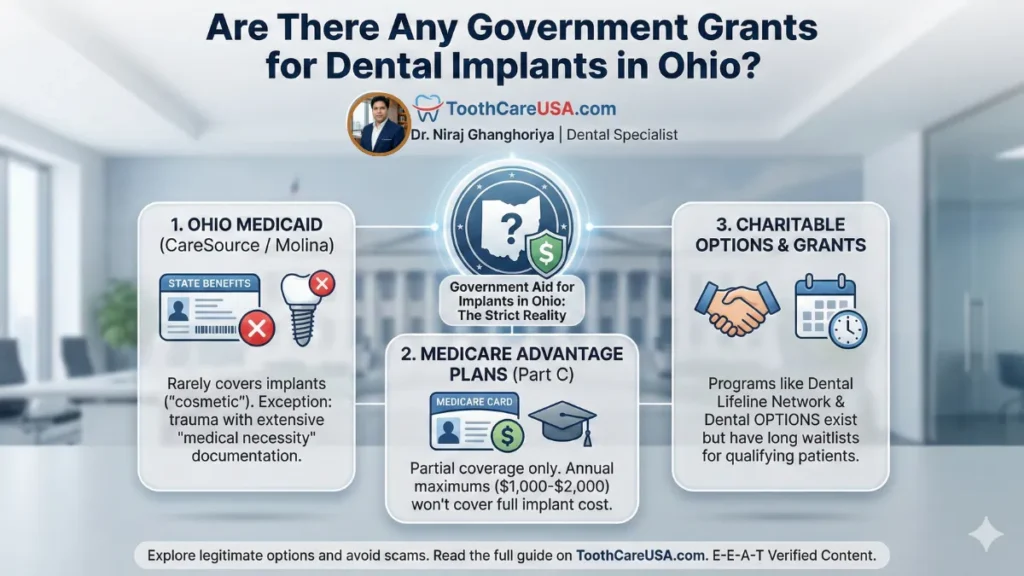
This is a tough conversation I have often. Many patients hope for government aid, but the reality is strict.
Medicaid in Ohio (CareSource / Molina)
Ohio Medicaid plans generally cover “medically necessary” procedures.
- The Reality: In 99% of cases, dental implants are classified as “cosmetic” or “elective” by insurance companies. Medicaid will typically pay for a denture (a removable plate) but rarely for a fixed implant.
- The Exception: Severe trauma (like a car accident) or reconstructive jaw surgery might get approved, but it requires extensive documentation of “medical necessity.”
Medicare Advantage Plans
Original Medicare (Part A and B) does not cover dental implants. However, many Medicare Advantage (Part C) plans sold in Ohio do offer dental benefits.
- The Limit: These plans often have an annual maximum of $1,000 to $2,000. This helps, but it won’t cover the full cost of an implant.
Charitable Options & Grants
- Dental Lifeline Network (Donated Dental Services): This program connects volunteer dentists with elderly or disabled patients in Ohio. Waitlists are long, but it’s a legitimate avenue for free care if you qualify.
- Dental OPTIONS: This is an Ohio-specific program partnering with the Ohio Department of Health. It links people with low incomes to dentists who agree to treat them for reduced fees.
How to Save Money Safely: Dr. Niraj’s Strategy

You don’t have to compromise on safety to save money. Here are three strategies I recommend.
University Clinics (The “Teaching Discount”)
Ohio is home to excellent dental schools like The Ohio State University (OSU) College of Dentistry and Case Western Reserve University.
- The Deal: You are treated by supervised students or residents.
- The Savings: Fees are typically 20-40% lower than private practice.
- The Trade-off: Appointments take much longer (3-4 hours) because every step is graded by a professor.
The “Rural Drive” Tactic
Dental fees are often dictated by zip code. Driving 45 minutes outside of a major city circle (like driving from Columbus to Marysville or Lancaster) can sometimes save you 15–20% per tooth.
Dental Savings Plans
These are not insurance. You pay a yearly fee (around $100–$150) to get access to a network of dentists who agree to discounted rates. It can shave 10-15% off the bill instantly with no waiting periods.
Risks vs. Rewards: Is the Cost Worth It?
Is spending $4,000 on a tooth worth it? Let’s look at the alternatives.
Implant Failure (Peri-implantitis)
The biggest financial risk isn’t the upfront cost; it’s failure. Peri-implantitis is an infection around the implant that can cause it to fall out. This is why “cheap” implants placed by inexperienced providers often end up costing double to fix.
Bridge vs. Implant: The 10-Year Cost
- Bridge: Cheaper upfront ($2,500). But it requires grinding down healthy neighboring teeth. If those teeth decay (which is common), the bridge fails.
- Implant: Higher upfront ($4,000). But it stands alone. It doesn’t damage other teeth. Over 15-20 years, an implant is often cheaper than replacing a bridge twice.
Bone Loss Prevention
This is the hidden value. Implants stimulate your jawbone just like a natural root. Dentures and bridges do not. Without an implant, your jawbone shrinks over time, leading to that “sunken face” look associated with aging.
Checklist: Questions to Ask Your Ohio Dentist Before Paying

Print this out and take it to your consultation.
- “Is the abutment and crown included in this quote?” (Preventing surprise bills).
- “What brand of implant do you use?” (Verifying quality—look for major FDA-approved brands).
- “How many implants have you placed this year?” (Verifying E-E-A-T—you want someone who does this weekly, not annually).
Critical Comparison Table: Dental Implant vs. Bridge in Ohio
| Feature | Single Dental Implant | Traditional Dental Bridge |
| Average Cost (Ohio) | $3,000 – $5,500 | $2,500 – $4,000 (3-unit) |
| Lifespan | 25+ Years (often lifetime) | 10 – 15 Years |
| Impact on Other Teeth | None (Independent) | Requires grinding down adjacent teeth |
| Bone Health | Prevents bone loss (Stimulates jaw) | Does not prevent bone loss |
| Aesthetics | Most Natural | Prevents bone loss (Stimulates the jaw) |
| Cleaning | Floss like a normal tooth | Requires special threading floss under the bridge |
Infographic on Cost of Dental Implants in Ohio
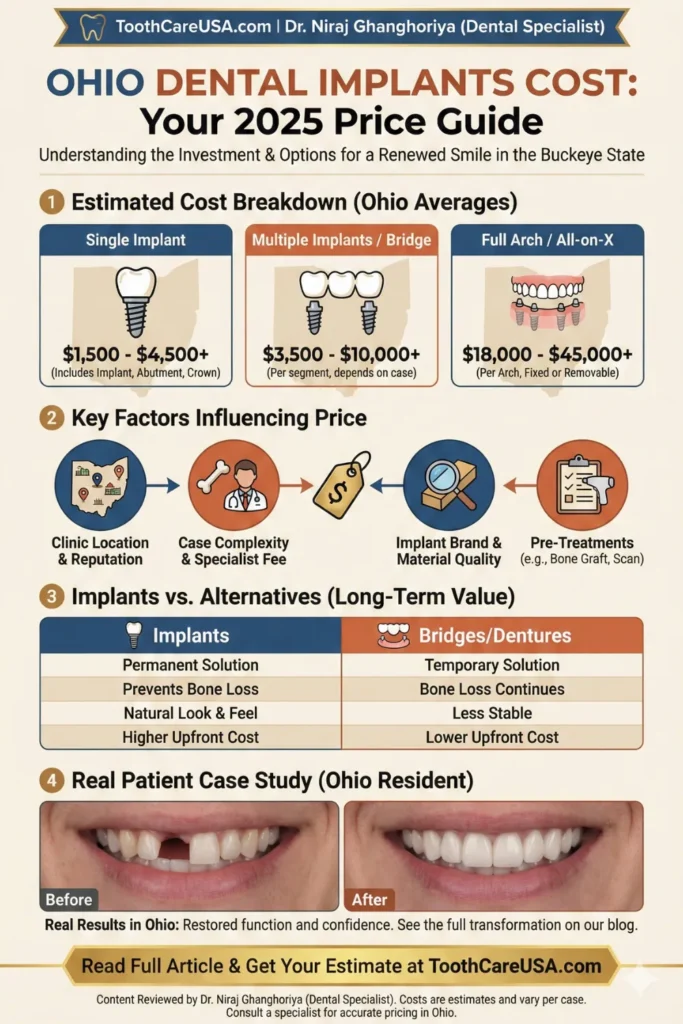
What to Expect: Dental Implant Pricing in Ohio
For residents of the Buckeye State, dental implant pricing offers a balance of affordability and access to quality care. As shown in the infographic, the average cost for a complete single tooth implant in Ohio typically lands between $3,000 and $4,500. This encompasses the surgical placement, the connector, and the final crown.
Ohio presents a diverse dental market. In major cities like Columbus, Cleveland, and Cincinnati, you may find more specialists (Periodontists and Oral Surgeons), which can influence pricing due to their advanced training. Conversely, in smaller towns, general dentists may offer implants at a lower price point, though it is crucial to verify their specific experience with implantology.
A key factor for Ohio patients is insurance coverage. While implants themselves are often considered “cosmetic” by basic plans, many Ohio employers offer dental benefits that may cover parts of the procedure, such as the anesthesia, extraction, or the final crown. At ToothCareUSA.com, we help Ohio patients navigate these benefits to minimize out-of-pocket expenses. We prioritize using high-grade titanium and zirconia materials to ensure that your investment withstands Ohio’s seasons and lasts a lifetime.
Dr. Niraj Ghanghoriya’s Verdict
Who is this for?
If you have a missing tooth but generally healthy gums and bone, an implant is the “Gold Standard.” It is the closest thing to getting your natural tooth back. It’s for the patient who wants a “set it and forget it” solution (with proper maintenance) and wants to protect their jawbone density.
Who should avoid this?
If you are a heavy smoker or have uncontrolled diabetes, your risk of failure skyrockets. Nicotine constricts blood vessels, stopping the oxygen needed for osseointegration. In these cases, I often refuse to perform the surgery until the patient cuts down, because I don’t want you to waste your money on an implant that won’t stick.
My advice: Don’t chase the lowest price. Chase the most experienced hands. Your jawbone is not renewable real estate; treat it with respect.
Conclusion & Next Steps
Understanding the cost of dental implants in Ohio is about more than just a number; it’s about value. While the initial investment is high, the long-term benefits for your health and confidence are unmatched.
- Takeaway 1: Expect to pay between $3,000 and $5,500 per tooth.
- Takeaway 2: Beware of “unbundled” low-cost ads.
- Takeaway 3: Look into university clinics or dental savings plans if budget is a major constraint.
Next Step: Consult a specialist for personal guidance. Do not rely on Google alone. You need a 3D scan to know your true options.
References & Further Reading
- American Academy of Periodontology (AAP): “Dental Implants: The Standard of Care.”
- Ohio Dental Association (ODA): Resources on “Dental OPTIONS” and patient assistance programs.
- Journal of Oral Implantology: Studies on “Osseointegration Success Rates in Smokers vs. Non-Smokers.”
Frequently Asked Questions (FAQ) on the cost of dental implants in Ohio
What is the average cost of dental implants in Ohio for 2026?
The average cost of a single dental implant in Ohio is between $3,000 and $5,000. This typically includes the titanium post, abutment, and porcelain crown. Prices in major metros like Columbus or Cleveland are often 10-15% higher than in rural counties due to higher operational overhead.
Dr. Niraj’s Take: “Always ask for the ‘out-the-door’ price—some Ohio clinics advertise $1,500 implants but hide the cost of the crown and CT scan in the fine print.”
Does Ohio Medicaid or CareSource cover dental implants?
Standard Ohio Medicaid generally does not cover implants, classifying them as elective. However, specific plans like CareSource MyCare Ohio (Dual Advantage) have introduced a $5,000 flex allowance for 2026 that can be applied toward major dental services, including implants, if you qualify for both Medicare and Medicaid.
Dr. Niraj’s Take: “Check your specific plan for the ‘flex card’ benefit—if you have dual coverage, you might essentially get your first implant for free.”
Where can I find affordable dental implants in Ohio?
The Ohio State University College of Dentistry in Columbus offers implant services at rates 30–50% lower than private practice. Because the procedures are performed by residents under the strict supervision of expert faculty, the costs are significantly reduced, though appointments generally take longer.
Dr. Niraj’s Take: “If you have time but a tight budget, OSU is a goldmine for quality care; you get university-level precision at a fraction of the market price.”
Is the dental implant procedure painful?
Patients in Ohio consistently report that implant surgery is less painful than a simple tooth extraction. The procedure is done under local anesthesia or IV sedation. Post-operative discomfort is usually mild, lasts only 3 to 5 days, and is easily managed with over-the-counter pain relievers like Ibuprofen.
Dr. Niraj’s Take: “Most of my patients go back to work the next day; the anxiety is usually far worse than the actual recovery.”
Are dental implants cheaper in rural Ohio areas?
Yes, dental offices in rural areas like Amish Country or southern Ohio often charge 10–20% less than clinics in downtown Cincinnati or Cleveland. Lower rent and operational costs allow these dentists to offer more competitive pricing, though you may need to travel for specialist appointments.
Dr. Niraj’s Take: “Driving 45 minutes outside the I-270 loop can sometimes save you $800 per tooth—it’s definitely worth the gas money.”
Medical Disclaimer: The information provided in this article is for educational purposes only and does not constitute medical advice. Prices mentioned are estimates based on 2026 market data in Ohio and may vary by clinic and case complexity. Always consult with a qualified dental specialist for a diagnosis and treatment plan tailored to your specific needs.

Dr. Niraj Ghanghoriya is a passionate dental surgeon with over 12 years of experience in clinical dentistry. He completed his BDS from the prestigious Sri Aurobindo Institute of Dentistry in 2012 and specializes in painless root canals, smile makeovers, and preventive oral care. He is the Founder of ToothCareUSA.com and a registered Dental Surgeon (Reg No: A-03649) based in Indore. Known for his patient-first approach and clear communication, Dr. Ghanghoriya aims to make dental knowledge accessible to everyone. When he’s not in the clinic, he enjoys writing informative dental blogs to help people take better care of their oral health. He reviews every article on this site to ensure medical accuracy and patient safety.