An impacted canine tooth represents one of the most challenging clinical situations in orthodontics. Due to its long, tortuous eruption path and critical role in occlusion and facial aesthetics, failure of canine eruption can lead to significant functional, periodontal, and esthetic complications if not diagnosed and treated appropriately.
Among impacted teeth, the maxillary canine is second only to third molars in frequency of impaction. Palatal impaction is significantly more common than buccal impaction, with reported ratios of approximately 3:1, and females are affected more frequently than males.
Impacted canine tooth PPT (PowerPoint) presentation
 Loading…
 Reload document
 Open in new tab
 Definition of Impacted Canine Tooth
An impacted tooth is defined as a tooth whose root formation is two-thirds complete or fully developed but fails to erupt into the oral cavity within the expected time. Commonly impacted teeth include:
- Mandibular third molars
- Maxillary canines
- Mandibular second premolars
The maxillary canine is particularly vulnerable due to its late eruption and complex developmental course.
What Is an Impacted Canine Tooth?
An impacted tooth is a tooth that fails to erupt into its normal position in the dental arch despite having sufficient root development. Among all teeth, maxillary canines are the second most commonly impacted teeth after third molars.
Maxillary canine impaction occurs more frequently on the palatal side than the buccal side, and studies show it affects females more often than males. Because canines follow a long and complex eruption path, they are particularly vulnerable to eruption disturbances.
Why Are Canine Teeth Important?
Canine teeth are often referred to as the “cornerstones” of the dental arch because they:
- Maintain facial harmony and smile aesthetics
- Guide lateral jaw movements (canine guidance)
- Support the lips and midface
- Help preserve arch length and periodontal health
An untreated impacted canine tooth can compromise all of these functions.
Development and Eruption Path of the Maxillary Canine
The maxillary canine begins its development around 4–5 months of age, forming high in the anterior maxilla between the roots of the deciduous first molar. Calcification begins at approximately 12 months, and crown formation is usually complete by 6–7 years of age.
During eruption, the canine migrates downward, forward, and laterally, passing close to the roots of lateral incisors and premolars. Between 8 and 12 years, known as the “ugly duckling” stage, space rearrangement occurs to accommodate the growing canine. Because the canine follows the longest and most complex eruption path of any tooth, disruption at any stage may result in impaction.
Classification of Impacted Canine Tooth
Based on location and orientation, impacted canines are classified as:
Class I – Palatal Impaction
- Horizontal
- Vertical
- Semi-vertical
Class II – Buccal or Labial Impaction
- Horizontal
- Vertical
- Semi-vertical
Class III – Combined Palatal and Buccal Position
The crown lies palatally while the root passes through alveolar bone to the labial surface.
Class IV – Alveolar Impaction
The canine is positioned vertically between the lateral incisor and first premolar.
Etiology of Impacted Canine Tooth
Multiple theories explain the etiology of canine impaction, reflecting its multifactorial nature.
Becker’s Concept
Palatal impaction results from:
- Absence of early guidance from the lateral incisors
- Failure of buccal migration of the canine
Guidance Theory (Miller)
The canine normally erupts along the distal surface of the lateral incisor root. Loss of this guidance leads to palatal displacement.
Moyers–Bishara Concept
Primary causes include:
- Trauma to deciduous tooth buds
- Delayed resorption of deciduous canines
- Arch space deficiency
- Disturbed eruption sequence
- Rotation of tooth buds
- Premature root closure
Secondary causes include:
- Endocrine disturbances
- Febrile diseases
- Abnormal muscle pressure
- Vitamin D deficiency
Peck and Peck Theory
Palatally impacted canines are considered a genetically determined dental anomaly, often associated with:
- Tooth agenesis
- Microdontia
- Supernumerary teeth
- Bilateral occurrence
Clinical Signs of an Impacted Canine
Clinical signs suggestive of impacted canines include:
- Prolonged retention of deciduous canines
- Delayed eruption of permanent canines
- Absence of labial canine bulge
- Presence of palatal swelling
- Distal tipping or migration of lateral incisors
Radiographic Diagnosis
Accurate localization requires multiple imaging techniques:
Intraoral Radiographs
- Periapical radiographs for root integrity and resorption
- Tube shift (Clark’s rule) to determine buccolingual position
Extraoral Radiographs
- Orthopantomogram (OPG) for canine angulation and root resorption risk
- Lateral cephalogram for vertical and anteroposterior position
- Posteroanterior view for buccolingual inclination
Advanced Imaging
CT or CBCT scanning provides a three-dimensional assessment, allowing precise evaluation of canine position relative to adjacent teeth, though at a higher cost and radiation exposure.
Treatment Options for an Impacted Canine Tooth
Management depends on patient age, position of the canine, depth of impaction, and periodontal considerations.
Interceptive Treatment
Extraction of the deciduous canine between 10–13 years may allow spontaneous eruption in mildly displaced cases.
Space Creation Techniques
- Maintenance or utilization of existing incisor spacing
- Arch expansion and archform correction
- Molar distalization
- Strategic extraction of premolars or malformed lateral incisors
Surgical Exposure and Orthodontic Traction
When spontaneous eruption does not occur, surgical exposure followed by orthodontic traction is indicated.
Methods of Exposure
- Open exposure (circular incision)
- Apically repositioned flap
- Closed eruption (full flap exposure)
Among these, the closed eruption technique demonstrates superior periodontal outcomes, minimal gingival scarring, and better esthetics.
Orthodontic attachments may include direct bonding, ligature wires, or auxiliary springs such as the Ballista spring or palatal arches, depending on the direction of traction required.
Periodontal Considerations
Excessive bone removal, heavy orthodontic forces, and improper surgical technique may compromise periodontal health. Studies show that:
- Bone removal should not exceed two-thirds of the crown
- Light, controlled orthodontic forces reduce periodontal breakdown
- Closed surgical approaches provide better gingival outcomes
Complications of Untreated Impacted Canine
Failure to treat impacted canines can result in:
- Root resorption of lateral incisors
- Dentigerous cyst formation
- Migration of adjacent teeth
- Loss of arch length
- Replacement resorption of the canine
Indications for Extraction of Impacted Canine
Extraction may be necessary when:
- The tooth is ankylosed
- Severe root resorption is present
- The position endangers adjacent teeth
- Pathologic lesions are present
- Occlusion is acceptable with premolar substitution
Conclusion
The management of an impacted canine tooth remains one of the most demanding procedures in orthodontics. Successful outcomes depend on early diagnosis, accurate localization, interdisciplinary planning, appropriate surgical exposure, controlled orthodontic mechanics, and patient cooperation.
When managed correctly, impacted canines can be aligned successfully with optimal function, esthetics, and long-term period.

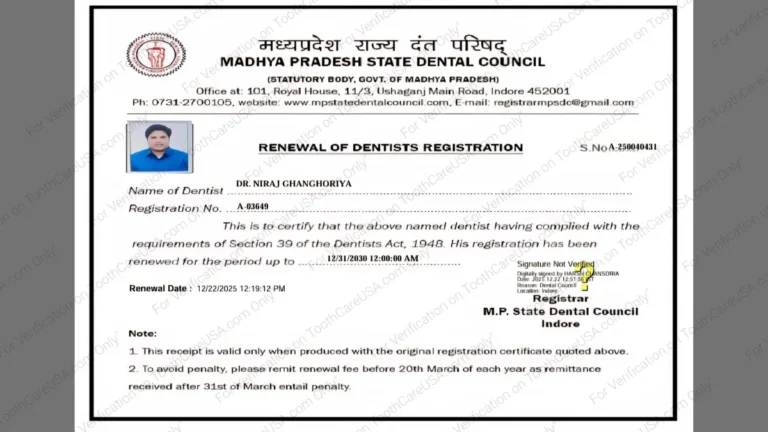
Dr. Niraj Ghanghoriya is a passionate dental surgeon with over 12 years of experience in clinical dentistry. He completed his BDS from the prestigious Sri Aurobindo Institute of Dentistry in 2012 and specializes in painless root canals, smile makeovers, and preventive oral care. He is the Founder of ToothCareUSA.com and a registered Dental Surgeon (Reg No: A-03649) based in Indore. Known for his patient-first approach and clear communication, Dr. Ghanghoriya aims to make dental knowledge accessible to everyone. When he’s not in the clinic, he enjoys writing informative dental blogs to help people take better care of their oral health. He reviews every article on this site to ensure medical accuracy and patient safety.